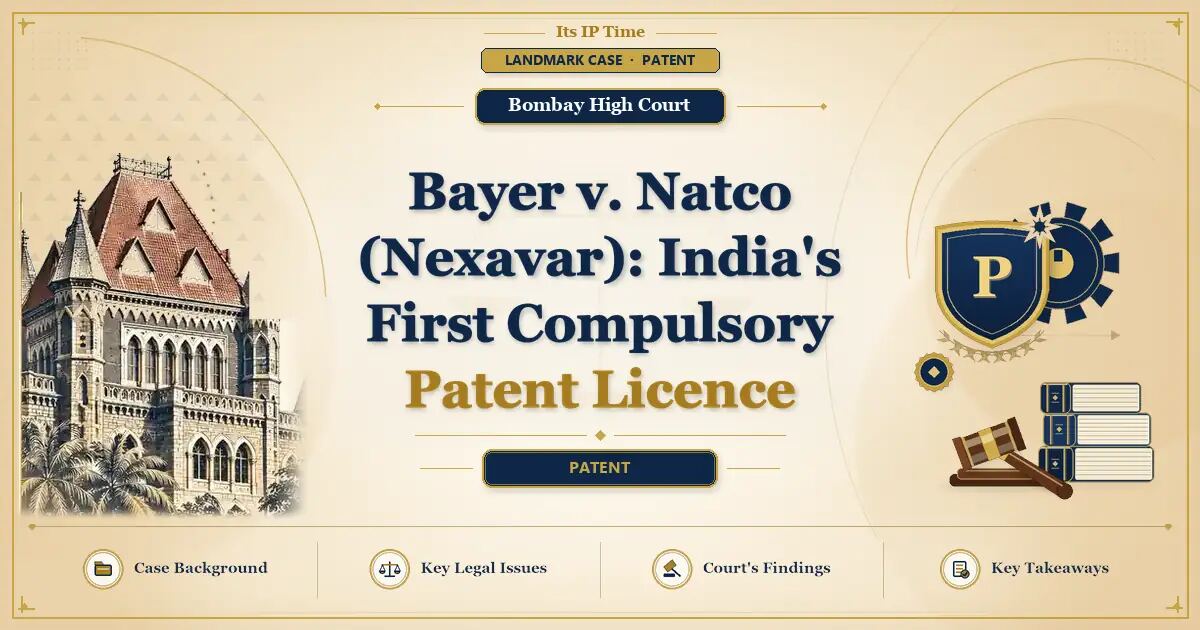
The interplay between pharmaceutical patent protection and public health access reached its definitive judicial milestone in India through the battle over Sorafenib Tosylate. The dispute pitted global innovator Bayer Corporation against Indian generic manufacturer Natco Pharma Limited. At stake was not merely the commercial market for a specialized anti-cancer drug, but the constitutional and statutory framework governing post-TRIPS compulsory licensing under Indian patent law.
When India amended the Patents Act, 1970 in 2005 to reintroduce product patents for pharmaceuticals, it incorporated public interest safeguards to prevent price-gouging and artificial supply bottlenecks. The litigation surrounding Sorafenib Tosylate tested these statutory balance mechanisms for the first time. The final determination by the Bombay High Court, subsequently affirmed by the Supreme Court of India, established clear parameters for affordable pricing, statutory working of patents, and the primary duty of patent holders to satisfy domestic public health demand.
For a full statutory walkthrough of Form 17 procedures and grounds, consult our detailed guide to Compulsory Licensing under Section 84 of the Indian Patents Act. To explore other defining Indian judicial rulings across patents, trademarks, and copyright, visit our curated index of Landmark IP Cases in India.
Background of the Nexavar Compulsory Licence Dispute
For foundational statutory analysis, consult our in-depth Patent Law Guide.
Bayer Corporation held Indian Patent No. 215758 (granted in March 2008) for Sorafenib Tosylate, a novel compound marketed internationally under the brand name Nexavar. The drug is a targeted therapy used in treating Advanced Renal Cell Carcinoma (kidney cancer) and Hepatocellular Carcinoma (liver cancer).
Bayer imported the drug into India at a retail price of approximately INR 2,80,000 per month for a standard dose of 120 tablets. According to market data and epidemiological estimates, out of an estimated eligible patient population of over 20,000 individuals needing the drug annually, Bayer’s supply reached fewer than 200 patients in 2010.
In December 2010, Natco Pharma Ltd. approached Bayer seeking a voluntary license to manufacture and sell a generic version of Sorafenib Tosylate in India at a proposed price of INR 8,800 per monthly therapy, offering a 6% royalty to Bayer. Bayer rejected this request.
Following the expiration of the statutory three-year waiting period from the date of patent grant, Natco applied to the Controller General of Patents in 2011 for the grant of a compulsory license under Section 84(1) of the Patents Act, 1970. On March 9, 2012, Controller General P.H. Kurian issued a historic order granting India’s first post-2005 compulsory license to Natco. The license permitted Natco to manufacture and market generic Sorafenib Tosylate at a price not exceeding INR 8,800 per monthly dose, subject to paying a 6% royalty on net sales to Bayer.
Bayer appealed this decision to the Intellectual Property Appellate Board (IPAB). On March 4, 2013, the IPAB, chaired by Justice Prabha Sridevan, upheld the grant of the compulsory license while marginally increasing the royalty payable to Bayer from 6% to 7%.
Bayer subsequently challenged the IPAB order by filing a Writ Petition (W.P. No. 1322 of 2013) under Article 226 of the Constitution of India before the Division Bench of the Bombay High Court. On July 15, 2014, the High Court dismissed Bayer’s petition. Bayer’s challenge culminated in a Special Leave Petition (SLP (C) No. 30141 of 2014) before the Supreme Court of India, which was summarily dismissed on December 12, 2014, putting a final end to the litigation.
Legal Questions Under Section 84 of the Patents Act
The litigation raised fundamental legal questions regarding the interpretation of Section 84 read with Section 83 and Section 90 of the Patents Act:
1. Interpretation of Section 84(1)(a): What constitutes the “reasonable requirements of the public,” and can a patentee rely on the market supply provided by unauthorized third-party infringers (such as Cipla, which was also selling generic versions) to demonstrate that public demand has been satisfied?
2. Standard of “Reasonably Affordable Price” under Section 84(1)(b): How must a “reasonably affordable price” be evaluated? Should it be assessed from the financial capacity of the purchasing public in India or from the innovator’s internal R&D recovery metrics?
3. Scope of “Worked in the Territory of India” under Section 84(1)(c): Does the expression “worked in the territory of India” mandate local manufacturing within India, or does importing the patented product satisfy this requirement?
4. Interplay of General Principles under Section 83: How do the legislative guidelines in Section 83 constrain and inform the exercise of executive and judicial discretion when granting compulsory licenses?
How Sections 83, 84, and 90 Govern Compulsory Licensing
Section 84(1)(a): Reasonable Requirements of the Public
Section 84(1)(a) requires the applicant to demonstrate that the reasonable requirements of the public with respect to the patented invention have not been satisfied. Bayer argued that the market demand was being met not only through its own imports, but also through the volume of generic Sorafenib Tosylate sold by Cipla, which Bayer was actively suing for infringement in the Delhi High Court.
The Bombay High Court decisively rejected this logic. The court held that a patent owner cannot rely upon the activities of an alleged infringer to claim that public demand is being met. The patentee itself, through its authorized distributors or licensees, must satisfy the public requirement. The court observed that Bayer’s supply met barely 2% of the total target patient group. So, the condition under Section 84(1)(a) was fully established.
Section 84(1)(b): Reasonably Affordable Price
Section 84(1)(b) establishes that a compulsory license may be granted if the patented invention is not available to the public at a reasonably affordable price. Bayer contended that its pricing of INR 2,80,000 per month was reasonable because it had to recover global research and development costs incurred over years of clinical trials.
The High Court ruled that “reasonably affordable price” must be interpreted primarily from the perspective of the public, particularly patients suffering from life-threatening conditions. The court noted that Bayer failed to provide transparent financial evidence proving the specific allocation of R&D costs to the Indian market. When compared against the per capita income and purchasing capacity of the general Indian populace, a monthly cost of INR 2,80,000 made the drug completely inaccessible to an overwhelming majority of the public, failing the statutory test under Section 84(1)(b).
Section 84(1)(c) and Section 83: Working of the Patent
Section 84(1)(c) specifies that a patent must be “worked in the territory of India.” Bayer asserted that under the TRIPS Agreement (specifically Article 27 and Article 31), importation must be treated at par with local manufacturing, and therefore importing Nexavar into India satisfied the “working” requirement.
The Bombay High Court provided a balanced interpretation of this provision. The court held that while importation could under certain circumstances qualify as working a patent, it is not an absolute rule. The patentee must demonstrate why local manufacture was not feasible on a commercial scale. Section 83(b) explicitly establishes that patents are not granted merely to enable a monopoly for importation. Since Bayer possessed manufacturing facilities in India for other products and had made no efforts to manufacture Sorafenib Tosylate locally over a three-year period, its reliance purely on imports failed to meet the threshold of working the invention under Section 84(1)(c).
Section 90: Terms and Conditions of Compulsory License
Section 90 outlines the parameters for setting the terms of a compulsory license, including royalty rates. The IPAB adjusted the royalty rate payable by Natco to Bayer from 6% to 7%, citing UNDP guidelines on pharmaceutical licensing. The High Court found this determination reasoned and balanced, keeping the ultimate retail price at INR 8,800 while ensuring adequate remuneration to the patentee.
Why the Bombay High Court Upheld the Natco Licence
Bombay High Court Division Bench
The Division Bench of the Bombay High Court, comprising Chief Justice Mohit S. Shah and Justice M.S. Sanklecha, delivered the primary substantive precedent on July 15, 2014.
The core ratio of the judgment includes three key principles:
1. Public-Centric Price Benchmark: The term “reasonably affordable price” under Section 84(1)(b) must be evaluated from the perspective of the consuming public. Price determination cannot depend solely on the unilateral commercial spending or cost recovery claims of the patent holder.
2. Exclusion of Infringing Supplies: A patentee facing a compulsory licensing application cannot claim compliance with Section 84(1)(a) by relying on generic supplies available in the market due to third-party patent infringement.
3. Contextual Requirement of Local Working: Importation per se does not automatically constitute the “working” of a patent under Section 84(1)(c). The burden rests on the patent holder to show why local manufacture could not be undertaken or why importation was the only economically viable mode of supply.
Supreme Court Affirmation
On December 12, 2014, a Supreme Court Bench comprising Justice Ranjan Gogoi and Justice M.Y. Eqbal heard Bayer’s Special Leave Petition. The Supreme Court declined to grant leave to appeal, observing that the Bombay High Court and the IPAB had correctly interpreted the statutory provisions. This summary dismissal permanently crystallized the Bombay High Court’s judgment as the governing jurisprudence on compulsory licensing in India.
What Bayer v. Natco Means for Pharma Patents and Generic Entry
For Innovator Pharmaceutical Companies (Patent Holders)
- Transparent Pricing Evidence: Innovators cannot rely on generalized global R&D expenditure figures to justify high prices during Section 84 challenges. Companies must maintain country-specific economic data and audited cost structures.
- Structured Access Programs: Informal or limited Patient Assistance Programs (PAPs) will not defeat a compulsory licensing petition if they cover only a small fraction of the affected population. Access schemes must be scalable, structured, and capable of demonstrating that public demand is comprehensively satisfied.
- Justification of Importation Models: If an innovator chooses to import rather than manufacture locally, it must maintain documented evidence explaining the technical, economic, or logistical reasons why local manufacturing in India is unfeasible. This evidence is necessary to counter challenges under Section 84(1)(c) and Form 27 working requirements.
- Engaging in Voluntary Licensing Negotiations: Broad refusals to enter voluntary license negotiations under Section 84(6) create significant exposure. Innovators should consider negotiated voluntary licenses with reasonable commercial royalty terms when facing access barriers in developing markets.
For Generic Manufacturers & Applicants
- Documenting Public Need: CL applications must be supported by reliable epidemiological data, pricing comparisons, and clear evidence of unmet domestic demand.
- Demonstrating Manufacturing Capability: Applicants must prove their existing technical capacity to manufacture the drug locally at a drastically reduced cost from day one of the grant.
- Procedural Compliance: Applicants must rigorously satisfy the statutory pre-condition of seeking a voluntary license on reasonable terms at least six months prior to filing a compulsory license application under Section 84.
Also Read: First Examination Report (FER) Reply in India: Rule 24B Deadlines and Prosecution Strategy
Key Precedents & Statutory Guidance
- Search recent High Court judgments in our Latest Indian IP Law Cases Directory.
- Examine core statutory doctrines in our Indian Patent Law & Jurisprudence Guide.
- Estimate official CGPDTM fees and FER deadlines with our IP Fee & Deadline Calculator or practice with Patent Agent Exam Prep.
- In-Depth Guide: Compulsory Licensing in India: Grounds, Procedure & Section 84 Guide.
- Catch up in 2 minutes with our latest Weekly Indian IP Law Digest: November 15 to 21, 2026 | Its IP Time (or browse the Weekly IP Digest Archive).
- Review nationwide litigation trends in our Latest Monthly IP Law Roundup.
Bayer v. Natco: Case Summary and Bench Details
Full Case Title: Bayer Corporation v. Union of India, Controller General of Patents, and Natco Pharma Ltd.
Citations: (2014) 141 DRJ 33; 2014 (59) PTC 561 (Bom); AIR 2014 Bom 178
Court & Jurisdiction: High Court of Judicature at Bombay (Writ Jurisdiction) / Supreme Court of India (Appellate)
High Court Bench: Chief Justice Mohit S. Shah and Justice M.S. Sanklecha, Supreme Court Bench: Justice Ranjan Gogoi and Justice M.Y. Eqbal
Date of High Court Judgment: July 15, 2014 | Date of Supreme Court Order: December 12, 2014
Key Statutory Provisions: Sections 83, 84(1)(a), 84(1)(b), 84(1)(c), 84(6), and 90 of the Patents Act, 1970
Patented Invention: Indian Patent No. 215758 (Sorafenib Tosylate / Nexavar)
Final Holding: Upheld the grant of India’s first compulsory license to Natco Pharma Ltd. Confirmed that pricing a life-saving drug out of reach of the vast majority of the domestic public breaches Section 84(1)(b), and mere importation without adequate local supply fails Section 84(1)(a) and (c). Generic retail price fixed at INR 8,800/month with a 7% royalty payable to the patentee.