The Glivec Controversy and India’s Post-TRIPS Patent Regime
Struggling with Indian Patent Law & Jurisprudence principles? Explore our complete Patent Law Guide.
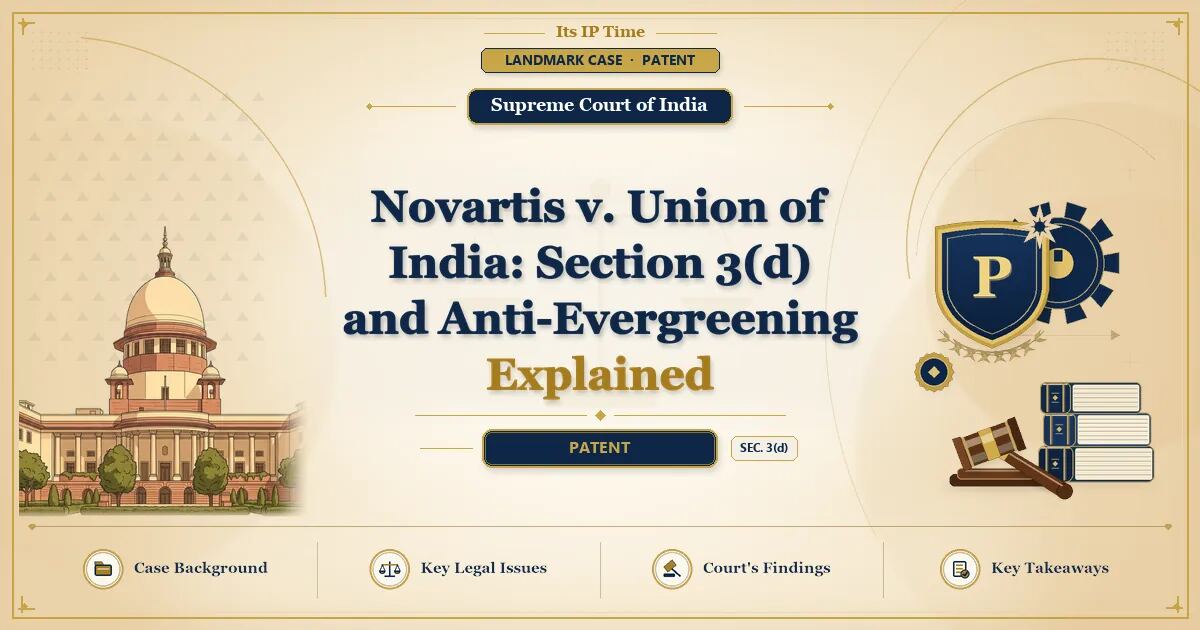
The legal confrontation in Novartis AG v. Union of India & Others represents a watershed moment in global intellectual property jurisprudence, establishing the structural boundaries between legitimate pharmaceutical innovation and illegitimate patent extension strategies. The origins of this dispute lie in India’s compliance with the Agreement on Trade-Related Aspects of Intellectual Property Rights (TRIPS). When India joined the World Trade Organization (WTO) in 1995, it committed to modifying its patent legal framework to allow product patents in all fields of technology, including pharmaceuticals. For over three decades prior, under the Patents Act, 1970, India permitted only process patents for drug substances. This statutory choice had enabled domestic generic manufacturers to develop reverse-engineered, cost-effective generic formulations, transforming India into the “pharmacy of the developing world.”
To fulfill its treaty obligations while safeguarding domestic public health imperatives, Parliament enacted the Patents (Amendment) Act, 2005. This amendment reintroduced product patent protection for pharmaceutical compounds, effective retrospectively from January 1, 2005. Parliament recognized that international innovator firms might attempt to extend market monopolies over established drugs by securing secondary patents for minor chemical modifications, crystal forms, salts, or derivatives, a practice known as patent evergreening.
To counter this risk, Parliament amended Section 3(d) of the Patents Act, setting a high statutory threshold for patenting new forms of known pharmaceutical substances. Section 3(d) established that a new form of a known substance would be non-patentable unless it demonstrated a significant enhancement in efficacy over the baseline substance.
The focal point of the global litigation that followed was Novartis AG’s anti-cancer drug Glivec (Imatinib Mesylate), used in treating Chronic Myeloid Leukemia (CML) and Gastrointestinal Stromal Tumors (GIST). The dispute questioned whether the international patent regime under TRIPS forced developing nations to grant secondary patents for incremental physical modifications, or whether sovereign nations retained the legislative flexibility to filter out trivial developments that failed to offer demonstrable therapeutic gains.
The Supreme Court of India’s decision resolved this question, setting an international precedent on how patent laws can balance incentives for genuine innovation with public health imperatives.
From Mailbox Application to the Supreme Court: The Decadal Procedural Process
The procedural history of the Novartis case spans fifteen years, passing through every level of the Indian intellectual property administration and judicial system.
The Mailbox Phase and EMR Grant (1998-2003)
On July 17, 1998, Novartis AG filed Patent Application No. 1602/MAS/1998 at the Chennai Patent Office. The application claimed the “beta-crystalline form of Imatinib Mesylate.” Because India had not yet fully transitioned to a product patent regime for pharmaceuticals, the application was placed in the “mailbox” system created under Article 70.8 of TRIPS.
In November 2003, Novartis leveraged statutory provisions governing transitional arrangements to secure Exclusive Marketing Rights (EMR) for Glivec in India. Using the EMR, Novartis obtained court injunctions against domestic generic manufacturers, including Natco Pharma, Cipla, and Ranbaxy Laboratories, who were manufacturing generic imatinib mesylate at a price of roughly ₹9,000 to ₹12,000 per patient per month, compared to Novartis’s retail price of approximately ₹120,000 per month.
Examination, Pre-Grant Oppositions, and Rejection (2005-2006)
Following the 2005 legal amendments, the Chennai Patent Office opened the mailbox applications for examination. Multiple generic drug manufacturers, alongside the Cancer Patients Aid Association (CPAA), filed pre-grant oppositions under Section 25(1) of the Patents Act. The opponent parties argued that:
- The claimed beta-crystalline form lacked novelty and inventive step over a prior disclosure, specifically US Patent No. 5,521,184 (the 1993 Zimmermann Patent), which disclosed Imatinib and its salt forms.
- The claim failed the statutory hurdle of Section 3(d) because the beta-crystalline form was merely a new form of a known substance (Imatinib Mesylate or Imatinib free base) without any documented enhancement in therapeutic efficacy.
On January 25, 2006, the Assistant Controller of Patents and Designs formally rejected Novartis’s patent application. The Assistant Controller held that the beta-crystalline form of Imatinib Mesylate was anticipated by the Zimmermann patent and failed to demonstrate enhanced therapeutic efficacy under Section 3(d).
High Court and IPAB Proceedings (2006-2009)
Novartis responded by filing writ petitions before the Madras High Court (W.P. Nos. 24759 and 24760 of 2006). Novartis sought two primary remedies:
- A declaration that Section 3(d) of the Indian Patents Act was unconstitutional for violating Article 14 (Equality before Law) due to excessive delegation of arbitrary power to the Patent Office.
- A declaration that Section 3(d) failed to comply with India’s international obligations under the TRIPS Agreement.
In August 2007, the Madras High Court dismissed both petitions. The High Court held that Section 3(d) provided sufficient guidance to administrative authorities and did not violate Article 14. It further held that domestic municipal courts lack jurisdiction to rule on whether a national law complies with international treaty obligations under TRIPS, as WTO dispute resolution mechanisms govern such compliance.
The statutory appeal on the merits of the Patent Office’s rejection was transferred to the newly constituted Intellectual Property Appellate Board (IPAB). In June 2009, the IPAB rendered its decision. The IPAB reversed the Patent Office on novelty and inventive step, concluding that the beta-crystalline form possessed technical advance over the 1993 Zimmermann patent. However, the IPAB upheld the rejection under Section 3(d), ruling that Novartis failed to establish any significant enhancement of therapeutic efficacy.
Novartis then bypassed the High Court’s writ jurisdiction and filed a Special Leave Petition (SLP) directly before the Supreme Court of India under Article 136 of the Constitution, setting the stage for the final judgment.
Statutory Provisions at Issue: Novelty, Inventive Step, and Section 3(d)
The Supreme Court’s analysis centered on three statutory provisions within the Patents Act, 1970:
Section 2(1)(j) and Section 2(1)(ja): The Baseline Thresholds
Under Section 2(1)(j), an “invention” is defined as a new product or process involving an inventive step and capable of industrial application. Section 2(1)(ja) defines “inventive step” as a feature of an invention that involves technical advance as compared to existing knowledge, or has economic significance (or both), making the invention non-obvious to a person skilled in the art.
Section 3(d): The Anti-Evergreening Provision
Section 3 of the Patents Act defines what are not inventions. Section 3(d) forms the core of India’s statutory mechanism against patent evergreening. The text provides:
“The mere discovery of a new form of a known substance which does not result in the enhancement of the known efficacy of that substance or the mere discovery of any new property or new use for a known substance or of the mere use of a known process, machine or apparatus unless such known process results in a new product or employs at least one new reactant.”
The statutory Explanation appended to Section 3(d) clarifies the range of derivative forms covered:
“For the purposes of this clause, salts, esters, ethers, polymorphs, metabolites, pure form, particle size, isomers, mixtures of isomers, complexes, combinations and other derivatives of known substance shall be considered to be the same substance, unless they differ significantly in properties with regard to efficacy.”
The statutory interaction between Section 2(1)(j), Section 2(1)(ja), and Section 3(d) establishes a two-tiered examination model. An applicant seeking to patent a new form of a known pharmaceutical substance must first clear the general thresholds of novelty and non-obviousness under Section 2(1)(j) and (ja). Once those hurdles are cleared, the application must independently satisfy the special statutory requirement of Section 3(d) by showing a significant enhancement of efficacy.
Statutory Interpretation: Defining ‘Therapeutic Efficacy’
The core legal issue before the Supreme Court was the statutory interpretation of the word “efficacy” in Section 3(d). Novartis argued for a broad construction of “efficacy,” asserting that any improvement in the physical or chemical properties of a pharmaceutical derivative that yields practical benefits should satisfy the statutory test.
Novartis’s Scientific and Legal Arguments
Novartis asserted that the beta-crystalline form of Imatinib Mesylate differed significantly from the baseline substance (Imatinib free base and non-crystalline mesylate salts disclosed in the prior 1993 Zimmermann patent). Novartis presented three main physical improvements:
- Higher thermodynamic stability.
- Lower hygroscopicity (making the compound less prone to absorbing moisture).
- A 30% increase in bioavailability in animal models compared to the free base form.
Novartis contended that improved bioavailability naturally leads to better drug absorption in the human body, which enhances therapeutic efficacy. Therefore, Novartis argued that demonstrating higher bioavailability met the requirement of Section 3(d).
The Court’s Analysis of Legislative Intent
The Supreme Court, led by Justices Aftab Alam and Ranjana Prakash Desai, examined the parliamentary history of the 2005 Amendments to ascertain legislative intent. The Court analyzed the Report of the Technical Expert Group on Patent Law Issues chaired by Dr. R.A. Mashelkar, alongside parliamentary debates preceding the amendment’s passage.
The Court noted that Parliament enacted Section 3(d) specifically to prevent evergreening and to preserve public access to affordable medicines. Parliament intended to set a strict standard for secondary patents on incremental pharmaceutical variations.
The Standard of Therapeutic Efficacy
The Court held that the word “efficacy” means “the ability to produce a desired or intended result.” The nature of the intended result depends entirely on the context of the substance under review. For medicine and pharmaceuticals, the core purpose of a drug molecule is to cure, alleviate, or prevent disease. So, in the context of pharmaceutical inventions, “efficacy” under Section 3(d) means therapeutic efficacy.
The Court rejected the argument that physicochemical improvements, such as thermodynamic stability, lower hygroscopicity, or better shelf-life, constituted enhanced efficacy:
- Physicochemical Properties vs. Therapeutic Efficacy: Physical attributes like improved stability, lower hygroscopicity, or solid-state processing advantages make a drug easier to store, transport, or formulate into tablets. However, these characteristics do not increase the drug’s therapeutic effect on the human body once administered.
- Bioavailability vs. Therapeutic Efficacy: Bioavailability measures the rate and extent to which an active pharmaceutical ingredient is absorbed into systemic circulation. While increased bioavailability can potentially lead to higher therapeutic efficacy under specific clinical conditions, the two concepts are not legally synonymous. An increase in bioavailability does not automatically prove an increase in therapeutic efficacy.
- Requirement of Empirical Proof: To satisfy Section 3(d), a patent applicant must provide empirical clinical data demonstrating that the increase in bioavailability directly yields a significantly enhanced therapeutic outcome in patients, such as increased tumor suppression, reduced dosage requirements with maintained efficacy, or lower toxicity.
Because Novartis failed to provide comparative clinical data demonstrating that the 30% increase in bioavailability led to a direct enhancement in therapeutic effect over Imatinib Mesylate in its existing form, the Court held that the claim failed Section 3(d).
Ratio Decidendi and Judicial Reasoning
The Supreme Court’s unanimous judgment delivered on April 1, 2013, rested on two main pillars: the status of the baseline substance in the prior art, and the strict application of Section 3(d).
- Identifiability of Prior Art 2. Section 3(d) Rejection
- 1993 Zimmermann Patent disclosed Imatinib base – Beta-crystalline form is a polymorph of a known substance.
and mesylate salt. – Physicochemical traits (stability/hygroscopicity) fail test.
- Imatinib Mesylate was already a “known substance.” – Bioavailability increase lacked clinical proof of enhanced
The Baseline Substance and Prior Art Analysis
Novartis argued that the baseline substance for assessing Section 3(d) was Imatinib free base, not Imatinib Mesylate. It contended that Imatinib Mesylate had never been manufactured or marketed prior to its patent application, making the beta-crystalline form novel.
The Supreme Court rejected this distinction after analyzing the 1993 Zimmermann Patent (US Patent No. 5,521,184). The Court found that the Zimmermann patent disclosed Imatinib, its pharmaceutical acceptable salts (specifically mentioning methane sulfonic acid to form mesylate salt), and its therapeutic uses in targeting leukemia. The Court held that:
- Imatinib Mesylate was fully comprehended and disclosed within the Zimmermann patent.
- A compound does not need to be commercially marketed to qualify as a “known substance” under Section 3(d). The statutory term “known substance” refers to prior public disclosure in scientific literature or patent specifications.
- So, the baseline substance against which efficacy had to be measured was Imatinib Mesylate, not merely Imatinib free base.
Failure to Meet the Section 3(d) Standard
Having established that Imatinib Mesylate was a known substance, the Court evaluated the beta-crystalline form as a polymorphic form falling directly under the statutory Explanation to Section 3(d).
The Court held that the beta-crystalline form was merely a new physical form of a known substance. Because Novartis failed to produce convincing clinical evidence of enhanced therapeutic efficacy over the baseline Imatinib Mesylate, the patent application failed to meet the statutory requirement of Section 3(d).
Constitutional Principles and Public Health Protections
The Court framed its statutory analysis within the broader constitutional framework of India. It recognized that patent law must balance the private economic rights of innovators with the constitutional duties owed to citizens.
The Court cited the fundamental Right to Life guaranteed under Article 21 of the Constitution of India, emphasizing that access to life-saving medicines is an integral component of the right to health. The Court observed that TRIPS flexibilities, reinforced by the 2001 WTO Doha Declaration on TRIPS and Public Health, affirm every member state’s sovereign right to interpret patent statutes in a manner that protects public health and promotes universal access to medicines.
Section 3(d) represents a valid exercise of this sovereign prerogative, preventing monopolistic extensions that restrict access to life-saving therapeutics.
Implications for Pharma Innovators, Generic Manufacturers, and Practitioners
The Supreme Court’s decision in Novartis AG v. Union of India reshaped pharmaceutical patent prosecution in India, creating distinct operational consequences for innovators, generic companies, and patent attorneys.
For Innovator Pharmaceutical Companies
- Elevated Evidentiary Burden: Innovators can no longer rely on physical or chemical properties, such as polymorphism, salt selection, particle size, or thermodynamic stability, to secure secondary patents in India.
- Mandatory Clinical Data: Patent applications claiming new forms, salts, esters, or polymorphs of existing molecules must present comparative clinical or pre-clinical trial data proving an actual enhancement in therapeutic efficacy over the baseline compound.
- Patent Portfolio Alignment: Foreign patent portfolios must be adjusted for India. Secondary claims that pass muster at the USPTO or EPO (which generally recognize physical stability or improved processing as patentable subject matter) face high rejection risks under Section 3(d) at the Indian Patent Office (IPO).
For Generic Manufacturers and Public Access
- Protection of Generic Production: The judgment protects domestic generic manufacturers from generic entry barriers created by evergreening patents. This ensures the continued production of generic versions of critical drugs at lower price points.
- Pre-Grant Opposition Mechanics: The decision validated pre-grant oppositions under Section 25(1) as an effective mechanism for public interest groups and generic firms to challenge broad or secondary patent applications before grant.
For Patent Practitioners and Attorneys
- Drafting Patent Specifications: Patent specifications filed in India must clearly establish the baseline substance and include explicit comparative data demonstrating enhanced therapeutic efficacy. Generating this data after filing can lead to severe evidentiary challenges during prosecution.
- Prosecution Strategy under Section 3(d): Patent practitioners must handle objections under Section 2(1)(j) and Section 3(d) separately. Clearing novelty and non-obviousness does not resolve a Section 3(d) objection. The response to Section 3(d) must focus on clinical outcomes rather than formulation efficiency.
Also Read: Indian Patent Agent Exam 2026: Eligibility, Syllabus, Form 22 and Paper Strategy
Key Precedents & Statutory Guidance
- Search recent High Court judgments in our Latest Indian IP Law Cases Directory.
- Examine core statutory doctrines in our Indian Patent Law & Jurisprudence Guide.
- Estimate official CGPDTM fees and FER deadlines with our IP Fee & Deadline Calculator or practice with Patent Agent Exam Prep.
- In-Depth Guide: Confidentiality Clubs in Indian IP Litigation (Delhi HC IPD Rule 19).
- In-Depth Guide: How to Register an Industrial Design in India (Designs Act, 2000).
- Catch up in 2 minutes with our latest Weekly Indian IP Law Digest: November 15 to 21, 2026 | Its IP Time (or browse the Weekly IP Digest Archive).
- Review nationwide litigation trends in our Latest Monthly IP Law Roundup.
Case Summary and Bench Details
| Metadata Field | Case Details | |:— |:— | | Case Title | Novartis AG v. Union of India & Others | | Citation | (2013) 6 SCC 1 | | Court / Forum | Supreme Court of India | | Bench | Justice Aftab Alam and Justice Ranjana Prakash Desai | | Date of Judgment | April 1, 2013 | | Statutory Provisions | Sections 2(1)(j), 2(1)(ja), 3(b), and 3(d) of the Patents Act, 1970 (as amended in 2005) | | Subject Matter | Pharmaceutical Patentability, Validity of Secondary Patents, Anti-Evergreening, and Statutory Interpretation of “Therapeutic Efficacy” | | Key Holding | A new form of a known pharmaceutical substance (such as a polymorphic form or salt) is non-patentable under Section 3(d) unless the applicant proves a significant enhancement in therapeutic efficacy over the baseline substance. Physicochemical improvements, such as greater thermodynamic stability, lower hygroscopicity, or increased bioavailability without accompanying therapeutic gains, do not meet the statutory threshold. |