The Core Intellectual Property Dispute
Looking to master Trade Secrets & Emerging IP Law jurisprudence? Read our full Trade Secrets Law Guide.
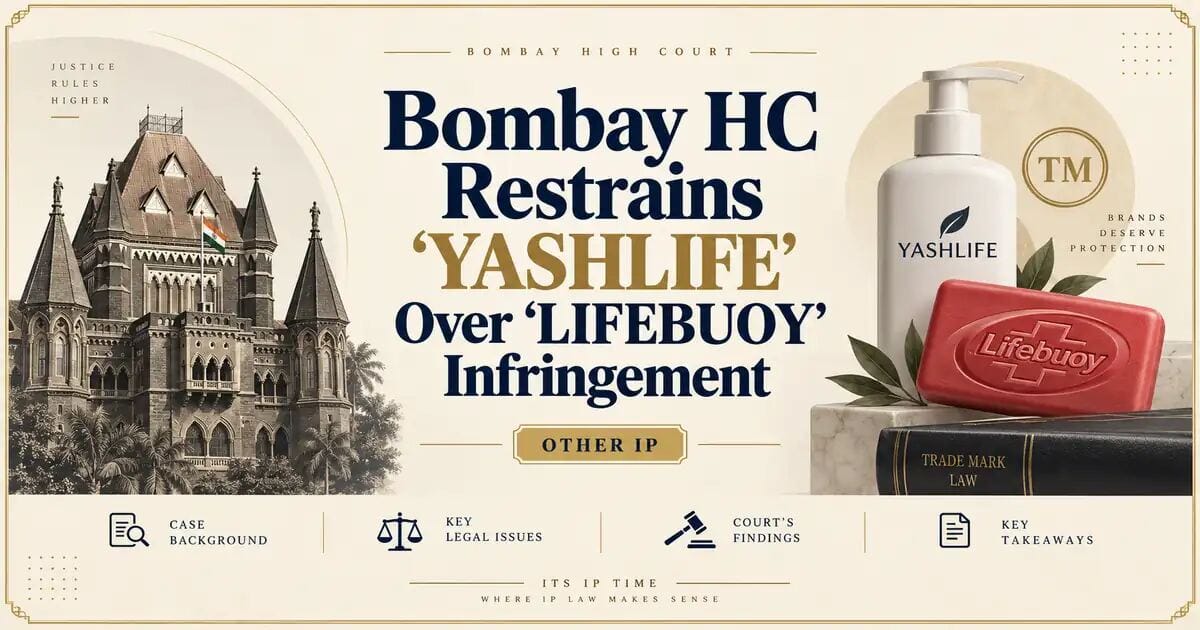
Whether the phonetic, structural, and visual similarities between a registered trademark for hygienic and personal care products and a defendant’s mark utilized for pharmaceutical preparations satisfy the statutory threshold of deceptive similarity under Section 29(2)(b) of the Trade Marks Act, 1999, constitutes the central inquiry in [Unilever Global IP Limited Vs Yash Lifesciences Pvt Ltd]. This interlocutory dispute, registered under Commercial Intellectual Property Rights Suits (L) No. 7770 of 2026 with Interim Application No. 1385 of 2026, brought the Bombay High Court face-to-face with the classic collision between a dominant trademark proprietor and a subsequent user claiming descriptive commonality. The plaintiff sought to protect its long-standing proprietary rights in hygienic formulations, while the defendant sought shelter under the defense that its mark was structurally distinct and catered to separate trade channels. The learned Single Judge evaluated the interlocutory prayers against the tri-partite test of trademark jurisprudence. Our analysis dissects the legal reasoning, statutory interpretations, and procedural directions that defined this high-stakes intellectual property battle.
Unilever Global IP Limited initiated this commercial suit to restrain trademark infringement and passing off. The crux of the conflict was Yash Lifesciences Pvt Ltd’s commercial use of the mark “YASHLIFE” on medicinal soaps, personal hygiene products, and skin formulations. Unilever asserted that this mark directly infringed its registered “LIFEBUOY” trademark, which has enjoyed registration under Class 3 (non-medicated soaps) and Class 5 (pharmaceutical preparations) for decades. The plaintiff contended that the word “LIFE” was an essential, memorable, and dominant component of its registered brand identity. By adopting “YASHLIFE” for identical products, the defendant allegedly created a high likelihood of consumer confusion. This confusion is particularly acute among consumers of average intelligence who possess imperfect recollection. Yash Lifesciences countered this by claiming that “LIFE” is a descriptive term widely used in the pharmaceutical industry. The defendant argued that no single corporate entity could claim a monopoly over a generic suffix. Consequently, the court had to resolve whether the defendant’s mark constituted a colorable imitation designed to capitalize on the plaintiff’s goodwill, or whether it represented a legitimate, distinct commercial identifier.
The Nature of Interim Relief Sought
Within the framework of Interim Application No. 1385 of 2026, the plaintiff prayed for broad ad-interim reliefs to preserve its market equity. First, Unilever sought a temporary injunction under Section 29 of the Trade Marks Act, 1999 (governing trademark infringement), to restrain Yash Lifesciences from manufacturing, marketing, distributing, or selling any goods bearing the mark “YASHLIFE” or any other phonetically or visually similar mark. Second, the plaintiff sought common-law protection against passing off under Section 27(2) of the Act (protecting passing off actions under common law), which preserves the right of action against any person passing off goods. Third, the application included a prayer for the appointment of a Court Commissioner under Order XXXIX Rule 7 of the Code of Civil Procedure, 1908 (governing preservation of subject matter), to inventory and seal the infringing goods, packaging materials, dies, and promotional brochures at the defendant’s manufacturing plants. Finally, Unilever demanded that the defendant maintain and periodically submit detailed commercial accounts of all sales executed under the “YASHLIFE” mark during the pendency of the suit. The petition targeted commercial dilution.
The Adversarial Contentions
To establish a prima facie case, Unilever relied heavily on the continuous and extensive historical usage of the “LIFEBUOY” mark since its registration. The plaintiff’s legal team presented substantial evidence of sales volumes and marketing expenditures to demonstrate global and domestic brand reputation. They argued that the “triple identity test” was fully satisfied in this instance. The goods are identical, the consumer base overlaps entirely, and the retail trade channels are indistinguishable. To support their claim of phonetic similarity, they cited classic precedents demonstrating that a junior user cannot escape liability by merely adding a proprietary prefix to a dominant trademark feature. The prefix “YASH” did not, in their view, sufficiently distinguish the defendant’s product. It merely suggested a sub-brand or a specialized clinical variant originating from the plaintiff’s house of brands. Phonetic similarity remains the primary test.
Yash Lifesciences presented a vigorous defense centered on the descriptive and common-to-the-trade nature of the word “LIFE” in Class 5 preparations. They argued that the trademark registry contains dozens of registrations featuring “LIFE” as a suffix or prefix for pharmaceutical goods. Under Section 17 of the Trade Marks Act, 1999 (which mandates that registration confers rights over the trademark as a whole), the plaintiff could not claim exclusive rights over a single generic component. The defendant’s counsel emphasized that “YASHLIFE” was a composite mark that must be compared in its entirety with “LIFEBUOY”. When viewed as whole marks, the visual layout, color scheme, and structural syntax of “YASHLIFE” packaging differed significantly from the red-and-white branding of the plaintiff. They also contended that their products were distributed primarily through licensed pharmacies and medical professionals, minimizing the possibility of casual consumer error at the retail level. No deceptive intent could be inferred, they argued, because the prefix “YASH” was derived directly from the defendant’s corporate name.
The Court’s Doctrinal Approach
The Bombay High Court Bench initiated its analysis by evaluating the three-prong test governing interlocutory injunctions. The court first assessed whether the plaintiff had established a prima facie case. Applying the test of imperfect recollection, the bench observed that the average consumer does not compare rival marks side-by-side in a retail environment. The court noted that while “LIFE” is indeed a common English word, its integration into a personal hygiene mark by a junior user must not cause structural or phonetic overlap with an established household brand. The bench rejected the defendant’s argument that the presence of the prefix “YASH” completely neutralized the likelihood of confusion. In the court’s estimation, the dominant and memorable portion of both marks remains the phonetic term “LIFE”, which carries immense commercial association.
The court’s application of the deceptive similarity test is consistent with established Indian IP jurisprudence. Unusually, the bench engaged directly with the claim construction issue, balancing the anti-dissection rule under Section 17 with the dominant feature doctrine. The court observed:
“When assessing deceptive similarity in products that border on medical and personal hygiene utility, the court must adopt a standard of high caution. The presence of a common word like ‘LIFE’ does not automatically permit a competitor to construct a mark that induces phonetic or structural association with an iconic brand, thereby capitalizing on consumer trust.”
Bombay High Court Bench
Evaluating the balance of convenience, the court compared the relative hardships of both parties. Unilever had spent decades cultivating its brand identity, whereas Yash Lifesciences had only recently launched the contested product line. The court held that the potential damage to the plaintiff’s brand equity through dilution outweighed the temporary commercial disruption to the defendant’s business. To address the final prong, the court analyzed the nature of irreparable injury. It held that dilution of a well-known trademark is an intangible injury that cannot be adequately compensated by monetary damages at the trial stage. The balance of convenience favored the plaintiff.
The Terms of the Interlocutory Order
The Bombay High Court, having found all three prongs of the interlocutory test in favor of the plaintiff, issued a series of specific interim directions. An ad-interim injunction was issued restraining Yash Lifesciences, its directors, distributors, and retail partners from manufacturing, selling, or advertising any products under the mark “YASHLIFE” or any other mark deceptively similar to Unilever’s registered trademark “LIFEBUOY”. The injunction was granted. However, the court introduced a pragmatic commercial carve-out to balance the equities. Yash Lifesciences was granted a strict transition period of 45 days to exhaust its existing retail stock already in the supply chain, subject to the condition that no new manufacturing under the infringing mark take place. The defendant was ordered to file an affidavit of compliance within 15 days, accompanied by a verified statement of its existing inventory. Additionally, the court directed the defendant to maintain detailed, audited accounts of all sales conducted under the impugned mark from its inception and submit them before the next date of hearing.
Key Precedents & Statutory Guidance
- Search recent High Court judgments in our Latest Indian IP Law Cases Directory.
- Examine core statutory doctrines in our Trade Secrets & Emerging IP Law Guide.
- Procedural Breakdown: Customs IP Recordal in India & ICER Portal Procedures.
- Review nationwide litigation trends in our Monthly IP Law Roundup.
Strategic Implications for Litigants
This interlocutory order carries significant strategic implications for intellectual property litigators and corporate brand owners in India. For Unilever, the status quo pending trial represents a decisive victory that protects its market share and prevents brand dilution. It reinforces the principle that prior users with established market goodwill can successfully prevent third parties from utilizing common words in a manner that creates phonetic or structural similarity. The ruling serves as a warning that simply adding a corporate prefix like “YASH” to a famous mark’s dominant element will not insulate a defendant from an infringement action.
For subsequent users like Yash Lifesciences, the decision highlights the perils of adopting marks that rely on generic terms heavily associated with market leaders. It demonstrates that courts will scrutinize the “triple identity test” closely, even when the defendant claims a different, targeted trade channel like licensed pharmacies. The 45-day carve-out for exhausting existing inventory provides a minor commercial cushion, but the forced re-branding process remains an expensive and disruptive hurdle. Re-branding remains an expensive hurdle. Ultimately, the order signals that the Bombay High Court remains highly protective of registered, high-equity trademarks in Class 3 and Class 5, refusing to allow descriptive defenses to dilute the fundamental protections of Section 29 of the Trade Marks Act, 1999. Litigators must advise their clients to conduct exhaustive trademark searches and clear phonetic clearance checks before launching products, particularly when advising on sectors where clinical and hygiene utility overlap.
Case Details: Unilever Global IP Limited Vs Yash Lifesciences Pvt Ltd | Case Number: COMIPL/7770/2026 | Court: Bombay High Court | Date: 17/09/2026