Skip to content
Subscribe

Browse the archive

Category: Copyright

Copyright

Keshan Infotech vs Oliver Brandt: AI Training and Copyright Law

The conflict between the Madras High Court in Keshan Infotech and the Delhi High Court in ANI Media reveals a judicial divide on AI training copyright. While ANI suggests fair dealing under Section 52 for LLM development, Keshan Infotech granted an interim injunction against scraping for AI training. This divergence highlights that courts weigh procedural posture and specific evidence of misappropriation—such as logo retention—differently. For Indian litigants, the current landscape necessitates a fact-specific approach, as the definitive legal framework for AI data usage remains under active judicial development.
8 min read
Copyright

AI Training is Fair Dealing: Delhi HC on ANI v. OpenAI

The Delhi High Court's ruling in ANI v. OpenAI clarifies that training Large Language Models (LLMs) on publicly available data qualifies as 'fair dealing' under Section 52(1)(a) of the Copyright Act, 1957. The court rejected an interim injunction, holding that such training is transformative, socially beneficial, and does not constitute a market substitute for news content. Crucially, it established that 'research' exceptions are not limited to non-commercial contexts or human actors. This decision provides significant legal breathing room for AI development in India while maintaining existing protections against literal reproduction.

10 min read
Copyright

Atyati v. Cognizant: Bombay HC on Reverse Passing Off and Logos

Establishing copyright infringement requires proving a reasonable opportunity of access, not merely a theoretical possibility. The Bombay High Court ruled that large multinational corporations cannot be assumed to have copied a logo based on workforce size, emphasizing that contemporaneous evidence of independent creation—such as design briefs, time logs, and market surveys—is essential for defense. Furthermore, while the Court acknowledged reverse passing off as a valid claim under Section 27(2), it maintained that such a claim fails if the senior user lacks distinct, standalone goodwill in the logo itself.

8 min read
Copyright

Zee vs. Libas: Instagram Music and Commercial Copyright Risks

Using the Instagram music library for brand promotional content constitutes unauthorized commercial exploitation of sound recordings, violating the owner's exclusive rights under the Copyright Act 1957. While platforms provide technical access to music, this does not grant a synchronization license for commercial advertising or brand marketing. Recent judicial trends, including the Delhi High Court's stance in Zee vs. Libas, confirm that fair dealing exceptions are inapplicable to commercial activities, necessitating that brands secure direct licenses from copyright owners to avoid infringement litigation and significant liability for damages.

11 min read
Copyright

Delhi HC Expands Dynamic Injunctions to Mobile Apps

Dynamic injunctions have become the gold standard for protecting live broadcast rights under Section 37 of the Copyright Act, 1957. In Zee Entertainment v. Soccerbox, the Delhi High Court confirmed that these orders extend to mirror sites, redirect URLs, and mobile applications, allowing rights-holders to block infringing content in real-time. This judicial approach addresses the temporal nature of piracy, ensuring that exclusive broadcast reproduction rights are not rendered otiose during major events. The ruling reinforces that prior piracy patterns justify proactive, site-wide enforcement across ISPs and mobile ecosystems.

7 min read
Copyright

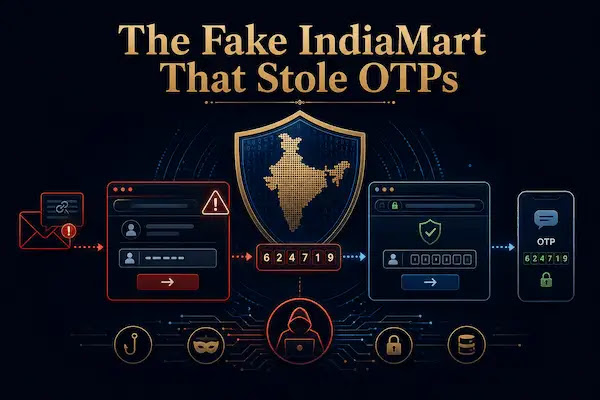
IndiaMart Phishing Injunction: Delhi HC Tackles Cyber Fraud

The Delhi High Court's recent IndiaMart injunction marks a major evolution in Indian IP enforcement by targeting the entire infrastructure of cyber fraud, including cloud hosts and telecom providers. By classifying website GUI as original artistic work under Section 2(c) of the Copyright Act and treating cloud platform infrastructure as an instrument of infringement, the Court has provided a robust framework for combatting OTP relay attacks. This order serves as a pivotal precedent for platform-wide protection and the accountability of digital intermediaries in preventing systemic trademark abuse.

10 min read
Copyright

Enforcing Copyrights: Strategies Against Infringement in India

Copyright infringement in India hinges on proving both the originality of the work—meeting the modicum of creativity threshold—and substantial similarity of protected expression rather than underlying ideas. Under the Copyright Act 1957, fair dealing is limited to specific categories like news reporting and research, excluding generic transformative use defenses found in other jurisdictions. Recent Delhi High Court jurisprudence, including dynamic injunctions against piracy and Section 60 relief against groundless threats, provides robust mechanisms for rights holders to protect digital assets and GUI designs from systematic imitation.

12 min read
Copyright

Music Licensing in Restaurants: Bombay HC Injunction Guide

Publicly playing music in any commercial establishment constitutes a 'communication to the public' under the Copyright Act, 1957, requiring valid public performance licences from rights holders. The Bombay High Court confirmed that exclusive licensees, such as PPL, have the statutory standing to enforce these rights and seek injunctive relief without needing to be registered as a copyright society under Section 33. Consequently, commercial operators cannot use ambient music or third-party streaming subscriptions as a defense for unlicensed public playback, as these do not grant the necessary commercial performance authorizations.

12 min read
Copyright

ANI v OpenAI: Navigating AI Training and Copyright Law in India

The ANI v. OpenAI litigation places Section 52 of the Copyright Act 1957 at the center of India's AI regulatory debate. With the Delhi High Court weighing whether unlicensed training of large language models on copyrighted news content constitutes fair dealing, the outcome will dictate the future of generative AI in India. While the DPIIT explores compulsory licensing, the current impasse highlights the legislative gap left by the 2012 amendment. Simultaneously, the Thaler application regarding AI authorship challenges the interpretation of Section 2(d)(vi) for autonomous, non-prompted machine outputs.

11 min read
Copyright

Heineken v Wagh: Why Copyright Registration Is Not a Verdict

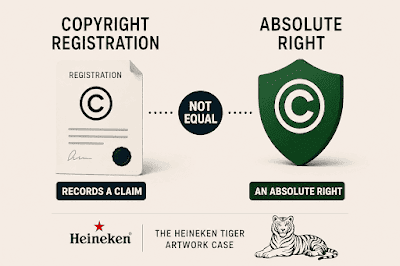
Copyright registration in India serves as an administrative record of a claim rather than a conclusive verdict on originality. The Delhi High Court in Heineken Asia Pacific Pte. Ltd. v. Vijay Keshav Wagh reaffirmed that registrations obtained for labels lacking originality or violating the Section 45 proviso—requiring search certificates for conflicting trademarks—are vulnerable to rectification under Section 50. Brand owners must ensure their label designs are truly original, as the intersection of copyright and trademark law allows for dual enforcement when artistic works are copied onto commercial products.

8 min read