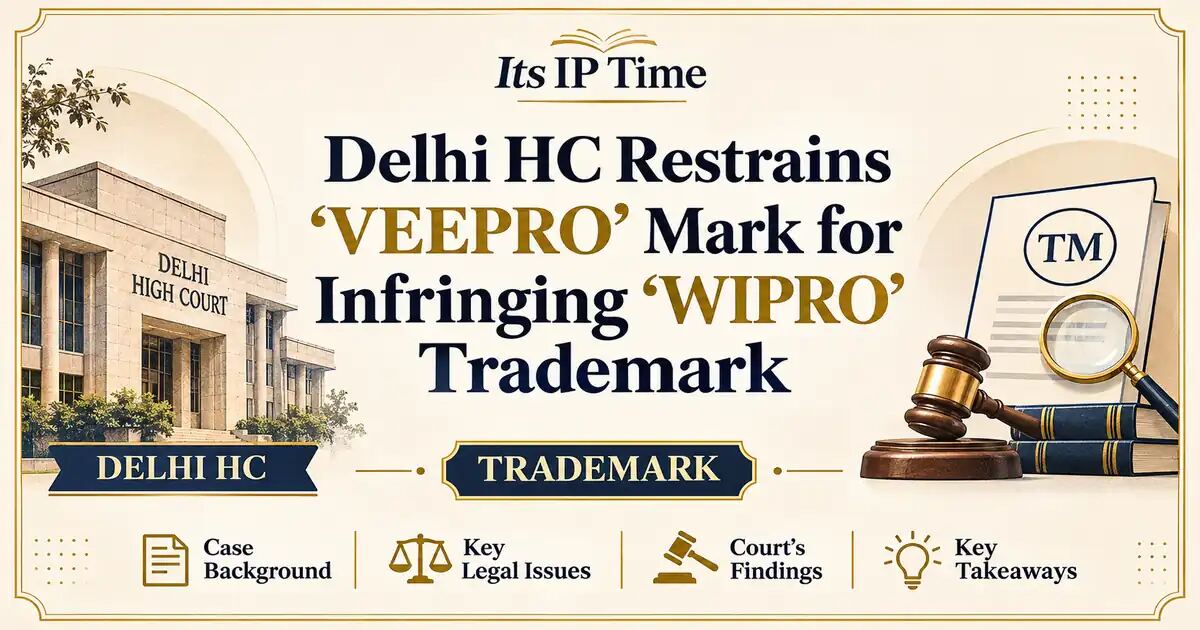
In WIPRO ENTERPRISES PRIVATE LIMITED Vs VEEPRO LIGHTS AND DECOR [CS(COMM)-156/2025 2026:DHC:9698], the Delhi High Court granted a commercial suit decree under Order VIII Rule 10 of the Code of Civil Procedure, 1908, permanently restraining Veepro Lights and Decor from infringing and passing off Wipro Enterprises Private Limited’s well-known registered mark “WIPRO” through the adoption of the deceptively similar mark “VEEPRO”. Presided over by Hon’ble Mr. Justice Vikas Mahajan, the Bench reaffirmed that where an infringing defendant defaults in filing a written statement and remains ex-parte, commercial courts possess full authority to dispense with ex-parte oral evidence and immediately pass a final decree based on uncontroverted pleadings, statutory mark registrations, and execution reports of the court-appointed Local Commissioner.
| Disputed Subject Matter | Phonetically and visually deceptively similar mark “VEEPRO” and domain “veeproled.com” for lighting solutions, infringing Plaintiff’s registered trademark “WIPRO” (Classes 9, 11). |
|---|---|
| Plaintiff / Petitioner’s Case | Plaintiff holds registrations for “WIPRO” dating to 1991, user adoption since 1977, and well-known mark status under Section 2(1)(zg). Asserts exclusive rights under Section 28 and infringement protection under Section 29. |
| Defendant / Respondent’s Defense | Defendant failed to enter appearance after service on March 28, 2025. Right to file written statement closed on September 22, 2025; proceeded ex-parte on October 6, 2026. No defense on record. |
| Governing Law & Authorities | Order VIII Rule 10 & Rule 1 CPC; Sections 2(1)(zg), 28, 29, 31 Trade Marks Act, 1999; Disney Enterprises I.N.C. v. Balraj Muttneja; Wow Momo Foods v. Wow Chinese; Castrol Ltd. v. Vivek Sen. |
| Decisive Holding & Relief | Suit decreed under Order VIII Rule 10 CPC. Permanent injunction issued against “VEEPRO”. Combined actual costs and damages of Rs. 4,00,000 awarded reimbursing court fees and commissioner costs. |
Doctrinal Interplay: Section 28 Statutory Rights, Section 34 Prior User, and Well-Known Protection
Struggling with Indian Trademark Law principles? Explore our complete Trademark Law Guide.
In intellectual property law, Section 28(1) of the Trade Marks Act, 1999 guarantees registered proprietors exclusive statutory rights to use their mark and obtain remedies against infringement. However, statutory exclusivity under Section 28 operates alongside common law passing off rights under Section 27(2) and prior user protection under Section 34. In S. Syed Mohideen v. P. Sulochana Bai (2016) 2 SCC 683, the Supreme Court clarified that trade mark registration creates a statutory presumption of validity, but common law rights arising from prior continuous adoption hold supreme authority. This principle was expanded in Neon Laboratories Ltd. v. Medical Technologies Ltd. (2016) 2 SCC 672, establishing that even registered owners cannot override first-in-the-market user rights.
In the present dispute, Wipro Enterprises Private Limited demonstrated continuous user adoption since 1977 and statutory registrations dating back to 1991. Supported by audited revenues of INR 5,055.9 Crores and advertising spends of INR 702.2 Crores in FY 2023-2024, Wipro fortified its commercial goodwill. Additionally, the mark was declared a well-known trade mark under Section 2(1)(zg) in Wipro Enterprises Pvt. Ltd. v. Shivam Udhyog [CS(COMM) 945/2025]. When an entity adopts a deceptively similar mark like “VEEPRO” for lighting solutions, Section 28 read with Section 29 creates an actionable infringement claim, forcing the defaulting defendant into statutory forfeiture unless valid Section 34 prior adoption or Section 57 cancellation grounds are established.
Summary Adjudication Mechanics: Order VIII Rule 10 CPC in Commercial Division Practice
Where any party from whom a written statement is required under Rule 1 or Rule 9 fails to present the same within the time permitted or fixed by the Court, the Court shall pronounce judgment against him, or make such order in relation to the suit as it thinks fit, and on the pronouncement of such judgment a decree shall be drawn up.
The procedural scheme under the Commercial Courts Act, 2015 provides distinct mechanisms for summary disposal. While summary judgments under Order XIII-A CPC require formal applications asserting that the defense lacks real prospects of success, Order VIII Rule 10 CPC operates as a direct judicial remedy when a defendant fails to file a written statement within the mandatory 120-day maximum limit under Order VIII Rule 1 CPC. Section 31 of the Trade Marks Act establishes that mark registration constitutes prima facie evidence of validity. Consequently, when an infringer defaults, requiring plaintiffs to lead formal ex-parte trial evidence imposes redundant procedural burdens.
Justice Vikas Mahajan reviewed the case trajectory where summons served on March 28, 2025 went unanswered, leading the Joint Registrar to close the written statement window on September 22, 2025, and the Court to proceed ex-parte on October 6, 2026. Dispensing with ex-parte affidavits, the Court affirmed that uncontroverted plaints backed by statutory certificates justify an immediate decree under Order VIII Rule 10 CPC.
Evidentiary Forensics: Local Commission Execution Reports and Verbatim Judicial Findings
The evidentiary weight of an ex-parte commercial suit relies on objective verification gathered prior to trial. Under Order XXVI Rule 9 CPC, execution reports by court-appointed Local Commissioners provide independent judicial proof of infringement. In digital and physical trademark enforcement, commission reports work alongside GST records and domain WHOIS data to establish liability.
Following the discovery of the Defendant’s active domain `veeproled.com` on February 14, 2025, the Plaintiff secured an ex-parte ad-interim injunction on February 21, 2025. The Court simultaneously appointed a Local Commissioner to inspect the premises and inventory infringing stock. Quoting verbatim from the foundational interim restraint, Justice Mahajan highlighted the initial judicial mandate protecting the registered mark:
Accordingly, till the next date of hearing, the defendant, its proprietors, partners or directors, as the case may be, their principal officers, servants, distributors, dealers and agents, and all others acting for and on behalf of the defendant, are restrained from using, selling, offering for sale, supplying, advertising, exporting, importing, directly or indirectly dealing in any goods and services under the trade mark/ trade name “VEEPRO” or any other trade mark/trade name which may be identical to or deceptively similar with the plaintiff’s registered trade mark “WIPRO”, so as to cause infringement of trade mark and passing off of the plaintiff’s trade mark/ trade name “WIPRO”.
Hon’ble Mr. Justice Vikas Mahajan, Delhi High Court
Because commissioner reports constitute substantive evidence under Order XXVI Rule 10(2) CPC, the unrefuted inventory report established clear statutory infringement, rendering formal trial cross-examination unnecessary.
Order XXXIX Triple Test, Damages Structuring, and Controlling Legal Ratio
To secure permanent injunctive relief, a trademark owner must satisfy the Order XXXIX triple test: establishing a prima facie case, showing balance of convenience, and proving irreparable injury. For well-known marks under Section 2(1)(zg), protection extends across all product categories. The mark “VEEPRO” represented a phonetic and structural slant aimed at piggybacking on “WIPRO”. Evaluating whether to decree the suit without oral trial evidence, Justice Mahajan delivered the core ratio decidendi:
Therefore, having regard to the uncontroverted averments made in the plaint, applying the rationale of Wow Momo Foods Private Limited (supra); Castrol Limited (supra), as well as, Disney Enterprises I.N.C. (supra), this Court is of the view that the plaintiff is entitled to decree in terms of Order VIII Rule 10 CPC and the plaintiff is also entitled to cost.
Hon’ble Mr. Justice Vikas Mahajan, Delhi High Court
On monetary relief, Plaintiff’s counsel strategically limited claims to actual expenses: INR 2,00,000 in court fees and INR 2,00,000 in Local Commissioner fees. Restricting recovery to actual audited costs under Section 35 CPC eliminated the need for an extended damages inquiry, enabling immediate final decree issuance.
Also Read: Delhi High Court Restores ‘KEI-KUMAR EQUIPMENT INDIA’ Trademark
Key Precedents & Statutory Guidance
- Search recent High Court judgments in our Latest Indian IP Law Cases Directory.
- Examine core statutory doctrines in our Indian Trademark Law Guide.
- Procedural Breakdown: Customs IP Recordal in India & ICER Portal Procedures.
- Review nationwide litigation trends in our Monthly IP Law Roundup.
Strategic Enforcement Playbook: Counsel Actionables for Fast-Track IP Enforcement
This decision delivers operational strategies for brand protection counsel and commercial litigators:
For Corporate In-House Counsel:
- Deploy E-Commerce Brand Monitoring: Implement automated web and domain tracking. Swift detection of `veeproled.com` allowed suit filing within days, preventing market dilution.
- Utilize Section 2(1)(zg) Rulings: Reference prior well-known trademark declarations in new actions to establish goodwill without repeated evidentiary proof.
- Cap Monetary Relief to Actual Costs: Claiming actual court fees and commissioner expenses under Section 35 CPC streamlines summary decrees without damages inquiries.
For IP Trial Practitioners:
- Pair Injunctions with Ex-Parte Commissions: Seek Order XXVI Rule 9 local commissions alongside Order XXXIX stay orders to build irrefutable physical proof.
- Enforce Commercial Time Limit Rules: Enforce the 120-day limit under Order VIII Rule 1 CPC immediately to forfeit defaulted defense rights.
- Invoke Order VIII Rule 10 CPC Promptly: Once written statements are barred, file under Order VIII Rule 10 CPC relying on Disney Enterprises to bypass redundant ex-parte oral evidence.
Case Details: WIPRO ENTERPRISES PRIVATE LIMITED Vs VEEPRO LIGHTS AND DECOR | Neutral Citation: 2026:DHC:9698 | Case Number: CS(COMM)-156/2025 2026:DHC:9698 | Court: Delhi High Court | Date: 27-10-2026 (pdf) 27-10-2026 (txt)
Presiding Bench: HON’BLE MR. JUSTICE VIKAS MAHAJAN
Appearances: Ms. Sucheta Roy and Mr. Rishabh Rao, Advocates for Plaintiff; Defendant Ex-Parte.