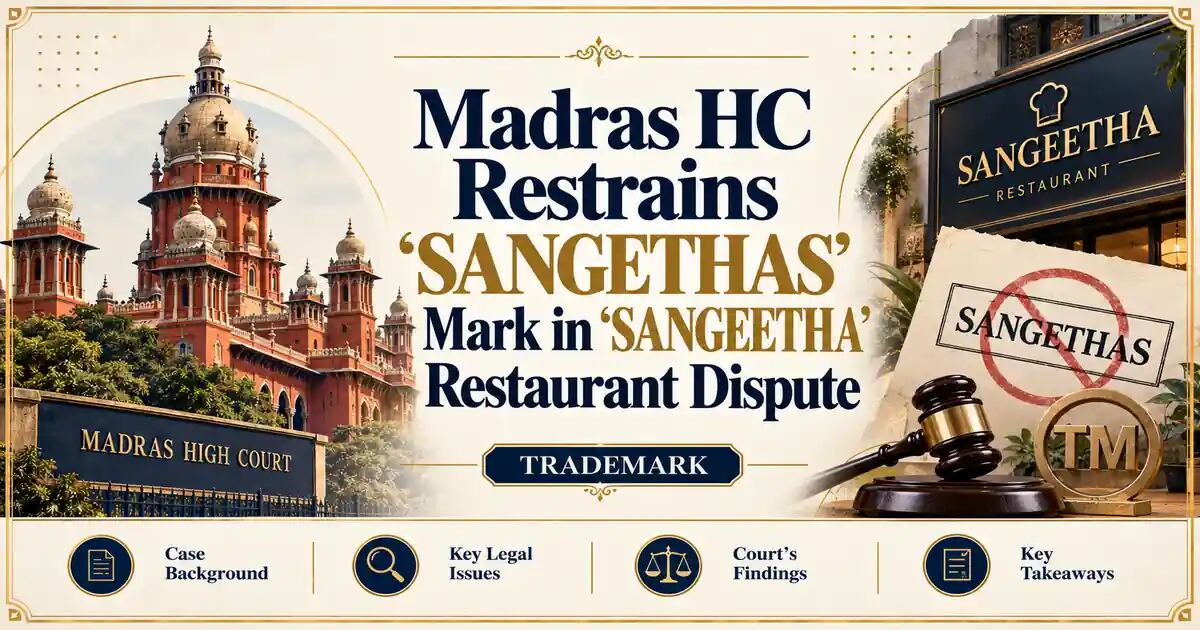
In M/S.Sangeetha Caterers and Consultants LLP Vs HOTEL SANGETHAS PURE VEG [OA.673/2026], the Madras High Court granted an interim injunction restraining the defendant from operating its restaurant under the name “HOTEL SANGETHAS PURE VEG RESTAURANT” or any deceptively similar mark pending final suit disposal. Presiding over the Commercial Division, Justice P.B. Balaji held that the respondent’s adoption of “SANGETHAS” for restaurant services directly infringed the applicant’s registered “SANGEETHA” trademarks under Classes 42 and 43. The Court resolved the core legal issue of deceptive similarity by formulating an innovative “hungry consumer” test, ruling that prospective restaurant patrons seeking immediate dining options are guided primarily by dominant phonetic memory and vernacular signboards rather than minor visual modifications, rendering minor English spelling variations and altered logo devices legally insufficient to defend against statutory trademark infringement.
| Disputed Subject Matter | Unregistered trademark “HOTEL SANGETHAS PURE VEG RESTAURANT” versus registered trademarks “SANGEETHA”, “SVR SANGEETHA”, “Sangeetha Veg. Restaurant SVR”, and “Sangeetha VEG Express” (Classes 42 & 43). |
|---|---|
| Plaintiff / Petitioner’s Case | Plaintiff asserted continuous adoption of the “SANGEETHA” brand since 1985, holding registered word and device marks across Classes 42 and 43, copyright registrations, legal user certificates, and an annual turnover exceeding Rs. 450 Crores for FY 2024-25. Alleged intentional statutory infringement and passing off by the Defendant. |
| Defendant / Respondent’s Defense | Defendant argued lack of deceptive similarity due to geographic separation (Thanjavur location without Plaintiff’s branch), distinct device marks (wheel and conch versus plaintiff’s veena device), prefix/suffix additions (“Hotel” / “Pure Veg”), altered color schemes, and minor English spelling variations (“Sangethas”). |
| Governing Law & Authorities | Trade Marks Act, 1999 (Sections 28, 29, 30, 34, 57); Code of Civil Procedure, 1908 (Order XXXIX Rules 1 & 2, Order XIX); Renaissance Hotel Holdings Inc v. B. Vijaya Sai; Cadila Health Care Ltd v. Cadila Pharmaceuticals Ltd; Corn Products Refining Co. v. Shangrila Food Products Ltd; Nandhini Deluxe v. Karnataka Cooperative Milk Producers Federation Ltd. |
| Decisive Holding & Relief | Interim injunction granted under Order XXXIX Rules 1 & 2 CPC. Defendant restrained from infringing Plaintiff’s registered trademarks and operating under the name “HOTEL SANGETHAS PURE VEG RESTAURANT” or any deceptively similar name pending final disposal of the commercial suit. |
Factual Trajectory, Prior Use Rights, and Territorial Goodwill Projection in Hospitality Services
For foundational statutory analysis, consult our in-depth Trademark Law Guide.
The applicant, M/s. Sangeetha Caterers and Consultants LLP, represented by its designated partners Mr. P. Rajagopal and Mr. P. Suresh, instituted commercial suit C.S.(COMM DIV) No. 192 of 2026 alongside Original Application No. 673 of 2026 seeking an interim injunction against M/s. Hotel Sangethas Pure Veg, managed by proprietor Mr. Narayanan Chandrasekaran in Thanjavur. The applicant established a continuous commercial lineage originating in 1985 with its first restaurant establishment at Parry Corner, Chennai. The proprietary interest evolved from a single outlet into a partnership firm in 2001, which was subsequently converted into a Limited Liability Partnership in 2015 under the Limited Liability Partnership Act, 2008. All trademark registrations standing in the name of the erstwhile partnership firm were formally transferred to the applicant LLP via Trade Marks Registry communications dated March 17, 2018.
The applicant holds valid legal user certificates for multiple word and device marks across Classes 42 and 43, including “SVR SANGEETHA”, “Sangeetha Veg. Restaurant SVR”, “Sangeetha (Device – Veena)”, “Sangeetha VEG Express”, and “SVR Sangeetha EXPRESS”. These statutory rights are supported by extensive commercial operations yielding an annual turnover exceeding Rs. 450 Crores for the financial year ending March 31, 2025, complemented by widespread domestic expansion and international franchising across the Middle East. Additionally, the applicant holds copyright registrations for the artistic work “SVR Sangeetha” with the Veena device, assigned to the LLP on January 1, 2023.
Representing the applicant, advocate Mr. L. Rajasekar submitted that the applicant’s registered trademarks had acquired extensive market reputation, rendering the defendant’s adoption of “SANGETHAS” a dishonest attempt to misrepresent its business as affiliated with the applicant. Conversely, counsel for the respondent, Mr. Adith Narayan Vijayaraghavan, contended that the respondent operated exclusively in Thanjavur, where the applicant maintained no physical restaurant branch. The defense highlighted structural variations, noting that while the applicant utilized a classical Veena device mark, the respondent deployed a sacred wheel and conch device. The defense also pointed to the prefix “Hotel”, suffix “Pure Veg”, contrasting color palettes, and an English spelling modification omitting the letter ‘e’ (“Sangethas” instead of “Sangeetha”).
Justice P.B. Balaji systematically rejected the respondent’s geographic isolation defense. The Court emphasized that Thanjavur is a major cultural city in Tamil Nadu housing the UNESCO World Heritage Brihadeeswara Temple, attracting massive global and domestic tourist populations. Because these floating visitors originate from regions where the applicant’s registered mark enjoys established reputation, the absence of a local brick-and-mortar branch in Thanjavur offered no defense against statutory infringement. This holding aligns with the principles articulated in Neon Laboratories Ltd. v. Medical Technologies Ltd. (2016) 2 SCC 672, where the Supreme Court affirmed that prior user rights and brand reputation under Section 34 of the Trade Marks Act, 1999 project across expanded territorial boundaries, preventing prospective market entrants from exploiting established commercial goodwill in untapped geographical zones.
The “Hungry Consumer” Test, Regional Script Phonetics, and Evidentiary Forensics
The evidentiary core of the decision lies in the High Court’s refusal to rely on formalistic visual comparisons when evaluating trademark infringement in the hospitality sector. Defense litigators routinely present comparative charts highlighting graphic variations, typography differences, and logo arrangements. Justice Balaji dismantled this hyper-technical approach by examining the cognitive state of a prospective consumer seeking dining services. To establish this judicial framework, the Court cited classical Tamil literary adages, referencing poetess Avvaiyar’s celebrated words “Pasi vandhaal pathum parandhu pohum” (when hunger arrives, all ten virtues fly away) alongside the common vernacular idiom “Pasi kanna kattudhu” (hunger blinds one’s vision).
Applying these human behavioral insights to the evidentiary record, the Court observed that a consumer experiencing immediate hunger does not perform side-by-side graphical comparisons of corporate logos or scrutinize color spectrums. Instead, the consumer relies upon dominant phonetic memory and prominent business signboards. The Court conducted a critical evidentiary audit of the respondent’s physical signboards, discovering that while the respondent omitted a single letter ‘e’ in its English spelling (“Sangethas”), its regional Tamil signboard reproduced the mark “Sangeetha” (சங்கீதாஸ்) identically. The Court noted that the Tamil language possesses full phonetic capacity to represent a non-infringing spelling and distinct pronunciation if the respondent had genuinely intended an honest adoption.
Evidentiary analysis of this nature demonstrates that minor spelling alterations engineered for English registration filings cannot override identical phonetic representations deployed on physical signboards. Justice P.B. Balaji articulated this practical standard of consumer perception directly in the judgment:
A person, especially who is hungry is the most potential customer for the Respondent. He is not going to see or notice the colour scheme or the device marks used, but will easily get carried away by “Sangethas” and “r’;fPjh!;” in Tamil. In fact, applying the quote and the idiom that I have discussed above, a customer would easily be deceived by the name of the Respondent and would be blind to the colour scheme, spelling, viz., omission of an ‘e’, use of ‘Hotel’ as a prefix or even the device marks and is very likely to be carried away by the name and only associate it with the Applicant.
Hon’ble Mr. Justice P.B. Balaji, Madras High Court
The Court also addressed preliminary procedural objections under Order XIX of the Code of Civil Procedure, 1908 regarding affidavit verifications and the absence of recorded third-party customer confusion testimony. Justice Balaji ruled that at the interlocutory stage under Order XXXIX Rules 1 & 2 CPC, strict trial-stage evidentiary requirements are not required. The production of physical invoices, store photographs, and proof of statutory registration certificates sufficiently establishes a prima facie case for interim injunctive relief.
Section 29 Statutory Infringement vs Section 30 Honest Commercial Use Defense
Statutory infringement under Section 29 arises when an unauthorized mark uses an identical or deceptively similar sign for identical goods or services. To establish a valid defense under Section 30, the defendant must prove that the adoption is in accordance with honest practices in industrial or commercial matters and does not take unfair advantage of or cause detriment to the distinctive character or repute of the registered trademark.
From a doctrinal perspective, the judgment clarifies the relationship between statutory rights under Section 28 of the Trade Marks Act, 1999 and the limited defenses available under Section 30. The respondent attempted to rely upon landmark Supreme Court precedents, including Cadila Health Care Ltd v. Cadila Pharmaceuticals Ltd (2001) 5 SCC 73, Corn Products Refining Co. v. Shangrila Food Products Ltd AIR 1960 SC 142, and Nandhini Deluxe v. Karnataka Cooperative Milk Producers Federation Ltd (2018) 9 SCC 183. The respondent argued that under the Nandhini Deluxe rationale, distinct visual logos and generic descriptive additions prevent public confusion.
Justice Balaji distinguished Nandhini Deluxe, observing that in the present dispute, both commercial entities operated within identical business categories (pure vegetarian restaurant services under Class 43), unlike the distinct product categories (milk products versus restaurant services) present in Nandhini Deluxe. Instead, the Court applied the controlling ratio of the Supreme Court in Renaissance Hotel Holdings Inc v. B. Vijaya Sai (2022) 2 SCC 25. The High Court reaffirmed that where an unauthorized user adopts a deceptively similar mark for identical services, statutory infringement under Section 29 is established, and the defendant cannot claim the protection of Section 30 without proving honest concurrent adoption.
Examining the strict statutory burden imposed on market entrants by Renaissance Hotel Holdings, Justice P.B. Balaji highlighted the core legal principle governing commercial mark adoptions:
In Renaissance Hotel’s case, (referred herein supra), the Supreme Court held that the Respondent who is alleged of infringement and passing off, before availing the benefit of Section 30 of the Act, has to establish the use of the mark was not to take unfair advantage of or is detrimental to the distinctive character or repute of the mark, and that use is in accordance with honest practices in industrial and commercial matters.
Hon’Found Mr. Justice P.B. Balaji, Madras High Court
This statutory interpretation aligns with the principles set out in S. Syed Mohideen v. P. Sulochana Bai (2016) 2 SCC 683, confirming that while Section 28 grants exclusive rights subject to other provisions of the Act, registration creates a strong statutory presumption of validity. A newcomer who appropriates the essential structural feature of an established mark bears a heavy burden to prove honest commercial adoption, a burden the respondent failed to discharge.
Interlocutory Standards under Order XXXIX CPC and Section 57 Rectification Strategy
In commercial IP litigation, applying Order XXXIX Rules 1 and 2 of the Code of Civil Procedure, 1908 requires balancing immediate market disruption against long-term brand equity dilution. Defense litigators frequently argue that interim injunctions should be denied where the defendant can be ordered to maintain quarterly accounts of sales. Justice Balaji implicitly rejected this approach, holding that in direct trademark infringement actions involving identical consumer services, maintaining financial accounts provides inadequate protection. Permitting an infringing signboard to remain active misleads the consuming public daily, causing irreparable harm to the distinctiveness of the registered mark that cannot be quantified or compensated by monetary damages at trial.
The decision also highlights strategic considerations regarding Section 57 Rectification proceedings before the High Court Intellectual Property Division (IPD). When faced with an infringement suit based on a senior registered mark, defense counsel often initiate parallel Section 57 cancellation petitions to challenge the validity of the registered mark on grounds of non-user or descriptive character. However, as demonstrated in this case, where the plaintiff establishes continuous commercial use dating back to 1985 alongside extensive turnover figures, parallel rectification challenges rarely undermine the plaintiff’s prima facie entitlement to interim injunctive relief under Order XXXIX Rules 1 & 2 CPC.
Also Read: Delhi HC Restrains ‘VEEPRO’ Mark for Infringing ‘WIPRO’ Trademark
Key Precedents & Statutory Guidance
- Search recent High Court judgments in our Latest Indian IP Law Cases Directory.
- Examine core statutory doctrines in our Indian Trademark Law Guide.
- Procedural Breakdown: Customs IP Recordal in India & ICER Portal Procedures.
- Review nationwide litigation trends in our Monthly IP Law Roundup.
Strategic IP Playbook: Corporate Risk Management and Enforcement Protocols
This ruling provides clear operational directives for IP litigators and corporate in-house counsel managing brand assets in competitive service sectors:
For Plaintiff Enforcement & Litigation Strategy
- Vernacular Signboard Audits: Pre-suit enforcement audits must capture physical photographic evidence of defendant signboards in all regional scripts. Visual discrepancies in English trademark registry filings can be neutralized by proving identical regional transliterations.
- Floating Population Evidentiary Submissions: When enforcing registered marks in regional commercial hubs where the plaintiff lacks physical outlets, litigators should submit demographic, tourism, and transit data to defeat geographic isolation defenses.
- Aggregator Data Integration: Counsel should incorporate digital evidence from food delivery platforms (e.g., Zomato, Swiggy) and e-commerce listings to establish widespread brand recognition across non-store territories.
For Defense Risk Mitigation
- Multi-Script Trademark Clearance: Clearance searches must extend beyond English word marks in the Trade Marks Registry to evaluate regional language transliterations and local commercial databases before launching brand identities.
- Evaluating Section 57 Rectification Counter-Attacks: Defense teams facing senior mark enforcement must assess the viability of dual-track proceedings, filing Section 57 Rectification petitions early before the High Court IPD if the senior mark faces vulnerability for non-user or genericness.
For In-House Corporate Governance
- Comprehensive Regional Script Portfolios: In-house legal departments must systematically register core brand names in English alongside key regional language scripts (e.g., Tamil, Telugu, Hindi, Kannada) across Classes 29, 30, and 43 to block opportunistic regional adoptions.
- Chain of Title Due Diligence: Corporate restructuring transactions converting partnership entities into LLPs or private limited companies must ensure prompt registration of trademark assignments under Section 45 of the Trade Marks Act, 1999 to maintain uninterrupted enforcement standing.
Case Details: M/S.Sangeetha Caterers and Consultants LLP Vs HOTEL SANGETHAS PURE VEG | Neutral Citation: 2026:MHC:4379 | Case Number: OA.673/2026 | Court: Madras High Court | Date: 2026-10-30
Presiding Bench: Hon’ble Mr. Justice P.B. Balaji
Appearances: Mr. L. Rajasekar (Applicant/Plaintiff); Mr. Adith Narayan Vijayaraghavan (Respondent/Defendant)