Core Controversy
Want to learn the fundamentals of Trademark Law? Read our complete Trademark Law Guide.
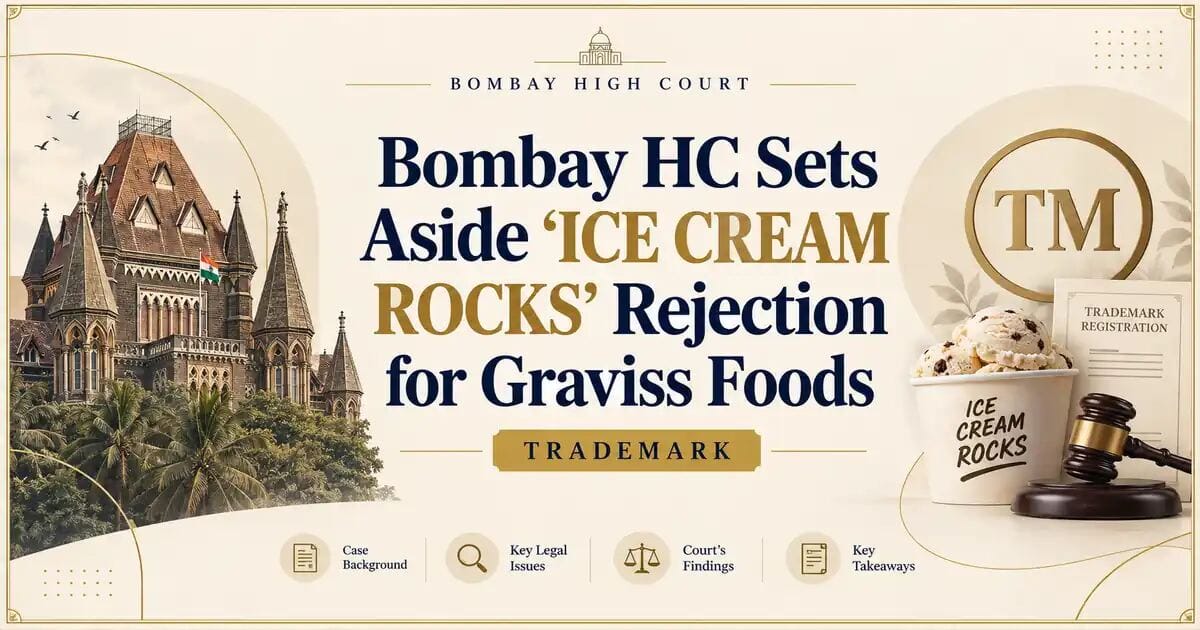
Under Section 9(1)(a) of the Trade Marks Act, 1999, which governs the absolute grounds for refusal of trademark registration, the quest for distinctiveness remains a central battleground in intellectual property adjudication. The statutory mandate is clear. Unless a mark possesses the inherent capacity to distinguish the applicant’s goods, registration is denied. This legal hurdle formed the core of the dispute in Graviss Foods Private Limited Vs The Registrar of Trade Marks (COMMPL/10288/2026), decided by the Bombay High Court on September 16, 2026. Before the Court, the Petitioner, Graviss Foods Private Limited, contested the summary refusal of its application for ‘ICE CREAM ROCKS’. Representing the Petitioner, Mr. Anand Mohan a/w Mr. Kaivalya Shetye & Ms. Kalyan argued that the trade mark registry applied an incorrect statutory standard by failing to appreciate the composite nature of the mark. Conversely, the Registrar of Trade Marks rejected the application, asserting that the mark, being composed of highly generic and descriptive terms, was fundamentally incapable of performing a source-identifying function. Such a rejection rested on a double objection: first, that the mark lacked distinctiveness per se under Section 9(1)(a) of the Act; and second, that without long and continuous user evidence, the mark could not invoke the benefit of the statutory proviso concerning acquired distinctiveness. The controversy thus centers on whether a composite mark comprising descriptive elements can be summarily rejected without a detailed, reasoned inquiry.
Governing Legal Framework
To resolve this dispute, the Court examined the statutory boundaries of Section 9(1)(a) of the Trade Marks Act, 1999, which bars registration for marks lacking distinctive character. Distinctive character is defined in relation to Section 2(1)(zb) as the capacity to distinguish goods or services of one person from those of another. Such absolute prohibition, however, is not without exception. The proviso to Section 9(1) of the Act contains a statutory safety valve, stipulating that registration shall not be refused if, before the application date, the mark acquired a distinctive character through use or is a well-known trademark. Applying this proviso requires an exacting evaluation of the factual matrix, particularly the extent and duration of commercial use.
In addition to these substantive provisions, the statutory framework of Section 91 of the Act, governing appeals against the decisions of the Registrar, brings administrative law principles into play. Quasi-judicial authorities, including the Registrar of Trade Marks, are bound by the duty to provide reasoned orders. Adherence to this duty represents a fundamental tenet of natural justice, ensuring that decisions are not arbitrary. The statutory mandate under Section 18(5) of the Act further obliges the Registrar to record in writing the grounds for decision and the materials used. Consequently, any order that bypasses this statutory requirement by deploying boilerplate templates or failing to engage with the applicant’s evidence constitutes a serious procedural error.
Court’s Reasoning
In dissecting the Registrar’s decision, the High Court focused heavily on the structural and procedural defects of the impugned orders. The Court began by addressing the Registrar’s finding that the mark ‘ICE CREAM ROCKS’ is generic and descriptive. Under established trademark law principles, a composite mark cannot be split into constituent parts to deny registration. Although the word ‘ICE CREAM’ is descriptive of the product class, and the word ‘ROCKS’ may possess generic connotations, the combination ‘ICE CREAM ROCKS’ creates a distinct visual and conceptual impression. Applying this principle, the Court distinguished this from other cases on the ground that the Registrar failed to evaluate the mark as an integrated whole. Indeed, the underlying rule, as the Court articulated it, appears to be that a mark must be assessed in its entirety rather than by dissecting it into individual, non-distinctive parts. Turning to the application of the proviso to Section 9(1), the Court analyzed the Registrar’s finding that because the Subject Mark had not had long and continuous use, the question of acquired distinctiveness does not arise. This reasoning was legally flawed. By imposing an artificial threshold of ‘long and continuous use’ as a pre-condition for even evaluating evidence of distinctiveness, the Registrar committed a patent error of law. Statutory provisions do not define a minimum temporal threshold for ‘use’ under the proviso; instead, it requires an assessment of whether the mark has, in fact, come to identify the goods in the minds of consumers. As the Court observed, the determination of distinctiveness is a mixed question of fact and law that cannot be resolved through simple administrative assumptions.
To support this position, the Court relied on several precedents governing administrative and intellectual property adjudications. The Petitioner relied on the decision in Bidisha Ghoshal v. Registrar of Trade Marks to assert that the Registrar must engage with the specific factual evidence of user placed on record before denying registration. Additionally, the Court drew inspiration from patent law jurisprudence, referencing Huhtamaki Oyj and Anr. v. Controller of Patents, 2023 (96) PTC 198, holding that orders passed by intellectual property registries must be reasoned. In applying this analogy, the Bombay High Court noted that this principle applies with equal force to the Registrar. Orders passed by the Registrar must be speaking orders that disclose a clear link between the facts on record, the statutory provisions, and the final decision. Such quality of decision-making in intellectual property registries must reflect the serious commercial and legal interests at stake.
“It is a well-established principle of trademark law that generic, descriptive, or laudatory terms – particularly when not having had long and continuous use – do not qualify for registration per se unless it is affirmatively shown that they have acquired secondary meaning or distinctiveness.”
Hon’ble Bombay High Court
In addition, the Court addressed the Registrar’s reliance on the decision in Pernod Ricard. The Court distinguished the present matter from Pernod Ricard on the ground that the latter involved a mark that was purely descriptive without any redeeming distinctive elements, whereas ‘ICE CREAM ROCKS’ possesses a conceptual playfulness that cannot be summarily dismissed as purely descriptive. Additionally, the registrar had failed to provide any comparative analysis of the prior cited marks under Section 11 of the Act, which governs relative grounds for refusal. Without analyzing whether they were phonetically, visually, or conceptually identical to the applicant’s mark, the Registrar had simply listed those marks. Such mechanical listing of cited marks, without any application of the test of imperfect recollection or consumer confusion, was held to be a grave error.
“Orders impugned in statutory appeals are often found to suffer from a lack of analytical reasoning, which hinders the appellate court’s ability to assess the proprietary exercise of discretionary power by the registering authority.”
Hon’ble Bombay High Court
By failing to address the evidence placed by Graviss Foods, the Registrar essentially abdicated its statutory duty of adjudication. This failure necessitated judicial intervention to restore procedural propriety.
Holding and Relief
Consequently, the High Court allowed the appeal and set aside the impugned orders of the Registrar of Trade Marks. In its determination, the Court held that the rejection of Graviss Foods’ applications was unsustainable on both procedural and substantive grounds. Rather than granting unconditional registration, the Court determined that the appropriate course of action was to remand the matter back to the trademark registry. This remand was ordered to ensure that the factual questions regarding acquired distinctiveness could be properly adjudicated. Specifically, the Registrar of Trade Marks was directed to afford Graviss Foods a fresh opportunity to present its case. In doing so, the Court ensured that the administrative process would be completed in accordance with the law. The registry must decide. Mr. Anand Mohan a/w Mr. Kaivalya Shetye & Ms. Kalyan, representing Graviss Foods, assured the Court that the applicant would place additional evidence of market use, sales figures, and promotional expenses on record to substantiate the claim of acquired distinctiveness. Under the terms of the remand, the Registrar must hear the matter afresh and pass a reasoned, speaking order within a period of four months from the date of receipt of the court’s order. Crucially, the Court directed that the Registrar must independently assess the evidence without being influenced by the findings in the set-aside rejection orders. This relief ensures that the applicant is not penalized by the registry’s administrative failures, while preserving the registry’s role as the fact-finding body.
Also Read: Karnataka HC Sets Aside Injunction: ‘Section 34’ Protects Prior Users
Practical Significance
The decision in the Graviss Foods appeal carries significant doctrinal and procedural implications for trademark prosecution in India. First, it reinforces the strict requirement for reasoned decision-making by intellectual property registries. By invoking precedents from both trademark and patent law, such as Huhtamaki Oyj, the Court has emphasized that the standards of administrative accountability are uniform across all intellectual property offices. This must lead to a reduction in the use of automated, pre-formatted rejection templates by the registry. Second, the ruling clarifies the evidentiary standard required to invoke the proviso to Section 9(1). The Court’s refusal to accept a rigid temporal threshold for ‘use’ means that applicants can establish distinctiveness through intensive commercial use over a shorter duration. For trademark attorneys, this underscores the necessity of compiling exhaustive evidence of market penetration, including digital reach and consumer association surveys. Third, the judgment highlights the importance of the ‘anti-dissection’ rule in evaluating composite marks. By reminding the registry that a mark must be assessed as a whole, the Court has provided valuable guidance on how descriptive terms, when creatively combined, can cross the distinctiveness threshold. The High Court’s insistence on a reasoned order aligns with the broader judicial trend of demanding transparency from quasi-judicial bodies. This judicial correction prevents the Registrar from acting as a mere gatekeeper who rejects applications based on subjective linguistic preferences. Consequently, enterprises that engage in aggressive marketing campaigns can secure protection for descriptive composite marks without waiting for decades of slow growth, shifting the focus from historical timelines to current consumer perception.
Case Details: Graviss Foods Private Limited Vs The Registrar of Trade Marks | Case Number: COMMPL/10288/2026 | Court: Bombay High Court | Date: 16/09/2026