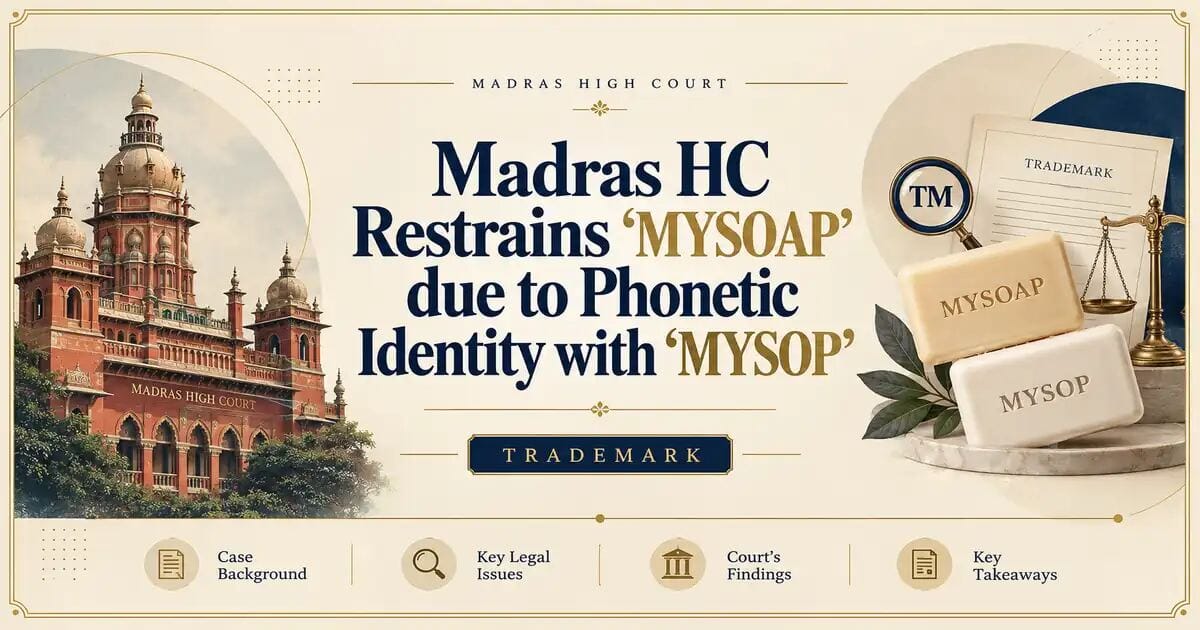
Trademark litigators must recognize that near-identical phonetic branding in fast-moving consumer goods triggers an immediate finding of trademark infringement and passing off, regardless of minor typographic distinctions. In the dispute of Pradeep Cholayil Vs Karnataka Soaps and Detergent (CS.225/2018, decided on September 21, 2026), the Madras High Court strictly protected the registered trademark MYSOP against the confusingly similar mark MYSOAP. The court issued a permanent injunction, a mandatory injunction, and ordered a preliminary decree for the rendition of accounts alongside damages.
Legal Context: Phonetic Equivalence in Mass Consumer Retail
Want to learn the fundamentals of Trademark Law? Read our complete Trademark Law Guide.
The consumer goods market relies heavily on brand recall. In the retail soap market, products are purchased by diverse consumer groups with varying levels of literacy and attention. Pradeep Cholayil, a prominent player in the personal care sector, filed this commercial suit to protect the proprietary integrity of his registered trademarks, MYSOP and MYSPO. The defendant, Karnataka Soaps and Detergent, introduced a product under the mark MYSOAP, directly threatening the market exclusivity of the plaintiff.
For parties seeking interim relief, establishing a clear path of phonetic identity is the most critical element of the litigation strategy. The plaintiff sought protection against trademark infringement and passing off under the Trade Marks Act, 1999. In mass-consumption segments, phonetic equivalence often outweighs structural or visual variations. The court must evaluate how an average consumer of average intelligence, possessing imperfect recollection, asks for a product in a noisy or hurried retail environment.
IP owners should note that courts do not look kindly on defendants who adopt near-identical phonetic equivalents for identical products. If a defendant is a state-owned enterprise or an established manufacturer, the burden to justify the adoption of a confusingly similar mark becomes even more demanding. The Madras High Court examined whether the minor addition of the letter “A” in the defendant’s mark MYSOAP was a bona fide commercial choice or an act of bad-faith piggybacking.
Issues Before the Court: Infringement, Passing Off, and Monetary Claims
The dispute required the Madras High Court to determine whether the defendant’s actions violated statutory protections and common law rights. The court framed specific inquiries to evaluate the commercial conflict. The key legal issues are detailed below:
- Statutory Trademark Infringement: Whether the defendant’s use of the mark MYSOAP constitutes trademark infringement under Section 29 of the Trade Marks Act, 1999 by copying the registered mark MYSOP (also referenced as MYSPO).
- Common Law Passing Off: Whether the manufacturing, distribution, and marketing of soaps under the mark MYSOAP constitutes passing off and enables third parties to pass off the defendant’s goods as those of the plaintiff.
- Procedural Relief under the Commercial Courts Act: Whether the plaintiff is entitled to a permanent injunction under the Commercial Courts, Commercial Division and Commercial Appellate Division of High Courts Act, 2015.
- Monetary Damages and Rendition of Accounts: Whether the plaintiff is entitled to damages of Rs. 10,00,000/- and a preliminary decree for the rendition of accounts to recover the profits made from the illegal use of the mark.
- Mandatory Injunction: Whether the court should direct a mandatory injunction requiring the destruction of all infringing packaging materials, dyes, and blocks bearing the mark MYSOAP.
These issues force a clear distinction between statutory protection and common law liability. Litigators must recognize that proving trademark infringement requires satisfying the visual and phonetic similarity tests under Section 29. On the other hand, the passing off claim requires demonstrating misrepresentation in the course of trade and actual or potential damage to the plaintiff’s goodwill. The court’s approach to these issues clarifies how commercial courts handle concurrent claims for damages and accounts of profits.
Treatment of Precedent: Phonetic Identity and the Imperfect Recollection Test
Applying the test of imperfect recollection, the Madras High Court rejected the defendant’s attempt to highlight minor visual differences between MYSOP and MYSOAP. The court observed that the two marks are phonetically indistinguishable. In oral transactions, which form a significant portion of soap purchases in India, the difference between the two terms disappears entirely. The court followed established Indian trademark jurisprudence, which states that when two marks are phonetically identical, structural differences on the label are irrelevant.
If prior commercial user is established, a subsequent adopter bears a heavy burden to prove their honest concurrent use. The court analyzed whether Karnataka Soaps and Detergent had any legitimate reason to choose a spelling that mimics the plaintiff’s registered trademark. By choosing MYSOAP, the defendant created an immediate likelihood of association with MYSOP. The court confirmed that such actions constitute classical passing off, as they allow the defendant to trade upon the established reputation of the plaintiff’s brand.
The court’s analysis of the deceptive similarity test relies on the target consumer’s perspective. In soap retail, purchases are quick and repetitive. Consumers do not engage in a detailed visual comparison of labels at the point of sale. Under these circumstances, phonetic identity becomes the primary cause of confusion. The Madras High Court’s treatment of precedent confirms that any mark containing the phonetic equivalent of a registered trademark will be restrained if used for identical goods.
Statutory Interpretation: Section 27, Section 29, and the Commercial Courts Act
The statutory basis of the suit rests on the interaction between Section 27 and Section 29 of the Trade Marks Act, 1999. Section 29 governs trademark infringement, protecting registered proprietors against unauthorized use of deceptively similar marks. In this case, the registration of MYSOP (and MYSPO) gave Pradeep Cholayil an exclusive right to use the mark. The defendant’s adoption of MYSOAP fell directly within the scope of Section 29(2), which addresses similarity of marks and identity of goods leading to consumer confusion.
Additionally, Section 27(2) of the Trade Marks Act, 1999 preserves the common law right of action for passing off. This provision allows the court to grant relief even if there are technical objections to the registration of the plaintiff’s mark. By manufacturing, distributing, and selling soaps under the confusingly similar mark MYSOAP, the defendant committed acts of passing off. This misrepresentation damaged the commercial goodwill of Pradeep Cholayil, justifying both the permanent injunction and monetary claims.
For parties seeking interim or final relief, the procedural framework of the Commercial Courts Act, 2015 is crucial. This statute aims to resolve commercial disputes quickly. Under this Act, the plaintiff sought a preliminary decree for the rendition of accounts to recover profits made from the illegal use of the mark. By combining this statutory procedure with the substantive provisions of the Trade Marks Act, the court established a clear path to financial recovery for the aggrieved brand owner.
The court’s order of a mandatory injunction for the destruction of infringing materials also demonstrates the practical remedies available under statutory law. This remedy prevents the defendant from re-introducing the infringing products under a slightly modified format. Litigators should note that the court did not limit its relief to a simple negative covenant. Instead, it ordered active steps to ensure the complete removal of the infringing brand from the market.
Also Read: Karnataka HC Sets Aside Injunction: ‘Section 34’ Protects Prior Users
Significance of the Decision: Key Takeaways for IP Practitioners
This decision provides important guidance for brand owners, corporate counsel, and trademark attorneys. The Madras High Court’s ruling shows that phonetic similarity in consumer products will lead to immediate liability. Trademark practitioners would do well to analyze the specific strategic lessons from this dispute.
IP owners should note that securing registrations for phonetic variations, such as both MYSOP and MYSPO, creates a strong defensive barrier. This multi-layered registration strategy makes it easier to establish infringement when a competitor adopts a mark like MYSOAP.
For parties seeking interim relief, the case shows that pleading phonetic similarity is highly effective. If the competing marks sound identical, the court will likely find deceptive similarity without requiring extensive evidence of actual confusion.
Corporate legal departments must ensure that any new brand name undergoes thorough phonetic clearance searches. Relying on minor spelling changes or adding single vowels will not protect a brand from infringement claims.
The safer approach going forward is to avoid any mark that mimics the sound of an existing registered trademark in the same product category. The court’s willingness to award damages of Rs. 10,00,000/- and order the rendition of accounts shows that trademark infringement carries significant financial risks.
This decision confirms that the Madras High Court will strictly protect established brands in the FMCG sector. By issuing a permanent injunction, a mandatory injunction, and ordering the rendition of accounts, the court protected both consumer interests and the plaintiff’s commercial rights. For trademark litigators, this case serves as a clear precedent that phonetic identity is a decisive factor in trademark disputes involving mass-market goods.
Case Details: Pradeep Cholayil Vs Karnataka Soaps and Detergent | Case Number: CS.225/2018 | Court: Madras High Court | Date: 26-09-21