Strategic Implications of Pending Rectification in ‘PANAMA’ Trademark Feuds
New to Indian Trademark Law? Start with our comprehensive Trademark Law Guide.
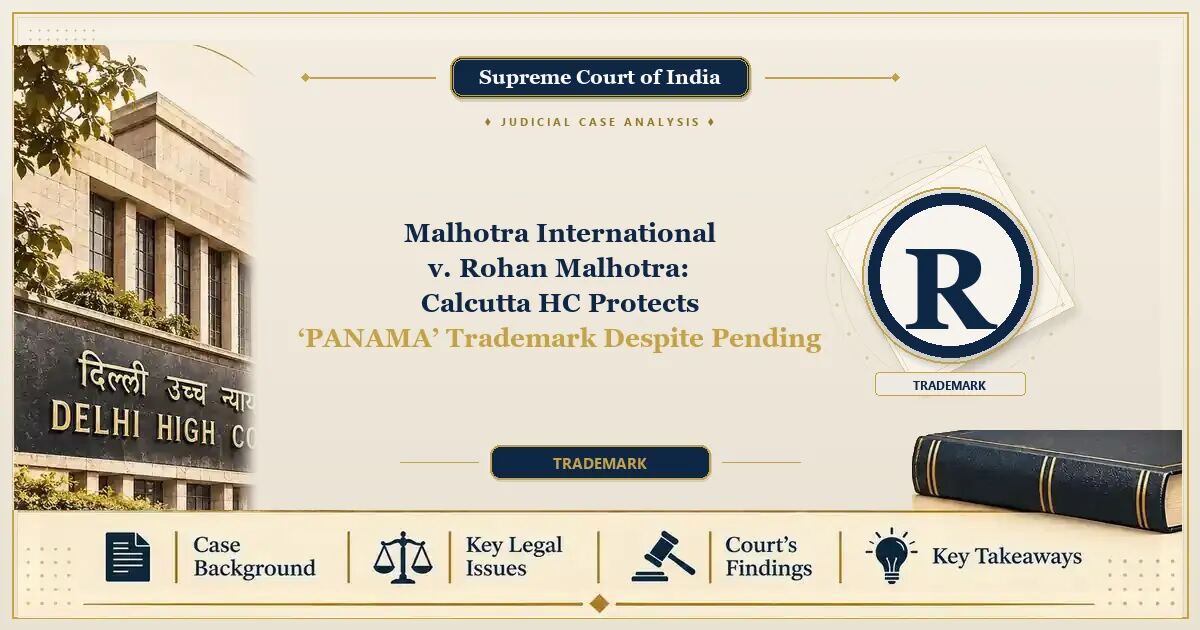
Can a defendant neutralize an immediate court injunction simply by challenging a registered trademark at the Registry? The Division Bench of the Calcutta High Court addressed this contentious commercial question in MALHOTRA INTERNATIONAL PRIVATE LIMITED vs. ROHAN MALHOTRA AND ORS. (TEMPAPO-IPD/7/2026). Decided on November 13, 2026, the ruling clarifies how pending cancellation applications interact with emergency judicial remedies.
Brand owners often assume statutory registration guarantees instant injunctive relief. Opponents routinely counter by challenging the underlying mark before administrative authorities. When these conflicting litigation strategies collide, commercial operations face paralyzing uncertainty.
This appeal challenged an interlocutory order passed by a single judge on October 14, 2026. Malhotra International Private Limited claimed exclusive statutory rights over the word mark “PANAMA”. Rohan Malhotra and his co-respondents attempted to blunt those rights by filing a formal rectification application. They asserted that administrative validity challenges should stall or temper court-ordered injunctions.
The High Court carefully dissected this defensive litigation tactic. Administrative rectification proceedings move slowly. Urgent injunction applications require immediate judicial intervention. Allowing pending cancellation petitions to automatically shield alleged infringers creates an unacceptable market imbalance.
This ruling reinforces the evidentiary weight of registered trademarks during preliminary court battles. It ensures that brand proprietors can defend their market presence without waiting years for administrative tribunals to complete validity reviews. Litigators must grasp this operational dynamic when structuring emergency interim applications.
Factual Matrix: The Clash Over the ‘PANAMA’ Brand
Commercial disputes between corporate entities or closely held family businesses regularly generate sharp intellectual property litigation. Malhotra International Private Limited established a substantial commercial footprint around its registered trademark “PANAMA”. The company actively used the mark across defined distribution networks and trade channels.
Trouble surfaced when Rohan Malhotra and the co-respondents began commercializing products under identical or deceptively similar branding. Malhotra International reacted swiftly. The company initiated a civil suit seeking permanent injunctions for trademark infringement alongside common law passing off remedies.
The plaintiff sought immediate temporary injunctions to halt unauthorized market sales. In response, Rohan Malhotra and the co-respondents attacked the structural foundation of the suit. They filed an application for rectification before the Registrar of Trade Marks, seeking total cancellation of the “PANAMA” registration.
The Registrar had not rendered a final decision on the cancellation petition when the trial judge considered the temporary injunction application. On October 14, 2026, the single judge passed an interlocutory order that left Malhotra International unsatisfied. The company promptly filed an appeal before the Division Bench of the Calcutta High Court.
Procedural positioning dictated the trajectory of the appeal. The lower court’s October 14, 2026 order had failed to grant immediate relief, effectively allowing the respondents to continue trading under the disputed label. Malhotra International contended that every day of delayed enforcement inflicted compounding market damage. The Division Bench had to determine whether interim protection could be withheld solely because registry proceedings remained active.
The appeal raised a fundamental question for commercial litigators. Should a registered proprietor lose interim injunctive protection merely because the defendant questions the mark’s statutory validity in administrative proceedings?
Statutory Framework: Interplay Between Injunctions and Rectification
Harmonizing concurrent IP proceedings requires reading several provisions of the Trade Marks Act, 1999 together. Section 28 of the Act confers exclusive rights upon registered proprietors to use their marks and seek statutory remedies against unauthorized adoption. Registration grants strong market exclusivity to brand owners.
Section 29 defines trademark infringement, detailing structural, visual, and phonetic similarity criteria. Complementing these rights, Section 31 establishes that trademark registration serves as prima facie evidence of validity in all legal proceedings. Litigators cannot treat a registered mark as a mere procedural formality.
Defendants frequently invoke Section 124 of the Act when challenging trademark validity during active civil suits. Section 124 dictates procedures for staying civil suits when a defendant raises a tenable invalidity plea. Section 125 governs rectification applications filed directly before the Registrar or High Court.
Crucially, Section 124(5) explicitly preserves judicial authority to issue interlocutory orders. Courts retain full power to grant temporary injunctions, order accounting of profits, or appoint receivers while the suit remains stayed for administrative rectification. Statutory stay provisions do not neutralize judicial emergency relief.
Understanding the interplay between Section 124 and Section 31 requires recognizing the distinct roles of courts and administrative registries. While the Registrar examines register integrity under Section 57, civil courts safeguard market equity and prevent consumer deception. Section 124(5) acts as a statutory bridge, ensuring that court powers remain active even when main suits are stayed. Litigators must use Section 124(5) to argue that statutory stays never freeze emergency injunction remedies.
Common law remedies also operate independently under Section 27(2) of the Act. Passing off actions protect established commercial goodwill regardless of registration status. Even if statutory title faces administrative scrutiny, passing off claims provide robust independent grounds for immediate interim relief.
Judicial Analysis: Evaluating Presumptive Validity Amid Cancellation Proceedings
Can an administrative delay at the Trade Marks Registry disarm a registered proprietor seeking emergency court remedies? The court was not buying the defendant’s argument that a pending cancellation filing neutralizes statutory trademark rights.
Judicial discretion in interlocutory injunctions depends on three mandatory criteria: a prima facie case, balance of convenience, and irreparable injury. Section 31 satisfies the prima facie threshold automatically. A registered mark carries a clear statutory presumption of legal validity.
Unilateral cancellation filings cannot overturn statutory presumptions overnight. Until the Registrar or competent court formally rectifies the register, legal title remains valid and enforceable. The Division Bench emphasized that administrative backlog must not compromise statutory property rights.
If courts suspended injunctions whenever defendants filed cancellation petitions, infringement litigation across India would break down completely. Infringers would launch rectification proceedings as a routine tactical delay mechanism. That practice undermines legislative intent.
Evaluating the balance of convenience requires weighing ongoing commercial damage against prospective market losses. Malhotra International demonstrated continuous commercial exploitation of the “PANAMA” brand. Allowing respondents to market competing goods under an identical mark dilutes brand equity immediately.
The Bench carefully evaluated the risk of market confusion in the trade channels associated with ‘PANAMA’. When identical word marks compete in identical product segments, consumer deception occurs inevitably. The court noted that trademark law protects not only the owner’s private property rights but also the purchasing public from origin confusion. Allowing parallel trade under a contested mark compromises public interest while administrative bodies deliberate.
Monetary compensation cannot repair broken consumer associations or eroded brand distinctiveness. Passing off principles further reinforced the proprietor’s claim for urgent protection. Common law goodwill survives even while statutory registration undergoes administrative review.
Interlocutory orders protect existing commercial status quo. Delaying interim relief while waiting for tribunal outcomes rewards unauthorized mark adoption. The court confirmed that trial judges must grant protection when statutory infringement and passing off claims meet preliminary evidentiary thresholds.
Also Read: Seematti Silks v T. Beena: Madras HC Bars ‘SEEMATTI’ Rectification
Key Precedents & Statutory Guidance
- Search recent High Court judgments in our Latest Indian IP Law Cases Directory.
- Examine core statutory doctrines in our Indian Trademark Law Guide.
- Procedural Breakdown: Customs IP Recordal in India & ICER Portal Procedures.
- Review nationwide litigation trends in our Monthly IP Law Roundup.
Practical and Commercial Takeaways for Litigators and Corporate Counsel
This ruling offers actionable insights for corporate legal departments, brand managers, and IP litigators operating in competitive Indian markets. Managing concurrent proceedings across courts and registries requires sharp strategic discipline.
Brand owners must audit their trademark portfolios aggressively. Securing clear word mark registrations before launching major commercial campaigns builds formidable litigation strength. When facing infringement, litigators should assert Section 31 presumptions forcefully from day one.
Defendants cannot rely on administrative rectification petitions as magic litigation shields. Launching cancellation proceedings creates long-term statutory pressure, but it rarely blocks emergency interim injunctions. Counsel defending infringement suits must present substantive evidence showing non-user, descriptive adoption, or honest concurrent use to defeat temporary stay applications.
Corporate legal counsel negotiating commercial settlements gain a clear strategic advantage from this decision. A registered owner armed with an interim injunction holds an enviable negotiating position. Administrative challenges seldom force an established brand owner into unfavorable licensing splits or compromise decrees.
Tactical choices made during early cease-and-desist exchanges shape future court outcomes. Sending a pre-suit notice often prompts the infringer to file a preemptive cancellation petition at the registry. IP attorneys must anticipate this counter-strike and prepare robust Section 31 arguments before serving formal legal notices. A well-prepared proprietor can neutralize defensive rectification petitions before trial judges even hear the first interlocutory motion.
Cross-border brand expansion strategies also benefit from clear judicial precedents regarding presumptive mark validity. International brand owners expanding into India frequently encounter domestic squatters who launch bad-faith rectification proceedings to block market entry. This ruling confirms that registered foreign entities holding valid Indian registrations can secure immediate interlocutory orders despite hostile registry filings.
Licensing agreements must address pending validity disputes explicitly. Draft contracts should allocate royalty risks clearly if third parties challenge the licensed mark’s validity before administrative authorities.
Corporate risk managers must monitor public trade mark journals continuously. Early identification of hostile filings allows brand owners to preempt defensive rectification tactics before opponents utilize pending petitions in court.
Valuation of brand assets during mergers and acquisitions also requires evaluating active registry disputes. A pending cancellation petition against a core trademark like “PANAMA” introduces legal noise, but strong judicial enforceability maintains underlying commercial asset value.
Ultimately, the Calcutta High Court’s ruling reinforces market stability. Registered brand owners can enforce their statutory monopolies decisively while administrative bodies evaluate long-term validity challenges.
Case Details: MALHOTRA INTERNATIONAL PRIVATE LIMITED vs. ROHAN MALHOTRA AND ORS. | Neutral Citation: 2026:CHC-OS:458-DB | Case Number: TEMPAPO-IPD/7/2026 | Court: Calcutta High Court | Date: 13-11-2026
Presiding Bench: The Hon’ble Justice Debangsu Basak and The Hon’ble Justice Ajay Kumar Gupta