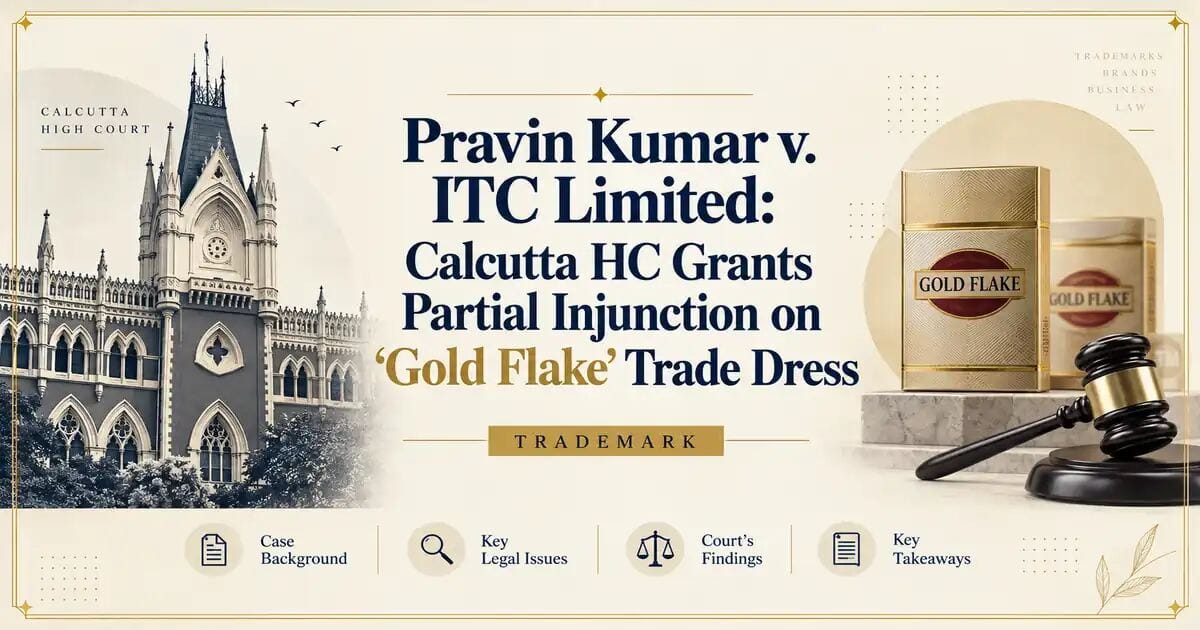
Jurisdictional Boundaries and the Proprietary Shield: Analyzing Pravin Kumar v. ITC Limited
The marketplace for consumer goods remains a battleground where heritage brands frequently defend their visual identity against new entrants. In Pravin Kumar v. ITC Limited and Ors, the Calcutta High Court was tasked with untangling a complex web of infringement allegations concerning the iconic “Gold Flake” cigarette brand. At its heart, this dispute touched upon the fundamental tension between protecting established brand equity and the scope of statutory protections available to registered proprietors. The commercial stakes were high, involving not just a famous name, but the underlying trade dress that signals authenticity to the Indian consumer.
ITC Limited initiated this action seeking to restrain the appellant, Pravin Kumar, from using trade marks and packaging that the company argued were deceptively similar to its own. The primary grievance centered on both infringement of registered marks and the common law action of passing off. What the court was really deciding was the extent to which the Trade Marks Act and the Copyright Act allow for the curtailment of competition when both parties operate within the same, highly regulated industry.
The Statutory Framework and Jurisdictional Challenges
Arguments raised by the parties necessitated a close examination of the interplay between specific procedural sections of the intellectual property statutes. Central to the discussion was Section 134(2) of the Trade Marks Act, which provides for territorial jurisdiction, and Section 62(2) of the Copyright Act, 1957. These provisions serve as essential mechanisms for copyright and trade mark holders to establish a forum where they can bring claims for infringement.
The appellant, however, challenged the applicability of these provisions in the context of passing off. Specifically, a significant portion of the legal debate hinged on whether the protections granted to a registered proprietor could be used as a sword against another party operating in the same space. The defense relied heavily on a defensive reading of Section 28(3) and Section 30(2)(e) of the Trade Marks Act, suggesting that a registered proprietor faces limitations when attempting to sue another entity that also claims ownership of a registered, albeit disputed, mark.
Judicial Logic: The Mechanics of the Injunction
Justice A.K. Mukherjee, presiding over the Bench, scrutinized the balance between existing trade dress rights and the appellant’s conduct. The court did not simply look at the names involved but focused on the holistic impact of the visual similarities present in the trade dress. It was clear that the court found the visual cues, when placed side-by-side, likely to confuse an average consumer of tobacco products, regardless of the granular differences in the labels.
This observation underscores the court’s reluctance to grant a blanket victory on the grounds of registered status alone. By carefully distinguishing the merits of the passing off claim from the technicalities of the trade mark infringement allegations, the court maintained a strict adherence to the evidentiary standards required for a temporary injunction. The resulting order granted partial relief to ITC Limited, signaling that while the law provides protection, it requires a substantive showing of deception before a court will intervene to stop market activity.
Decision and Industry Significance
The court’s decision to partially allow the temporary injunction reflects a measured approach to intellectual property litigation. It serves as a reminder that the registration of a mark is not an absolute barrier to every competitor. Instead, the court emphasized that passing off remains a potent tool for established players, provided they can clearly demonstrate the distinctiveness of their trade dress and the likelihood of consumer confusion.
For legal practitioners, this ruling confirms that the specific legislative avenues provided under Section 134(2) and Section 62(2) remain the primary conduits for filing, but they do not automatically guarantee an expansive, unfettered right of action. The outcome effectively limits the ability of a registered proprietor to claim exclusive dominance in markets where concurrent usage or similar aesthetic elements might coexist. By declining to grant a comprehensive, all-encompassing injunction, the court has signaled a preference for specific, evidence-backed findings rather than broad, prophylactic orders.
This case serves as a valuable case study for attorneys advising corporate clients on how to structure their litigation strategy. It highlights the necessity of focusing on the specific, tangible elements of trade dress when statutory trade mark claims are met with counter-claims of registration. Moving forward, litigators should take care to separate the threads of passing off from the technical arguments of infringement, as the Calcutta High Court clearly viewed them as distinct inquiries requiring different levels of proof.
Ultimately, Pravin Kumar v. ITC Limited reinforces the notion that the Indian IP legal system remains a forum where fairness in the marketplace is balanced against the rigidity of statutory registries. While ITC Limited succeeded in securing partial protection for its “Gold Flake” brand, the decision serves as a warning that intellectual property rights, however historic or well-guarded, must be substantiated through robust evidence in every instance. The judgment effectively maintains the status quo in a competitive industry, ensuring that while the law protects the established, it does not necessarily grant them an absolute monopoly over visual styles without the requisite proof of deceptive intent or consumer harm.
Case Details: PRAVIN KUMAR vs. ITC LIMITED AND ORS | Case Number: TEMPAPO-IPD/6/2025 | Court: Calcutta High Court | Date: 18-09-2026