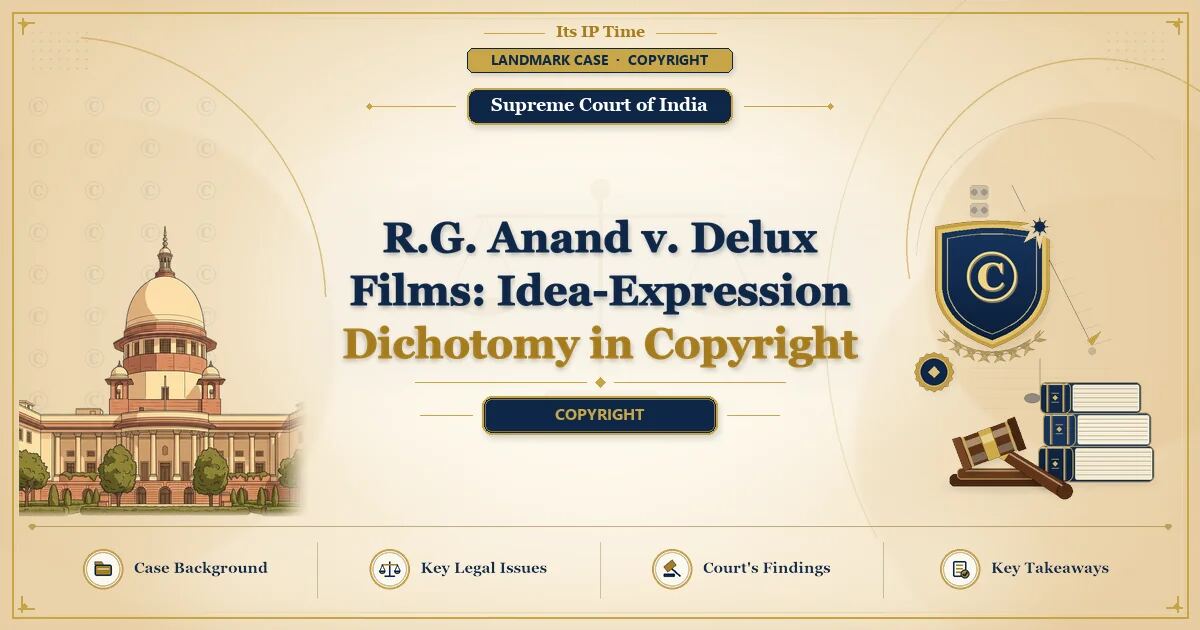
The Indian entertainment and media market has long wrestled with the boundaries between creative influence, shared cultural motifs, and unlawful copyright appropriation. The conflict between playwright R.G. Anand and production house Delux Films stands as the definitive watershed moment in Indian copyright jurisprudence, documented in our picked reference of Landmark IP Cases.
At its core, the dispute pitted an independent theatrical playwright against a commercially established film studio, raising fundamental economic and legal questions regarding the scope of protection afforded to literary and dramatic works when adapted into visual motion pictures. When script ideas and broad thematic concepts circulate within creative hubs, defining where an unprotectable idea ends and a protected original expression begins is an important economic inquiry.
The litigation reached the Supreme Court of India via Special Leave Petition, forcing the apex court to establish a clear doctrinal test to evaluate copyright infringement across different artistic media under the Copyright Act of 1957.
The Film Script Dispute Behind R.G. Anand v. Delux Films
Struggling with Indian Copyright Law principles? Explore our complete Copyright Law Guide.
The appellant, R.G. Anand, an architect by profession and a playwright by passion, authored a play titled Hum Hindustani in 1953. The play was staged successfully in New Delhi in 1954, securing wide public acclaim and favorable press coverage. The central narrative of Hum Hindustani revolved around the socio-cultural phenomenon of provincialism, regional parochialism, and prejudices prevalent among residents of Delhi, specifically depicting the interactions between a Punjabi family and a Tamil family. The conflict culminated in the love story of their children, overcoming provincial bias through humor, drama, and eventual reconciliation.
In 1955, the respondent, Mohan Sehgal, a film director representing M/s Delux Films, contacted Anand after hearing about the popularity of Hum Hindustani. Anand met Sehgal and narrated the complete script of the play to him, as Sehgal expressed interest in producing a commercial Hindi feature film based on the play’s theme. While negotiations took place regarding a potential formal assignment of rights or collaboration, no written contract was executed, and the negotiations in the end fell through.
In September 1956, Delux Films released the feature film titled New Delhi. Upon viewing the film, Anand discovered that the narrative structure, theme, character archetypes, and sequence of events closely mirrored his play Hum Hindustani. The film also dealt with provincialism in Delhi, featuring a Punjabi family, a Tamil family, and an inter-provincial love affair resolving regional hostilities.
Believing his dramatic work had been unlawfully copied, Anand instituted a copyright infringement suit in the District Court of Delhi against Delux Films and Mohan Sehgal. Anand sought a permanent injunction, an accounting of profits, and damages.
The District Court dismissed the suit, holding that despite thematic similarities, the film was not a copy of the play. Anand appealed to the High Court of Delhi, which upheld the District Court’s decision, finding that the differences between the two works outweighed the similarities. Anand then approached the Supreme Court of India via Special Leave, leading to the landmark 1978 judgment by a three-judge Bench.
Copyright Infringement Questions Before the Supreme Court
The Supreme Court was tasked with resolving several fundamental questions of intellectual property law:
1. Whether copyright protection extends to a general thematic idea, abstract concept, or historical/social phenomenon (such as provincialism), or whether protection is strictly confined to the concrete expression of that idea. 2. What constitutes a “substantial copy” or “colorable imitation” of a original literary or dramatic work under Indian copyright law. 3. How courts should assess copyright infringement when an original work created for the stage (a theatrical play) is modified, expanded, and translated into a visually distinct medium (a feature film). 4. What evidentiary standard and legal test must be applied to determine whether an alleged infringing work is a copy of the plaintiff’s copyrighted work, specifically regarding the perspective of an ordinary viewer or lay observer.
Idea-Expression Dichotomy Under Sections 14 and 51
The Supreme Court undertook a rigorous statutory examination of the Copyright Act, 1957, focusing on Section 14 and Section 51, while drawing heavily upon English common law and American copyright jurisprudence.
Section 14: Scope of Exclusive Rights
Section 14 of the Copyright Act defines copyright as the exclusive right to do or authorize the doing of specific acts in respect of a work, including the right to reproduce the work in any material form, perform the work in public, or make any adaptation or translation thereof. Anand argued that Delux Films exercised his exclusive rights under Section 14 by converting his dramatic work into a cinematograph film without authorization.
Section 51: Infringement Thresholds
Section 51 specifies that copyright in a work is deemed to be infringed when any person, without a license granted by the owner of the copyright, does anything the exclusive right to do which is by the Act conferred upon the owner. The Court clarified that to establish infringement under Section 51, the plaintiff must prove that the defendant has copied a substantial portion of the original work’s expression.
Evolution of the Idea-Expression Dichotomy
The Court engaged with international jurisprudence to establish the foundation of the Idea-Expression Dichotomy in India. Analyzing classic English cases such as Hanfstaengl v. Empire Palace (1894), Corelli v. Gray (1913), and Donoghue v. Allied Newspapers Ltd. (1937), along with American precedents like Baker v. Selden (1879) and Sheldon v. Metro-Goldwyn Pictures Corp. (1936), the Bench emphasized a foundational principle:
Copyright subsists only in the concrete form, arrangement, sequence, and expression of ideas, not in the ideas, themes, or historical facts themselves.
An abstract theme, such as regional prejudice or caste discrimination, belongs to the public domain. Anyone may write a book, play, or script centered on provincialism. Monopolizing an abstract idea would stifle artistic creation and public commentary, defeating the constitutional and economic purpose of intellectual property law. Infringement requires taking the specific, original selection, arrangement, dialogue, and dramatic structure through which the author expressed that idea.
The Seven-Point Ordinary Observer Test Laid Down by the Court
The Supreme Court Bench comprising Justice Jaswant Singh, Justice R.S. Pathak, and Justice S. Murtaza Fazal Ali unanimously dismissed Anand’s appeal, holding that the film New Delhi did not infringe the copyright of the play Hum Hindustani.
Justice S. Murtaza Fazal Ali, writing the principal judgment, codified the controlling principles of Indian copyright law into seven fundamental propositions.
The Seven Golden Propositions of Copyright Law
1. No Copyright in Ideas: There is no copyright in an idea, subject matter, themes, plot, or historical/legendary facts. Violation of copyright is confined strictly to the form, manner, arrangement, and expression of the idea by the author. 2. Substantial Similarity Standard: Where the same idea is developed in a different manner, similarities are bound to occur. To constitute infringement, the similarities must be substantial and fundamental. The court must determine whether the defendant’s work is a transparent copy of the plaintiff’s work. 3. The Ordinary Observer Test: The ultimate test to determine copyright infringement is the perspective of the ordinary reader, viewer, or spectator. If an ordinary viewer, after reading or viewing both works, is unmistakably left with the impression that the subsequent work is a copy of the original work, infringement is established. 4. Theme vs. Treatment: Where the theme is identical but is treated and presented differently, creating a completely distinct work, no question of copyright infringement arises. 5. Incidental Coincidences: Coincidences and similarities in minor details or standard genre tropes do not constitute infringement unless substantial material elements of the original work have been pirated. 6. Safe Harbour for Independent Creation: If the defendant’s work is an independent creation, developed without access to or direct copying of the plaintiff’s work, no infringement occurs even if coincidental similarities exist. 7. Burden of Proof on Intentional Piracy: The burden of proof rests heavily on the plaintiff to establish clear, intentional piracy. When an alleged infringement is an adaptation across a visual medium, the court must assess whether the visual presentation alters the core emotional and narrative experience of the viewer.
Application of the Test to the Facts
The Supreme Court evaluated both scripts in detail. While acknowledging that both works shared the underlying theme of provincial prejudice in Delhi and both featured a romance between a Punjabi man and a Tamil woman, the Court identified critical structural differences:
- Scope of Narrative: The play Hum Hindustani focused strictly on provincialism between two neighboring families in a residential colony. The film New Delhi expanded the scope significantly, addressing broader social themes including land racketeering, casteism, and intra-state politics, featuring a wider array of characters (including a Bengali family).
- Climax and Resolution: The sequence of events, dramatic climaxes, and resolutions differed fundamentally between the play and the film.
- Overall Visual Impact: Applying the Ordinary Observer Test, the Court concluded that a spectator viewing the film New Delhi would not walk away with the unmistakable impression that they had watched a cinematic copy of the stage play Hum Hindustani.
In his concurring opinion, Justice R.S. Pathak highlighted that while the respondents clearly drew initial inspiration from Anand’s play after the script narration meeting, inspiration alone does not equal actionable piracy. The film industry routinely transforms abstract ideas into visual spectacles; unless the specific dramatic expression is pirated, the law permits filmmakers to build upon common cultural themes.
Protecting Scripts, Formats, and Plots Under Indian Copyright Law
The ruling in R.G. Anand v. Delux Films provides clear operational guidelines for media litigators, script clearance teams, and in-house counsel handling content production, studio acquisitions, and copyright disputes.
1. Execute Formal Idea Submission Policies
To mitigate exposure to unsolicited script pitch lawsuits, media studios and production houses should establish formal pitch protocols. Written submission agreements must explicitly state that broad themes, concepts, and ideas are non-proprietary, and that access to a script pitch does not prevent the studio from independently developing projects based on similar themes.
2. Implement the “Scene-a-Faire” Filter in Script Clearances
Litigators and clearance counsel must separate unprotectable ideas from protected expressions. Under the Scenes-a-Faire doctrine, elements of a script that are standard, stock, or inherent to a specific genre (e.g., romantic misunderstandings, hostile future in-laws in cross-cultural marriages) cannot be monopolized. Counsel should conduct comparative script audits to ensure similarities lie in standard genre tropes rather than specific dialogue sequences or unique plot twists.
3. Maintain Rigorous Evidence of Independent Creation
Because independent creation is a complete defense against copyright infringement, creative teams must maintain chronological records of script evolution. Documenting initial outlines, character sketches, draft revisions, and writer logbooks establishes an evidentiary record that can refute claims of unlawful copying, even where access to the plaintiff’s work is conceded.
4. Deploy Lay Observer Panel Audits Pre-Litigation
When defending or prosecuting copyright claims involving film, television, or digital content, litigators should not rely solely on microscopic textual comparisons. Courts prioritize the overall impression of an ordinary viewer. Conducting focus-group audits with non-lawyers provides reliable empirical feedback on whether an average viewer would perceive an unmistakable copy or a distinct artistic work.
Also Read: KVN Thespian Films Withdraws HAIWAAN Copyright Suit in Madras HC
Key Precedents & Statutory Guidance
- Search recent High Court judgments in our Latest Indian IP Law Cases Directory.
- Examine core statutory doctrines in our Indian Copyright Law Guide.
- Calculate statutory filing fees & deadlines with our Indian IP Fee Calculator or explore the IP Agent Exam Prep Workbench.
- In-Depth Guide: First Examination Report (FER) Reply in India: Rule 24B & Sec 21 Guide.
- In-Depth Guide: Confidentiality Clubs in Indian IP Litigation (Delhi HC IPD Rule 19).
- Catch up in 2 minutes with our latest Weekly Indian IP Law Digest: November 15 to 21, 2026 | Its IP Time (or browse the Weekly IP Digest Archive).
- Review nationwide litigation trends in our Latest Monthly IP Law Roundup.
R.G. Anand v. Delux Films: Case Summary and Bench Details
- Full Case Citation: R.G. Anand v. M/s Delux Films & Ors., (1978) 4 SCC 118; AIR 1978 SC 1613
- Court: Supreme Court of India
- Decided On: August 18, 1978
- Bench Composition: 3-Judge Bench: Justice Jaswant Singh, Justice R.S. Pathak, and Justice S. Murtaza Fazal Ali
- Author of Main Judgment: Justice S. Murtaza Fazal Ali (Concurring: Jaswant Singh & R.S. Pathak, JJ.)
- Key Statutory Provisions: Sections 14 and 51, Copyright Act, 1957
- Core Doctrines Established: Idea-Expression Dichotomy; Ordinary Observer / Lay Observer Test; Substantial Similarity Requirement; Theme vs. Treatment Distinction
- Final Disposition: Appeal Dismissed; High Court judgment affirmed in favor of the Defendants/Respondents.