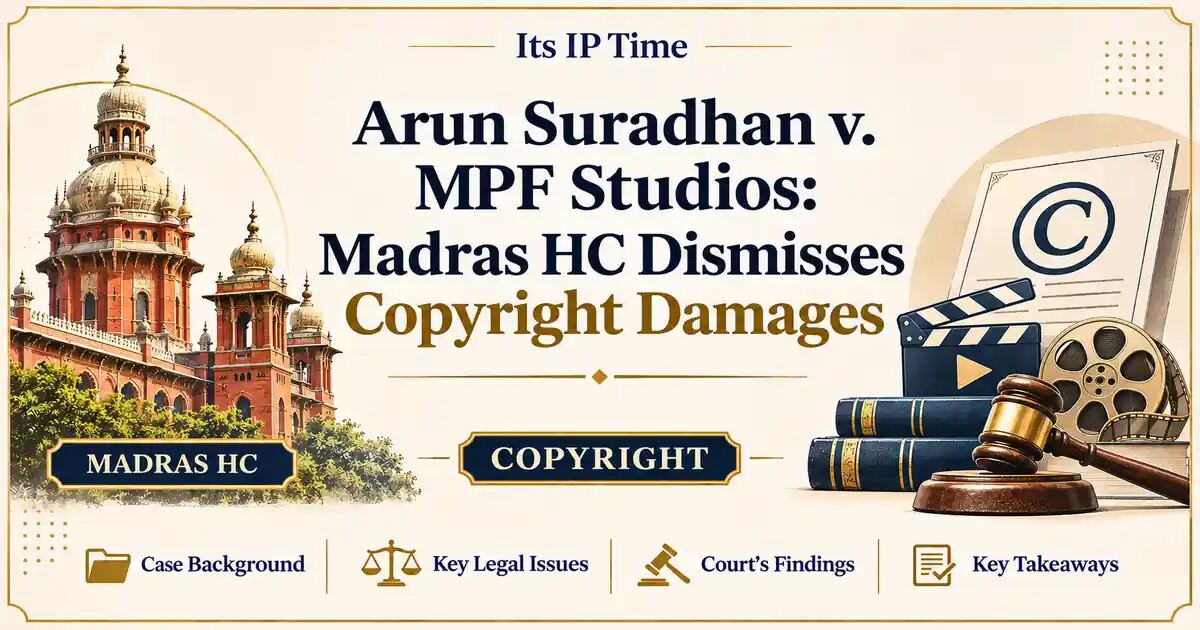
In Arun Suradhan Vs M/s.MPF Studios [CS.2/2017], the Madras High Court dismissed the suit for damages, holding that the plaintiff’s failure to substantiate the quantum of loss through rigorous evidentiary compliance and proper pleadings rendered the claim unsustainable, despite the clear subsistence of copyright ownership in the underlying musical work.
| Core Parameter | Case Analysis |
|---|---|
| Disputed Subject Matter | Unauthorized usage of musical work in advertising media post-expiry of license. |
| Primary Legal Conflict | The intersection of copyright duration under Section 14 and the burden of proving quantum of damages in civil litigation. |
| Plaintiff’s Position | Damages are a consequential right following the admitted breach of the Commercial Music Contract Agreement (CMCA). |
| Defendant’s Position | Lack of privity, failure to prove loss, and invocation of the doctrine of acquiescence due to continued negotiation. |
| Procedural Outcome | Suit dismissed against the first defendant; second defendant matter settled prior to judgment. |
The Doctrinal Clash of Contractual Lifecycle and Copyright Protection
New to Indian Copyright Law? Start with our comprehensive Copyright Law Guide.
The judicial determination in Arun Suradhan illuminates the friction between statutory copyright protection and the contractual constraints of commercial licensing. At the heart of the litigation lay the CMCA and the subsequent Amended CMCA, which established a fixed window of commercial exploitation for the plaintiff’s musical compositions. When that window closed on 03.11.2015, the legal character of the defendants’ continued usage shifted from authorized licensed exploitation to actionable copyright infringement.
From an intellectual property standpoint, the Plaintiff’s right is essentially a Right in Rem. However, the litigation strategy faltered by conflating the enforcement of this right with the recovery of unliquidated damages. The Court’s analysis underscores the necessity of distinguishing between the statutory right to sue for infringement and the evidentiary burden of proving actual loss. While the defendants’ continued use of the musical work post-expiry was factually established, the failure to reconcile this with the specific terms of the agreements allowed the defense to successfully pivot toward a lack of provable loss.
Evidentiary Forensics and the Failure of Pleadings
A critical, if not fatal, deficiency in the plaintiff’s case was the reliance on documents that were entirely absent from the initial plaint. In commercial litigation, the “surprise” introduction of evidentiary materials during the examination of witnesses is a high-risk strategy that rarely withstands scrutiny in the Madras High Court’s IP Division. The reliance on Ex.P17, the offer letter from M/s. Dazu Entertainment, without pleading it in the original cause of action created a procedural chasm.
The Court applied a standard of strict scrutiny to these materials. The inability of the witness (PW2) to substantiate the commercial reality of the transaction with his client, or even identify the client for whom the music was supposedly intended, signaled to the Bench that the claim for Rs. 26,00,000 was speculative.
Under the Indian Evidence Act and the Code of Civil Procedure, a plaintiff seeking damages must adhere to the rule of specificity in pleadings. Speculative claims regarding lost business opportunities must be anchored by contemporaneous records, failing which the claim remains a mere assertion rather than a provable financial loss.
Verbatim Judicial Observations: Evidentiary Standards
The Court’s evaluation of witness testimony serves as a definitive guide for IP counsel on the necessity of substantive witness preparation and cross-examination readiness. Regarding the disconnect between the witness claims and documentary evidence, the Court observed:
Even though, the PW2 claimed that the music that was to be composed by the plaintiff was for the use of his client, when cross-examined on the details of the client, the PW2 had specifically answered that he do not know who the client was. In that regard, this Court is of the view that the plaintiff had not substantiated by any evidence that it had suffered damages and claim by it particularly to the tune of Rs. 26,00,000 as quantified by it.
Hon’ble Mr. Justice K. Kumaresh Babu, Madras High Court
The Bench further emphasized the procedural sanctity of the plaint as the definitive document defining the scope of the dispute:
Even though, the plaintiff had led PW2 and relied upon Ex.P17, as rightly pointed out by the learned counsel appearing for the defendants, the pleadings in his plaint had not pleaded the facts relating to the arrangement between it and M/s. Dazu and Ex.P17 also did not form part of the plaint documents. In that regard, this Court is of the view that the plaintiff is not entitled for damages as claimed by him.
Hon’ble Mr. Justice K. Kumaresh Babu, Madras High Court
Strategic Inadequacies in Intellectual Property Litigation
The litigation highlights a recurring failure in IP matters: the assumption that proof of infringement automatically leads to an award of substantial damages. This is a hazardous assumption. In Indian jurisprudence, the Court is not inclined to award damages based on conjecture. The Plaintiff sought a substantial sum without a valuation report or concrete proof of market erosion caused by the infringement.
For the defense, the strategy of focusing on the “approbating and reprobating” conduct of the plaintiff was highly effective. By engaging in ongoing price negotiations with the defendants after the expiry of the license, the plaintiff diluted the assertion that the infringement was a singular, catastrophic event resulting in loss of reputation. The defense correctly positioned these negotiations as a form of acquiescence, which, while not negating the underlying copyright, effectively eroded the argument that the plaintiff was entitled to the exorbitant damages initially claimed.
Corporate Due Diligence and License Lifecycle Management
The involvement of a large IT corporation as the second defendant highlights the risks inherent in sub-licensing and agency-based creative workflows. Even in cases where the primary contract exists between the composer and an advertising agency (the first defendant), the corporate client remains vulnerable to secondary liability. The fact that the second defendant had to eventually settle the matter demonstrates that the chain of custody for intellectual property rights is only as strong as its weakest link.
For in-house counsel, this case should serve as a wake-up call to tighten the following internal controls:
- Centralized Asset Tracking: Every creative work, from musical compositions to graphic design, must be tracked in a unified ledger that includes the expiry date of the license. The classification of a video as “private” on platforms like YouTube is not an effective legal defense if the asset remains in the company’s possession and accessible to authorized parties.
- Due Diligence on Creative Agency Workflow: When onboarding creative partners, counsel must ensure that agreements mandate the disclosure of all sub-licenses and sub-licensing durations. The failure of an agency to renew a license is a breach for which the agency must be held contractually liable through robust indemnification.
- The “Notice-Response” Protocol: In the event of a copyright notice, the legal team should immediately verify the status of the underlying license. Delaying this process or relying on informal communications with agencies often creates an evidentiary trail of negligence that is difficult to overcome during litigation.
Also Read: Universal City Studios v. Dembed2: Delhi HC Orders Dynamic Injunction
Key Precedents & Statutory Guidance
- Search recent High Court judgments in our Latest Indian IP Law Cases Directory.
- Examine core statutory doctrines in our Indian Copyright Law Guide.
- In-Depth Guide: Customs IP Recordal in India & ICER Portal Procedures.
- Catch up in 2 minutes with our latest Weekly Indian IP Law Digest: November 15 to 21, 2026 | Its IP Time (or browse the Weekly IP Digest Archive).
- Review nationwide litigation trends in our Latest Monthly IP Law Roundup.
Procedural Rigidity as a Gatekeeper
The Court’s stance in Arun Suradhan mirrors a broader trend toward judicial strictness in civil proceedings. The “Order XXXIX” approach to interim relief, which often focuses on the balance of convenience, is distinct from the final judgment stage where the “preponderance of probability” must be backed by the “pleadings of the parties.”
The Plaintiff’s attempt to introduce the M/s. Dazu Entertainment arrangement late in the day was treated as an effort to circumvent the fundamental tenets of the Code of Civil Procedure. This serves as a cautionary tale: evidence, no matter how compelling it may appear to the claimant, is subordinate to the pleadings. If a fact is not part of the initial cause of action, attempting to squeeze it into the trial process via testimony will lead to a rejection of the evidence.
Ultimately, the dismissal of the suit is a reaffirmation that the law of copyright, while protective of creative ownership, is not a mechanism for extracting wealth from corporations without a strict, demonstrated causal link to actual pecuniary loss. The Court’s decision is a balanced approach that protects the sanctity of the copyright but prevents the abuse of the litigation process through inflated and unproven financial claims. Practitioners must prioritize the development of a comprehensive, evidence-backed case at the point of filing, rather than relying on the hope that discovery or testimony will bolster an underdeveloped claim for damages. In the High Court, as in other premier forums, the strength of the remedy is entirely dependent on the rigor of the initial filing.
Case Details: Arun Suradhan Vs M/s.MPF Studios | Case Number: CS.2/2017 | Court: Madras High Court | Date: 2026-11-04
Presiding Bench: Hon’ble THE HON’BLE MR.JUSTICE K.KUMARESH BABU
Appearances: For Plaintiff(s): Mrs.V.Saradha Vivek (BFS Legal) | For Defendant(s): Mr.Ashwin Shanbhag