Introduction: The Generative AI Ingestion Dilemma
Struggling with AI & Intellectual Property Law principles? Explore our complete AI & IP Law Guide.
Generative Artificial Intelligence has challenged the status quo in respect of information creation, processing, and consumption. Large language models (LLMs) can rapidly generate text, summarise documents, answer questions, and assist with complex research. Behind these capabilities lies an intensive computational process in which training a foundation model requires ingesting vast volumes of digital data, including books, academic articles, journalistic reports, websites, photographs, artwork, and software code. As part of this training pipeline, ephemeral and permanent copies of protected works are routinely made and stored to enable neural networks to extract syntactic, semantic, and visual patterns. This poses a fundamental dilemma for copyright law: under what legal parameters may an AI system ingest copyrighted material without express statutory authorization?
Training generative AI models raises a tension between technological development and copyright protection. If every copyrighted work used in AI training requires individual permission, large-scale computational analysis could become considerably more difficult. On the other hand, allowing unrestricted copying could impact the commercial interests of authors, publishers, journalists, and other copyright owners.
A legal mechanism that has emerged internationally to address this problem is Text and Data Mining (TDM). TDM broadly refers to the automated computational analysis of large quantities of text, data, or other digital material to identify patterns, trends, and relationships. Because this process normally involves making copies of the material being analysed, a number of jurisdictions have introduced specific copyright exceptions for TDM.
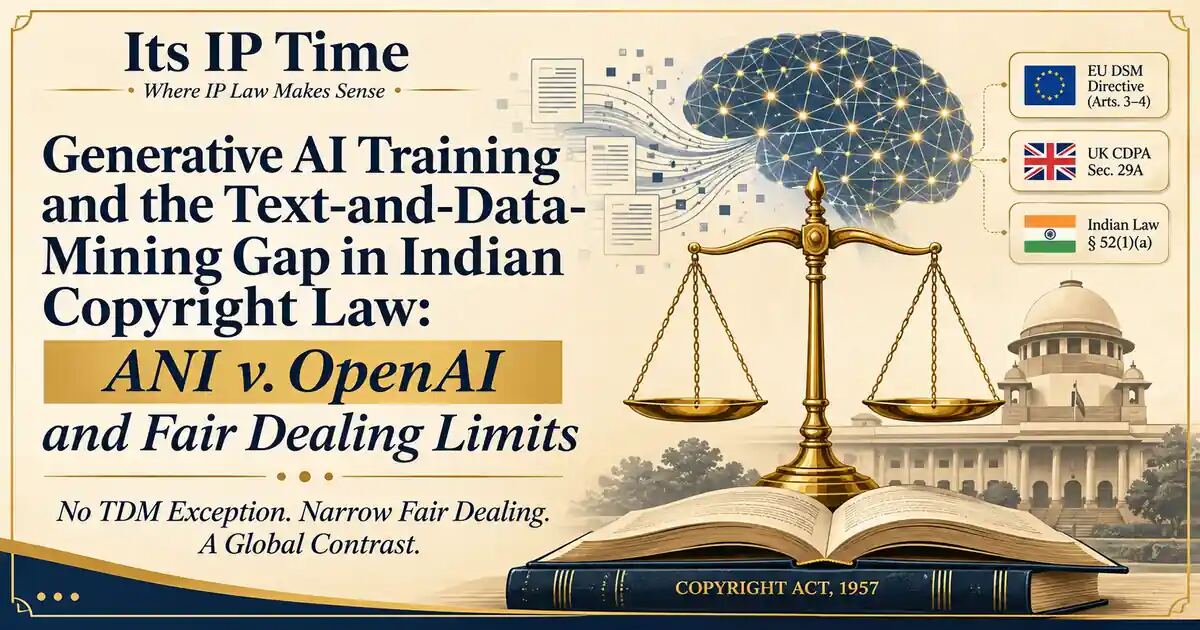
The European Union has created express TDM exceptions through Articles 3 and 4 of its Digital Single Market Directive, whereas the United Kingdom maintains a more confined exception under Section 29A of the CDPA for non-commercial research. India, however, lacks a dedicated statutory TDM exception. Consequently, computational training on protected works must be evaluated through the traditional, rigid fair dealing framework of Section 52(1)(a) of the Copyright Act, 1957, raising profound doctrinal uncertainty for domestic innovation under artificial intelligence and copyright law.
This gap has become increasingly significant with the expansion of generative AI. The question is no longer simply whether copyright law protects a particular article, book, or image. It is also whether that protected material may be copied and computationally analysed as part of the process of developing an AI system.
Recent Indian litigation, particularly ANI Media Pvt. Ltd. v. OpenAI OpCo LLC, has brought this question directly before the courts. The Delhi High Court proceedings represent an important initial step in exploring this boundary, though the broader legal issues remain subject to ongoing judicial and appellate determination.
Comparative International Benchmarks: TDM Exceptions in the EU and UK
The approaches adopted by the European Union and the United Kingdom demonstrate two distinct ways in which copyright law can accommodate computational analysis.
The European Union: Articles 3 and 4 of the DSM Directive
The European Union introduced specific TDM provisions through the Directive on Copyright and Related Rights in the Digital Single Market (Directive 2019/790).
Article 3 creates a mandatory exception for text and data mining undertaken by research organisations and cultural heritage institutions for scientific research, where those entities have lawful access to the works being analysed. It also permits copies made for the purpose of such research to be retained securely for scientific study and verification of research results.
Article 4 establishes a broader commercial TDM exception. It allows reproduction and extraction for TDM where works have been lawfully accessed, subject to the copyright holder’s ability to expressly reserve their rights (opt-out) through machine-readable means.
The EU framework therefore recognises an important practical reality: computational analysis may require technical reproduction, but that copying does not necessarily share the same economic purpose as copying a work for ordinary expressive consumption.
The EU model attempts to accommodate both interests by permitting automated analysis under defined conditions while preserving mechanisms for copyright owners to license or protect their works.
This approach is particularly relevant to generative AI because it provides statutory provisions specifically tailored to automated analysis, rather than requiring courts to stretch analog-era copyright concepts over machine-learning architectures.
The United Kingdom: Section 29A CDPA and Non-Commercial Research
The United Kingdom adopts a narrower approach. Section 29A of the Copyright, Designs and Patents Act 1988 permits copies of copyright works to be made for computational analysis as part of TDM, provided the purpose is non-commercial research and the researcher has lawful access to the underlying material.
The UK framework places considerable emphasis on the commercial character of the activity. Large-scale commercial AI training does not automatically fall within this non-commercial research exception.
The distinction between the EU and UK approaches is significant. The former provides a broader framework covering commercial entities subject to rights-holder opt-outs, while the latter’s statutory safe harbor remains strictly confined to non-commercial research. The UK Government itself has recognized this divergence as it evaluates whether its domestic framework remains fit for purpose in the generative AI era.
These international benchmarks demonstrate that there is no singular global consensus on AI training exceptions. Different jurisdictions have struck distinct balances between academic research, technical innovation, lawful access, and the economic interests of creators.
India’s Statutory Vacuum on Text and Data Mining
There is expressly no exception in India’s Copyright Act, 1957 specifically addressing text and data mining. This creates legal complexity because the Act grants copyright owners exclusive rights to reproduce and exploit their works, while Section 52 sets out exhaustive categories of acts that will not amount to copyright infringement.
Section 52(1)(a) of the Act permits fair dealing with a work, other than a computer programme, for the purposes of private or personal use, including research; criticism or review; and the reporting of current events and current affairs. The provision also addresses electronic storage of the work for those specified purposes.
What the statutory provision does not explicitly address, however, is any of the following:
- Text and data mining;
- Machine learning;
- Artificial intelligence training;
- Large language models; or
- Computational analysis of large datasets.
This statutory silence presents a major interpretative challenge. Conventional research typically involves an individual human scholar studying materials for a specific inquiry. Generative AI training, by contrast, relies on the automated computational ingestion of massive digital corpora.
The lack of a standalone statutory exception raises fundamental questions: Can the computational training of an AI model qualify as “research”? Does the commercial character of an AI developer preclude the research exception? Does the quantitative scale of copying affect the fairness of the dealing? And how much weight must be attached to the economic interests of copyright owners when their works are ingested into training sets?
These issues have gained increased significance amid mounting legal disputes between AI developers and content owners worldwide.
Government Perspective: The Indian Government Working Paper (2025) on Generative AI & Copyright acknowledges this problem. In the working paper, the Government examines the implications of India’s missing TDM exception and explores how to incentivize copyright creation while facilitating domestic AI research.
Thus, the silence of the law in India cannot be interpreted as an explicit statutory ban on AI training. Instead, there is simply no dedicated statutory provision authorizing the copying of copyrighted works for the purpose of TDM or AI training.
Section 52(1)(a) Fair Dealing as an Imperfect Workaround
Where no specific TDM exception exists, parties and courts must look to the general fair dealing provisions in Section 52.
Unlike the open-ended fair use doctrine in the United States, Indian fair dealing does not extend to any activity simply because it is socially beneficial or technologically innovative. The use must fall squarely within one of the exhaustively enumerated statutory purposes in Section 52(1)(a), and the dealing must independently meet established standards of fairness.
Consequently, establishing that AI training is beneficial or novel does not automatically resolve the legal inquiry. The statutory purpose must be satisfied, and the specific dealing must be judged fair on its procedural and economic merits.
Judicial Reckoning: The Significance of ANI Media v. OpenAI
In ANI Media Pvt. Ltd. v. OpenAI OpCo LLC, ANI alleged that OpenAI utilized its copyrighted news articles without permission to train ChatGPT, resulting in copyright infringement. The litigation brought fundamental questions regarding the ingestion of protected works for AI training directly before the Delhi High Court, testing whether Section 52 could shelter large-scale model training.
In evaluating the dispute, the Delhi High Court considered whether the potential storage of ANI’s journalistic works for training ChatGPT’s models could constitute private or personal use, or at least be justified as research or study under Section 52(1)(a)(i).
The Court adopted a two-fold approach: first, examining whether the storage and processing fell within one of the enumerated statutory purposes; second, determining whether the dealing could be considered fair.
With regard to purpose, the Court indicated that training large language models could arguably be included within the scope of ‘private or personal use, including research’ under Section 52(1)(a)(i). The Court noted that the concept of research should not be confined exclusively to activities directly conducted by a human researcher, acknowledging the computational nature of machine learning.
The Court then turned to whether the dealing was fair, recognizing that fair dealing is not statically defined in the Copyright Act and must be evaluated through established judicial benchmarks.
This decision represents a landmark development as one of the first Indian rulings to navigate the parameters of fair dealing in the context of AI training. However, it would be premature to interpret the interim proceedings as establishing an unqualified exemption for generative AI training in India. The order arose in specific interim procedural circumstances, and the broader questions regarding commercial deployment, legitimate access, market competition, and rights-holder protections remain subject to ongoing judicial consideration.
Why Fair Dealing Cannot Resolve the Structural AI Training Dilemma
Relying on fair dealing to address AI training offers an obvious short-term advantage: it allows courts to apply an existing statutory mechanism without waiting for legislative reform.
Yet it introduces substantial uncertainty. AI training operates at an entirely different scale and operational logic than traditional scholarship. A commercial AI developer may process millions of copyrighted works simultaneously, encompassing works by thousands of authors and publishers across diverse domains.
This structural reality raises complex legal questions:
- Purpose: Whether developing a commercial foundation model can legitimately qualify under the statutory concept of research.
- Scale: Whether copying vast digital datasets remains fair merely because the downstream activity involves computational analysis.
- Market Impact: Whether AI systems providing information or synthetic content similar to that of copyright owners will impair existing commercial markets.
- Lawful Access: Whether training requires a verified right of lawful access, and whether bypassing technical barriers negates fair dealing.
- Outputs: How to doctrinally distinguish intermediate computational copying during training from model outputs that reproduce substantial expression.
These questions demonstrate that while judicial interpretation provides valuable guidance, case-by-case litigation cannot fully resolve the structural ambiguity surrounding commercial training datasets.
A specific statutory TDM exception would establish definitive legal clarity regarding lawful access standards, commercial versus non-commercial use, rights-holder opt-outs, and statutory remuneration, providing certainty for innovators and creators alike.
Conclusion: The Imperative for a Statutory TDM Framework in India
Generative AI has revealed a distinct gap between the technical realities of machine learning and the statutory language of traditional copyright legislation. The European Union and the United Kingdom have addressed this challenge through tailored TDM provisions, adopting different balances on research scope, commercial activity, and creators’ rights.
India has not yet enacted a comparable statutory TDM exception. Instead, the Copyright Act, 1957 must be interpreted through existing exceptions such as Section 52. The recent ANI Media v. OpenAI proceedings demonstrate that courts are willing to examine whether fair dealing can accommodate modern computational techniques.
Yet the broader legislative challenge remains.
A future Indian framework will likely need to provide comprehensive statutory clarity regarding the use of protected works in AI training, particularly addressing lawful access, commercial foundation models, opt-out mechanisms, licensing structures, and AI-generated outputs.
The policy objective is not simply to permit or prohibit AI training. The deeper task is to define the legal terms under which copyrighted material may be used in developing AI systems, preserving technological innovation while safeguarding the legitimate rights of creators.
For Indian copyright law, the TDM gap represents more than an absent statutory clause. It reflects a fundamental transition: adapting an IP regime designed primarily for human authors and human readers to a digital environment where autonomous algorithms process, learn from, and synthesize content at an unprecedented scale.
Until Parliament enacts a dedicated framework, courts will continue to shoulder the burden of applying analog-era copyright principles to machine learning. The question is no longer whether artificial intelligence will challenge copyright law, but how effectively copyright law can adapt without abandoning the creative incentives it was built to sustain.
Key Precedents & Statutory Guidance
- Search recent High Court judgments in our Latest Indian IP Law Cases Directory.
- Examine core statutory doctrines in our AI & Intellectual Property Law Guide.
- In-Depth Guide: AI Copyright Infringement & Training Data Legality in India.
- In-Depth Guide: Personality Rights & Character Merchandising under Indian IP Law.
- Catch up in 2 minutes with our latest Weekly Indian IP Law Digest: November 15 to 21, 2026 | Its IP Time (or browse the Weekly IP Digest Archive).
- Review nationwide litigation trends in our Latest Monthly IP Law Roundup.
References
- Government of India, The Copyright Act, 1957 (Act No. 14 of 1957), Section 14 (Exclusive rights), Section 51 (Infringement), and Section 52(1)(a) (Fair dealing exemptions), India Code.
- European Parliament and Council of the European Union, Directive (EU) 2019/790 on Copyright and Related Rights in the Digital Single Market (DSM Directive), Articles 3 and 4 (Text and data mining exceptions and rights reservation).
- United Kingdom Intellectual Property Office (UK IPO), Copyright, Designs and Patents Act 1988 (CDPA), Section 29A (Copying for text and data analysis for non-commercial research).
- Department for Promotion of Industry and Internal Trade (DPIIT), Ministry of Commerce and Industry, Government of India, Working Paper on Generative Artificial Intelligence and Copyright Framework.
- Delhi High Court, ANI Media Pvt. Ltd. v. OpenAI OpCo LLC & Ors., CS(COMM) 1039/2024 (Examining copyrighted news ingestion for LLM training and fair dealing boundaries).