Introduction to Character Merchandising
Struggling with Indian Copyright Law principles? Explore our complete Copyright Law Guide.
The Harry Potter T-shirt, my Hello Kitty mug, those new limited-edition running shoes, and BTS merchandise I just purchased were not bought solely for utility but because of the characters and personalities that endorsed them. These products are the result of the creative expression and labour that a person has put into building their popularity and recognition, these, in turn, become commodities.
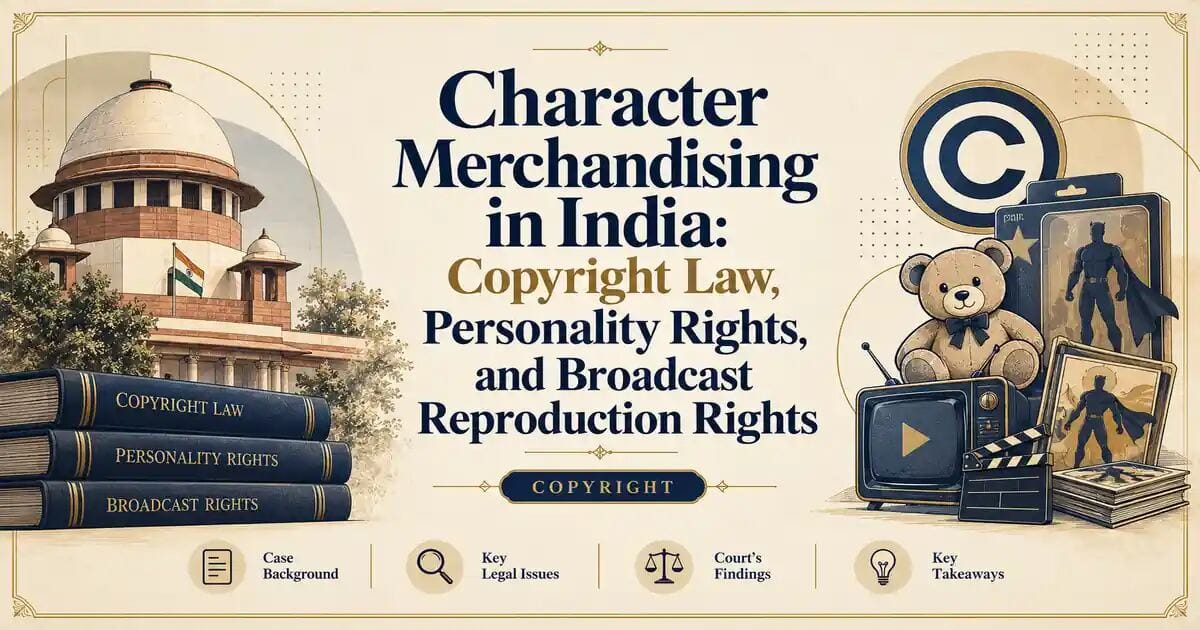
Character Merchandising as defined by the World Intellectual Property Rights Organisation (WIPO) is “the adaptation or secondary exploitation, by the creator of a fictional character or by a real person or by one or several authorized third parties of the essential personality features (such as the name, image, or appearance) of a character, in relation to various goods and/or services with a view to creating in prospective customers a desire to acquire those goods and/or to use those services because of the customers’ affinity with that character.”
Merchandising can attach to fictional characters like Sherlock Holmes, and Spiderman as much as to real personalities like Salman Khan; and Virat Kohli. The commercial value being protected is not the underlying copyrighted work itself, but the goodwill and recognition the character or persona has independently acquired, which courts often call its “commodity value.” India has no standalone merchandising statute, it protected through a patchwork of copyright, trademark, and common-law passing-off principles, stitched together by judicial interpretation.
Character merchandising has experienced exponential expansion and profits as commercial markets decided to create characters and sell them in the form of clothing, costumes, prints of characters on clothing; and famous dialogue from any movie or series, in order to popularise goods. The whole aspect of merchandising is encashing on this ‘marketing factor’ which plays a dominant role in the purchasing process.
Legal Basis Under the Copyright Act
A character can be understood as a fictional character, a non-human character, or a real personality. No country or internationalational treaty has enacted a sui generis legislation specific to Character Merchandising. Likewise, in India the Copyright Act, 1957, has no express mention of “character merchandising,” but several of its provisions are pressed into service to protect it.
Under Section 2(c) a painting, a sculpture, a drawing, an engraving or a photograph, whether or not any such work possesses artistic quality, the copyright owner holds the exclusive rights under Section 14 including the right to reproduce, adapt, and communicate the work to the public. Therefore, an unauthorised use of the character’s likeness amounts to reproduction of a substantial part of a copyrighted artistic work. Indian courts have been cautious about exceeding the threshold of real merchandising, so as to not readily give copyright protection to characters, unless there is a presence of actual commercial exploitation.
In Star India Pvt. Ltd. v. Leo Burnett (India) Pvt. Ltd., Star India, which held rights in the widely recognised television serial Kyunki Saas Bhi Kabhi Bahu Thi, sued an advertising agency over a Tide detergent commercial titled “Kyunki Bahu Bhi Kabhi Saas Banegi,” alleging that its scene and character types had been copied to falsely imply endorsement and that an average viewer would mistakenly believe that there was a business connection between the TV serial and the detergent..
The Bombay High Court dismissed this claim, by saying that the characters depicted in the advertisement were generic Indian household archetypes rather than the plaintiff’s distinctive creation, and significantly that no actual character merchandising exercise (i.e., no licensing of the characters themselves onto goods) had taken place. The court coined the term ‘originality’ and that they should come under section 17 of the Copyright Act. The plaintiff’s film work was of 262 episodes and the defendant’s advertisement was about 10 seconds, therefore no comparable situation, therefore held it not to be a substantial copyright infringement. The court explained that merchandising involves exploiting fictional characters or celebrity personas by licensing them once the character has developed independent commodity value, and copyright infringement requires substantial copying of protectable expression, not merely similar ideas or stock character types.
In Disney Enterprises & Anr. v. Santosh Kumar & Anr., the Delhi High Court ruled that the defendants were defendants were liable for selling variety of stationary items using globally prominent disney characters such as Hannah Montana, Winnie the Pooh, whose merchandising rights were owned by the plaintiffs (Disney Enterprises Inc. & another). The court determined that as a result of this, there has been a strong bond formed between the plaintiffs and the aforementioned figures, and that any mention of these characters only brings up images of the plaintiffs in the minds of the general public. Plaintiffs’ have also established that defendants were engaged in the sale and distribution of goods with a mala fide intent to pass off their goods and to cash upon the goodwill and reputation enjoyed by the plaintiffs in their trademarks and copyrights in the said characters.
Broadcast Reproduction Rights (Section 37)
Broadcasting organisations are not authors in the classical sense and are granted separate but related rights that protects them through “broadcast reproduction rights” under Chapter VIII of the Copyright Act. This is a neighbouring or related right distinct from copyright. The underlying literary, musical, or cinematographic content of the broadcast is created specifically to protect the broadcaster’s investment in the communication of content to the public by wireless diffusion or wire, including satellite transmission.
Section 37(1) of the Copyright Act provides that every broadcasting organisation has a special right (broadcast reproduction rights). Section 37(2) states that this right subsists for 25 years from the beginning of the calendar year following the year of broadcast. This is considerably shorter than the term for most copyrighted works, reflecting this right’s narrower, transmission-specific nature. This is five years above the minimum standard set by the Rome Convention 1961 and the Trips Agreement 1994 (both minimum 20 years). India is a signatory only to the Trips Agreement, exceedingly fulfilling its international obligation.
Section 37(3) sets out infringement. During the subsistence of the right, a person acting without licence from the broadcaster commits infringement by carrying out the actions laid down in the provision.
Section 39 carves out exceptions, that do not infrine on broadcast reproduction rights or performers’ rights, i.e., acts like making use of any sound recording or visual recording for private use. This must be consistent with fair dealing, for bonafide review, teaching/research purposes, and any acts with necessary adaptations and modifications that do not constitute infringement under section 52.
Licensing & Contractual Structures
Character merchandising sits at the intersection of several statutory rights and the commercial reality is governed less by litigation and more by consciously and effectively executed licenses to cull out the best results. It is a practise where Intellectual Property holders, such as creators and companies execute license agreements to authorise the use of characters, both registered and unregistered, on various commercial goods and services or to legally prevent third parties from using the characters, without authourisation.
Just like no country has a specific Character Merchandising statute, even its licensing structure is solely covered under general IP licensing. One way is through Section 49 of the Trademarks Act, where the licensor has absolute control to determine the quality of items and services linked to the their trademark, (1) the registered proprietor and the proposed registered user shall jointly apply in writing to the Registrar in the prescribed manner, and every such application shall be accompanied by (a) the agreement in writing or a duly authenticated copy thereof, entered into between the registered proprietor and the proposed registered user with respect to the permitted use of the trade mark; and (b) an affidavit made by the registered proprietor or by some person authorised to the satisfication of the Registrar to act on his behalf. Section 57 provides for remedies from infringement through court ordered protection like injunction as compensation and removal of the improper trademark from the trademark register.
Merchandising agreement is still a grey area, as it is quite similar to a licensing agreement. A typical merchandising agreement would address; Firstly, the scope of the licensed rights, whether the licence covers copyright in the artistic work, trademark rights in the name/logo, and/or publicity rights in an associated real person, since each requires separate authorisation. Secondly, the territorial extent and duration, often shorter than the underlying IP term (25 years in India), with renewal options tied to the continued popularity of the character. Thirdly, that the product category exclusivity of a licence for apparel does not extend to toys or food packaging unless expressly granted. Fourthly, quality control clauses, allowing the licensor to approve designs before manufacture, since poor-quality merchandise can dilute the character’s goodwill. Fifthly, royalty structures based on a percentage of wholesale or retail sales, with minimum guarantees. Sixthly, broadcast-linked clearances, where merchandise uses stills or footage from a television broadcast, requiring separate clearance from the broadcaster under Section 37 in addition to the copyright owner’s consent.
Practical Guidance for Rights Holders
The most important advice would be to register early and across classes. Trademark registration for a character’s name and likeness, filed across the Nice Classification classes relevant to anticipated merchandise, provides protection independent of and often stronger than copyright. For practitioners, the operative lesson from the case law is that courts look for actual, demonstrable commercial exploitation and likely consumer confusion, not merely the fame of the underlying work before granting relief. Lawyers therefore advise creators and business owners to register their ideas under the respective IP laws.
Conclusion
Character merchandising and broadcast reproduction right highlights the growing commercial value of characters, personalities, and media content. India does not yet have a specific governing character merchandising and may eventually need one, however, for now, protection is available through existing IP laws copyright, trademark, passing-off principles and contraactual licensing.
Key Precedents & Statutory Guidance
- Search recent High Court judgments in our Latest Indian IP Law Cases Directory.
- Examine core statutory doctrines in our Indian Copyright Law Guide.
- Procedural Breakdown: Section 57 Trademark Rectification: Grounds, Jurisdiction & Procedure.
- Review nationwide litigation trends in our Monthly IP Law Roundup.
References
- The sailor, the turtle and the jungle man – striking the balance between protection and public domain in fictional character merchandising , Entertainment and Sports Law Journal available at https://www.entsportslawjournal.com/article/id/822/
- Character Merchandising: International Experience And Indian Perspective, Raman Mittal available at <https://lesi.org/wp-content/uploads/2024/04/character-merchandising-international-experience-and-indian-perspective.pdf>
- Character Merchandising and Copyright: An Analysis SS Rana & Co https://www.lexology.com/library/detail.aspx?g=463bb451-7b6a-4c32-8377-c8993a4c83c7
- The Copy Right Act, 1957 https://copyright.gov.in/documents/copyrightrules1957.pdf
- Star India Private Limited vs Leo Burnett (India) Private Limited on 24 September, 2002 https://indiankanoon.org/doc/1271015/
- Disney Enterprises Inc & Anr. vs Santosh Kumar & Anr. on 23 May, 2014 https://indiankanoon.org/doc/187470521/
- Agreement on Trade-Related Aspects of Intellectual Property Rights
- (unamended) World Trade Organization https://www.wto.org/english/docs_e/legal_e/27-trips_01_e.htm
- Rome Convention for the Protection of Performers, Producers of Phonograms and Broadcasting Organizations, WIPO https://www.wipo.int/en/web/treaties/ip/rome/index
- MERCHANDISE RIGHTS: A GREY AREA UNDER IPR LAWS Lexport | Advocates and Legal Consultants https://www.linkedin.com/pulse/merchandise-rights-grey-area-under-/
- The burgeoning Saga of Character Merchandising- instances and legalities, SS Rana & Co https://ssrana.in/articles/the-burgeoning-saga-of-character-merchandising-instances-and-legalities/