
This is a guest post by Abha Gupta, who is a practicing Advocate with a keen interest in IP law. The views and analysis expressed here are her own.
Introduction
New to Trademark Law? Start with our complete Trademark Law Guide.
Imagine you pour everything into your start-up. You have the perfect name, a logo you love, and you are eager to share it with the world. Then reality hits. You apply to register your mark and discover that somebody already has superior rights in a nearly identical mark. Now you are sitting there trying to figure a way out of the mess.
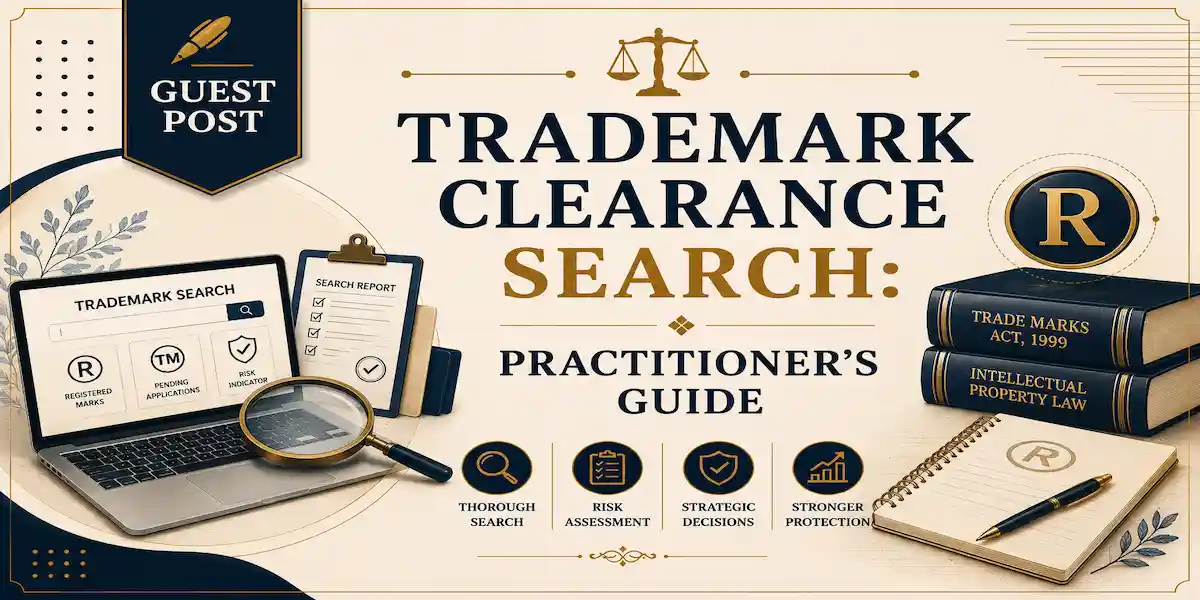
A substantial part of my work as a trademark practitioner is identifying this problem early. In IP, we call it running a clearance search for the proposed mark. A proper trademark search goes beyond Google. It involves a deep dive into the similarity search on the official trademark database of the relevant jurisdiction, the global trademark database, and across various online platforms. This sounds simple on the surface, but the result is only correct if you get the decisions right at each step, because one wrong call can cost somebody their business name.
Why the comparison matters at the registration stage
The search report is not an antidote to litigation. It is a way of identifying threats early and taking measures that minimise damage and reduce risk. The process is primarily about predicting whether an examiner, applying Section 11 of the Trademarks Act or its equivalent in another jurisdiction, is likely to raise an objection on the basis of likelihood of confusion with an existing mark. Your mark might clear the formality check easily but still fail to establish that it is not confusingly similar to a cited mark. A clearance search saves you from that surprise and from the costs that come with it.
Building the list of marks that actually matter
The starting point is always the official database of the relevant jurisdiction. Each database has a different interface. Some require you to log in, some require an account, and some are open access. You search for marks identical to yours, same name, similar appearance, and so on. But the search does not end there.
A comprehensive search means checking different variants of your mark, because the risk is not only from identical marks but also from marks so similar that the public might get confused about the source of the goods or services. And it is not as simple as putting your mark into a search box and getting a clean result. Sometimes you get 5 to 10 results and sometimes the database returns 8,000 or more. That is where the complexity begins. You have to decide what goes into the report and what gets left out.
Standard practice is to filter first on mark similarity, then on Nice classification, then on the specific goods and services if the list is still unmanageable. There is no formula for this. It tests your judgment at every stage. Once you have your shortlist of potentially threatening marks, the analysis begins.
The factors that decide where a mark lands
Every shortlisted mark gets assessed against the same core factors.
The first is similarity of marks, which is the actual basis for an objection on likelihood of confusion. This is not only about visual appearance. It covers visual similarity, phonetic similarity, and conceptual similarity. If two marks share the same words, they are almost certainly a high threat.
When both marks are word marks, the comparison is straightforward because either can be stylised any number of ways. When one mark is a device and one is a word mark, the comparison is somewhat easier because the distinct visual elements generally help distinguish them. Phonetic similarity also matters. “Kat” and “Cat” look a little different but sound identical, and that is enough to create confusion. Conceptual differences can also be argued where marks are otherwise similar, and coined or arbitrary terms tend to have an advantage here.
The second factor is goods and services, and in my experience this carries the most weight. Identical or closely related goods moving through the same trade channels raise the risk significantly, while unrelated goods reduce it. Nice classification matters, but it is not the whole answer. Marks in the same class can still cover quite different goods, which brings the risk down, and marks in different classes can cover sufficiently related goods that the risk remains real.
The third factor is consumer sophistication, and this is the one that trips people up most often. It certainly took me the longest to internalise. Where consumers are more attentive and make informed purchase decisions, the likelihood of confusion drops. Where goods or services lend themselves to impulse purchases, the risk is higher. That inverse relationship is straightforward in theory but genuinely counterintuitive in practice.
The fourth factor is fame and dilution risk, and this requires going beyond the register. A mark with wide market presence can change the entire analysis even when every other factor points to low risk. Registries tend to give well-known marks expanded protection across unrelated classes. In India, such marks are formally designated as well-known marks under the Trademarks Act. If the mark you are searching against carries that status, the scope of the risk is much broader than classification alone would suggest.
Where the real difficulty sits – The risk band
Analysing each factor individually is the easier part. Weighing them against each other to land on an actual risk level is where judgment is required, and where, if I am being honest, I still make the most mistakes.
An identical mark against identical goods is a clear high-risk call. But if the marks are identical and the goods are highly unrelated, you cannot call it high risk on visual similarity alone, and you cannot call it low risk just because the goods are different. Depending on the other factors, you are somewhere between moderate and moderate-high.
Getting the risk band wrong runs in two directions and both can cost the client. A wrongly flagged mark might push someone to abandon a perfectly registrable name or spend on unnecessary rebranding. A missed threat can result in an objection or opposition. Neither error usually comes from misreading any one factor. It comes from not weighing them together properly.
Also Read: Calcutta HC Returns ITC Plaint for Skipping Section 12A Mediation
Conclusion
A clear search report reflects the register as it stands on the day the search was run, not a guarantee against every future dispute. If your report flags a mark, ask specifically which factor is driving that flag. Targeted advice on that point might save you the cost of full rebranding.
If you are filing across multiple jurisdictions, treat each one separately rather than assuming a clear result in one carries over. The core factors are broadly similar, but the marks on each register are different. WIPO searches help, but individual jurisdiction searches are necessary.
For practitioners doing this work, particularly those newer to it as I am, the discipline that matters most is resisting the pull of any single factor. Identical spelling does not automatically mean high risk. Different spelling does not automatically mean the mark is safe. The risk band comes from reading every factor together against the specific facts of that mark, and that judgment sharpens mainly through doing it repeatedly and being willing to revisit calls that turned out wrong.