Demarcating Jurisdictional Boundaries: The Case Snapshot
New to Trademark Law? Start with our complete Trademark Law Guide.
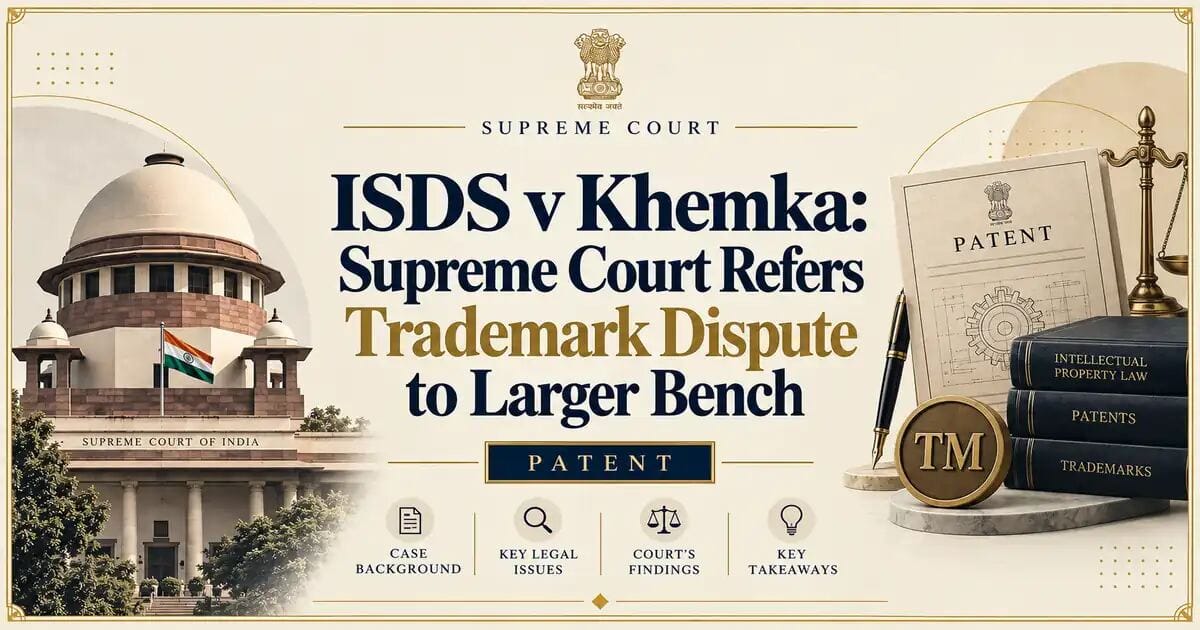
Statutory designations of forum exclusivity under special intellectual property legislation cannot be easily dismantled by delegated state notifications constituting sub-district courts as commercial divisions. In I.S.D.S. Private Limited & Anr. v. M/s Khemka Food Products Pvt. Ltd. & Anr., the Supreme Court of India referred this precise jurisdictional friction to a larger bench while staying the underlying commercial suit. Decided on September 21, 2026, the reference targets an administrative anomaly. This anomaly arises when executive notifications designate the Civil Judge (Senior Division) as a Commercial Court, effectively downgrading the forum designated by Parliament for trademark disputes. Litigants face an absurd choice between statutory forum guarantees and state-level structural consolidation.
By examining the procedural posture, one observes that the dispute emerged from Commercial Suit No. 11 of 2023, which was pending before the Civil Judge (Senior Division)-I at Jamshedpur, Jharkhand. Through this litigation, I.S.D.S. Private Limited challenged the jurisdiction of the sub-district commercial court, asserting that Section 134 of the Trade Marks Act, 1999 (which restricts trademark infringement suits to courts not inferior to a District Court) explicitly forbids any court inferior to a District Court from entertaining such intellectual property actions. Khemka Food Products Pvt. Ltd., conversely, defended the trial court’s authority by pointing to Jharkhand’s notification establishing the Civil Judge (Senior Division) as a competent commercial forum. Consequently, the Division Bench of Justice J. B. Pardiwala and Justice K. Vinod Chandran had to decide whether the Commercial Courts Act, 2015, overrode the statutory minimum forum requirements of the Trade Marks Act, 1999.
The Battle Over Statutory Supremacy: Parties’ Submissions
Arguing for the appellants, learned counsel emphasized that the primary legislative intent behind Section 134 of the Trade Marks Act, 1999, was to ensure that complex intellectual property disputes are exclusively adjudicated by experienced judicial officers at the District Court level. Diluting this parliamentary safeguard via executive notifications under the Commercial Courts Act, 2015, severely prejudices the rights of trademark owners. If suits are forced before a Civil Judge (Senior Division) acting as a Commercial Court, any subsequent appeal must be directed to the District Court, rather than the High Court. Such an appellate structure curtails the litigant’s remedies, restricting subsequent recourse before the High Court to a supervisory challenge under Article 227 of the Constitution of India, which prohibits any re-appreciation of evidence.
Supporting the appellants, the intervener advanced a compelling structural argument regarding statutory construction. Under sub-section (1) of Section 134 of the Trade Marks Act, 1999, the phrase “having jurisdiction to try the suit” refers strictly to territorial parameters and does not dilute the exclusive subject-matter jurisdiction conferred upon the District Court. According to this view, the Trade Marks Act, 1999, stands as a special legislative enactment, whereas the Commercial Courts Act, 2015, functions as a general statute bringing diverse commercial disputes under its broad umbrella. Executive notifications issued by High Courts cannot unilaterally override explicit statutory prohibitions contained within a specialized central enactment. Rights established by Parliament must remain sacrosanct.
Vigorously contesting these assertions, learned counsel for the respondent pointed to Section 2(1)(c)(xvii) of the Commercial Courts Act, 2015, which explicitly includes intellectual property rights relating to trademarks within the definition of “commercial disputes.” Because the Commercial Courts Act, 2015, is a subsequent, highly specialized legislation designed to expedite the resolution of commercial conflicts, its provisions must take precedence. Relying on Section 21 of the Commercial Courts Act, 2015 (which contains a non-obstante clause giving overriding effect to its provisions), the respondent argued that any contrary forum guidelines in earlier statutes must yield.
Deconstructing Precedential Friction: Court’s Analysis
Analyzing the legal conflict, the Supreme Court examined two seemingly divergent lines of precedent. First, the bench examined the landmark decision in Kandla Export Corporation v. OCI Corporation, which addressed whether an appeal barred under Section 50 of the Arbitration and Conciliation Act, 1996 (governing appeals against orders refusing to refer to arbitration or enforce foreign awards) could be salvaged by invoking Section 13(1) of the Commercial Courts Act, 2015. In that case, the Court held that the Arbitration Act constitutes a self-contained, exhaustive code that prevails over the more general provisions of the Commercial Courts Act, 2015. Thus, the subsequent general law did not override the specific limitations of the prior arbitration statute.
Conversely, the Bench confronted its later ruling in Jaycee Housing Private Limited v. Registrar (General), Orissa High Court, which presented a different approach to statutory dominance. There, the Court upheld an Orissa High Court notification designating Civil Judges (Senior Division) as Commercial Courts, ruling that they could entertain applications under Section 34 of the Arbitration Act (governing challenges to arbitral awards). Judicial reasoning in Jaycee Housing held that because the Commercial Courts Act, 2015, was enacted later, the legislature was fully aware of the existing definition of “Court” in Section 2(1)(e) of the Arbitration Act and intentionally chose to override it.
Recognizing the profound tension between these two authorities, Justice J. B. Pardiwala and Justice K. Vinod Chandran sought to reconcile the statutory provisions through a logical “genus and species” analysis. They observed that while the Commercial Courts Act, 2015, covers the broad genus of commercial disputes under its extensive clauses, intellectual property rights constitute a specific species of that genus under Section 2(1)(c)(xvii). Under this formulation, Section 21 of the Commercial Courts Act, 2015, only triggers an override when there is an irreconcilable inconsistency with another statute. If a special statute like the Trade Marks Act, 1999, limits the forum to a District Court, no real inconsistency exists. Conflict only materializes under executive overreach.
“In our humble view too, the Commercial Courts Act deals with the genus of commercial disputes as delineated in clauses (i) to (xxii) of section 2(c) while arbitration is an alternate dispute resolution process, itself a special legislation regulating the procedure. Likewise, intellectual property rights including that of trade marks is only a species [2(c)(xvii)] of the larger genus of commercial disputes.”
Hon’ble Justice J. B. Pardiwala and Hon’ble Justice K. Vinod Chandran
Highlighting the mathematical absurdity of the current system, the Court pointed out the bizarre pecuniary anomalies arising in Jharkhand. Under Section 3 of the Commercial Courts Act, 2015, the pecuniary jurisdiction of the Civil Judge (Senior Division) as a Commercial Court spans from Rs. 3 lakhs to Rs. 1 crore. Consequently, a trademark infringement suit valued below Rs. 3 lakhs must be filed before the District Court pursuant to Section 134 of the Trade Marks Act, 1999, whereas a high-value suit exceeding Rs. 3 lakhs must be filed before the inferior Civil Judge (Senior Division). Such an upside-down jurisdictional hierarchy contradicts basic principles of judicial administration. This structural confusion cannot stand.
The Reference to the Larger Bench: Outcome
Concluding that these structural conflicts require definitive resolution, the Division Bench referred the entire matter to a larger bench of the Supreme Court. Uniformity across states is essential, and jurisdiction cannot be left to the mercy of diverse, fragmented administrative notifications issued by various High Courts. Highlighting legislative supremacy, the Bench declared that executive notifications should not dilute the explicit will of Parliament. Until the larger bench settles this foundational question, the Supreme Court ordered a stay on Commercial Suit No. 11 of 2023, which was pending before the Civil Judge (Senior Division)-I at Jamshedpur.
“We are of the opinion that the matter has to be referred to the Larger Bench for resolving the conflict and also settling the law to be uniform throughout the States and the jurisdiction not to be left to the different notifications issued in the various States. In our humble view the legislative imprimatur cannot be diluted by the notifications issued by the High Courts.”
Hon’ble Justice J. B. Pardiwala and Hon’ble Justice K. Vinod Chandran
Also Read: Karnataka HC Sets Aside Injunction: ‘Section 34’ Protects Prior Users
Strategic Maneuvers for Practitioners: Implications for IP Practice
Strategic planning for intellectual property litigators must immediately account for this pending reference. Practitioners in states like Jharkhand, where Civil Judges (Senior Division) act as Commercial Courts, must evaluate whether their trademark, copyright, or patent infringement actions face jurisdictional challenges. If a plaintiff files a suit valued between Rs. 3 lakhs and Rs. 10 lakhs in a sub-district commercial court, the defendant can immediately exploit this Supreme Court reference to seek a stay of proceedings. To avoid such procedural paralysis, intellectual property attorneys should consider valuing their suits carefully to ensure they are instituted directly in the principal civil court of original jurisdiction.
Beyond these immediate procedural tactics, the judicial trend highlighted in Kerala’s regulatory evolution offers a blueprint for other states looking to resolve this anomaly proactively. Kerala initially designated Subordinate Judge’s Courts as Commercial Courts, but later corrected this mistake by issuing a subsequent notification under Section 3 of the Commercial Courts Act, 2015. This corrective notification designated all District Courts and Additional District Courts as the exclusive Commercial Courts for disputes arising under the Arbitration and Conciliation Act, 1996, the Copyright Act, 1957 (governing registration and ownership of creative works), the Trade Marks Act, 1999, and the Patents Act, 1970 (governing patent grants and enforcement). Corporate legal counsel must monitor state notifications closely to determine if their local jurisdictions are moving toward a similar District Judge-level consolidation.
Ultimately, this referral serves as an important reminder that statutory rights and remedies cannot be administrative victims of judicial dispatch. Losing the right of first appeal to a High Court is a precious statutory privilege that cannot be replaced by a restrictive revision under Article 227 of the Constitution. For trademark owners, maintaining litigation before a senior, experienced District Judge is not a mere procedural preference; it is a substantive safeguard. Litigators must aggressively contest any attempt by respondents or trial courts to dilute these protections through general commercial notifications. Until the larger bench rules, raising robust jurisdictional objections based on Section 134 of the Trade Marks Act, 1999, remains a vital defensive shield for defendants and a crucial planning consideration for plaintiffs nationwide.
Case Details: I.S.D.S. PRIVATE LIMITED VS. M/S KHEMKA FOOD PRODUCTS PVT. LTD | Case Number: SLP(C) No. 6793/2026 | Diary Number 60138 / 2025 | Court: Supreme Court of India | Date: 21-Sep-2026
Presiding Bench: Hon’ble Justice J.b.pardiwala