
Introduction
Want to learn the fundamentals of Trademark Law? Read our complete Trademark Law Guide.
Say your trademark application comes back with an objection citing a registered mark that is, to your knowledge, not in active use, or you are a defendant in an infringement suit and suspect the plaintiff’s mark was fraudulently registered, or you are a business that has been building goodwill in a name for years, only to discover a competitor registered the same term first. In each of these situations, there is one provision you rely on, i.e., Section 57 of the Trade Marks Act, 1999.
Section 57 gives the Registrar and the High Court the authority to cancel, vary, or otherwise correct entries in the Trade Marks Register. It is the statutory mechanism for challenging a registration after the fact, whether on grounds of non-use, fraud, deceptive similarity, or violation of the conditions under which the mark was registered. Most practitioners know it exists. Far fewer know how to use it well, or which court to file in after the abolition of the Intellectual Property Appellate Board.
A June 2026 judgment from the Bombay High Court, Raman Kwatra v. Registrar of Trade Marks, pronounced on 15 June 2026, has added a significant layer to that second question. The Court declined to exercise jurisdiction despite having it, on the ground of forum conveniens. That is a ruling every practitioner handling rectification in 2026 needs to understand.
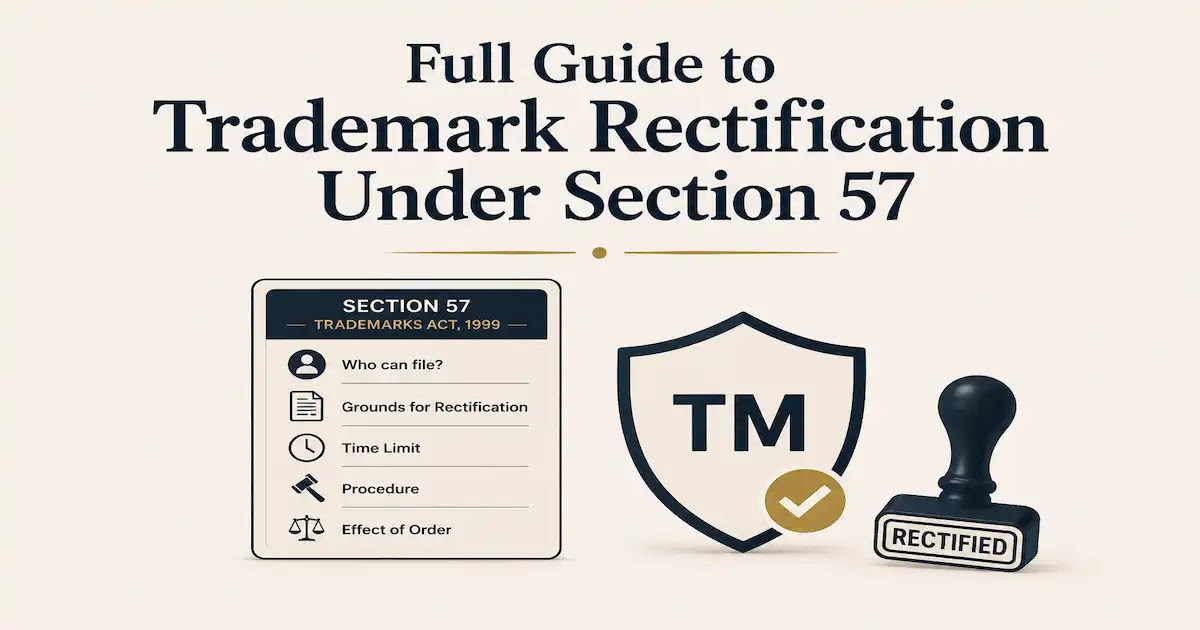
This post covers the full picture on what Section 57 says, who can use it, the grounds it covers, how jurisdiction works in the post-IPAB landscape, the procedure, and how rectification interacts with a pending infringement suit.
What Section 57 Actually Says
Section 57 is deceptively short for the power it carries. The following sub-sections exist:
- Section 57(1) permits an aggrieved person to apply to the Registrar or the High Court for cancellation or variation of a registration on the ground that the registration involves a contravention of, or failure to observe, a condition entered in the Register in relation to the mark.
- Section 57(2) is the broader provision. It allows an aggrieved person to apply where there is an absence or omission from the Register that should be there, where an entry was made without sufficient cause, or where an entry is wrongly remaining on the Register. This is the subsection that covers most rectification petitions in practice.
- Section 57(3) gives the High Court or Registrar the authority to decide any question that is necessary or expedient to resolve in connection with the rectification. This prevents parties from having to run to a different forum for incidental issues.
- Section 57(4) provides the suo motu power. The Registrar or the High Court can initiate rectification proceedings on their own motion after giving notice and an opportunity to be heard. This is rarely invoked but worth noting because it means a mark can be challenged without anyone filing a petition.
A technical point that the Bombay High Court addressed in Raman Kwatra: the word “Register” in Section 57 refers to the Register of trade marks maintained under Section 6 of the Act. The well-known trade marks list is maintained separately. The Registrar in that case argued that Section 57 does not cover well-known marks because they are not on the Section 6 Register. The Court rejected this, holding that once a mark is declared well-known, it carries all the trappings of a registered mark under Section 11(8), and cannot therefore be insulated from challenge under Sections 57 and 125.
Who Can File: The “Aggrieved Person” Standard
Both Sections 47 and 57 confine the right to petition to a “person aggrieved.” This expression has a long interpretive history.
The standard reading comes from Hardie Trading Ltd. v. Addisons Paint and Chemicals Ltd. (1993), where the Supreme Court held that an aggrieved person is one who, in some practically possible way, may be damaged or injured if the impugned mark remains on the Register. The standard is not narrow. A person with a competing mark in the same class is aggrieved. A business operating in the same trade is aggrieved. A defendant in an infringement suit who wishes to challenge the validity of the plaintiff’s registered mark is also aggrieved.
A more recent example in Honasa Consumer Ltd. v. Visage Beauty and Health Care Pvt. Ltd, the Delhi High Court confirmed that the petitioner fell within the meaning of “aggrieved person” under Section 57 because it had received a cease-and-desist notice restraining it from using a term the petitioner contended was descriptive. The restraint on lawful trade was itself sufficient to establish locus standi.
What does not establish aggrievement: a bare statement that you operate in the same industry with no nexus to the impugned mark, or a complaint about a mark in a completely different class with no plausible overlap.
The Main Grounds for Rectification
Courts and the erstwhile IPAB have recognised several grounds under Section 57(2). These are not exhaustive in the text of the Act but have been catalogued through decades of litigation.
- Non-use. A mark registered but not used in trade for a continuous period of five years and three months following the date of actual registration can be challenged under Section 47 read with Section 57. The three-month buffer is designed to prevent last-minute token use before a petition is filed. The count runs from the date of registration, not application. The petitioner carries the initial burden of showing prima facie non-use. Once established, the burden shifts to the registered proprietor to prove actual use during the relevant period.
- Entry without sufficient cause. This covers registrations that were wrongly granted in the first place because they failed the conditions under Sections 9 or 11 at the time of registration. In Honasa v. Visage (June 2026), the Delhi High Court cancelled the mark “D-TAN” on precisely this ground, finding it descriptive of the nature and purpose of the goods, devoid of distinctive character, and common to trade.
- Entry wrongly remaining on the Register. Distinct from entry without sufficient cause, this addresses marks that may have been validly registered but have since lost their right to remain. A mark that has become generic is the most common example. Aspirin, cellophane, and escalator are the textbook foreign examples. In India, courts have examined whether marks like “COLA” or common chemical names have crossed into the generic.
- Fraud and misrepresentation. Where a registration was obtained by making false statements to the Registrar, for example by claiming a date of first use earlier than the actual date, or by misrepresenting that there were no similar marks, Section 57(2) can be invoked. Courts treat this as a ground for cancellation rather than mere rectification.
- Contravention of conditions. Where the registration contains geographic limitations, product-specific restrictions, or other conditions, and the proprietor has used the mark in violation of those conditions, Section 57(1) applies.
- Grounds under Sections 9 and 11. Section 26 clarifies that a registered mark is not immune from examination on absolute grounds. A registration that violates the absolute grounds under Section 9 (descriptive marks, marks deceptive as to nature, marks likely to hurt religious sentiments) or the relative grounds under Section 11 (likelihood of confusion with an earlier mark, marks identical to a well-known mark) can be challenged even after registration.
Jurisdiction After the Abolition of IPAB
This is where the law has been in flux since 2021, and where practitioners need to pay close attention.
Before the Tribunal Reforms Act, 2021, rectification petitions above a certain threshold went to the Intellectual Property Appellate Board. The IPAB was abolished. Jurisdiction over rectification proceedings transferred to the High Courts. The immediate question was: which High Court?
The answer, confirmed by the Madras High Court in M/s. Woltop India Pvt. Ltd. v. Union of India (2025 SCC OnLine Mad 9347) and the Kerala High Court in PAS Agro Foods v. KRBL Limited (2025 SCC OnLine Ker 11104), is the High Court exercising appellate jurisdiction over the Trade Marks Registry that made the impugned entry. The five offices are Mumbai, New Delhi, Kolkata, Chennai, and Ahmedabad. Jurisdiction follows the office that processed and recorded the registration, not the office nearest to the petitioner’s business.
The Kerala HC in PAS Agro Foods was direct on this. The petitioner had filed a rectification petition before the Kerala High Court seeking cancellation of a trademark registered with the Delhi Registry. The Court dismissed the petition as not maintainable: a rectification petition must be filed before the High Court exercising appellate jurisdiction over the registry that registered the mark. The concept of “dynamic effect,” which suggested that jurisdiction could be attracted wherever the mark’s commercial impact was felt, was rejected in both Woltop and PAS Agro Foods.
Now, Raman Kwatra v. Registrar of Trade Marks (Bombay HC, 15 June 2026, Justice Arif S. Doctor) adds a further dimension. In Raman Kwatra, the marks “KEI” had been registered with the Delhi Registry. An infringement suit concerning the same marks was pending before the Delhi High Court. The petitioner nonetheless filed a rectification petition before the Bombay High Court, on the ground that the application for declaring the marks as well-known had been processed by the Mumbai Registry. The Bombay HC confirmed it had jurisdiction because the well-known mark declaration was processed and recorded by the Mumbai Registry. On that question, the petitioner was correct.
But the Court then declined to exercise that jurisdiction, on the ground of forum conveniens. Five factors drove the decision: the infringement suit was already pending before the Delhi HC; both parties carried on business within Delhi’s jurisdiction; the underlying registrations were applied for and granted by the Delhi Registry; overlapping issues including goodwill, use, and reputation would arise in both proceedings; and the well-known trademark section of the Registry had been transferred from Mumbai to Delhi by February 2026.
Justice Doctor was clear in paragraph 44: “while this Court does not lack jurisdiction to entertain the present Petition… the Delhi High Court is the more appropriate and convenient forum for the adjudication of the present Petition.”
The practical lesson from Raman Kwatra is this: having jurisdiction is not enough. Where parallel proceedings exist before another High Court on substantially overlapping issues involving the same marks and parties, a court may decline to exercise the jurisdiction it technically possesses.
For practitioners, this means the choice of forum in a rectification petition is now a strategic decision that requires mapping all existing proceedings and assessing where the overlapping adjudication is concentrated.
The Section 124 Interplay: When a Suit Is Already Pending
One of the most important yet commonly mishandled procedural rules in trademark litigation concerns what happens when a defendant in an infringement suit wants to challenge the validity of the plaintiff’s registered mark.
Section 124 controls this scenario. The defendant cannot simply file a rectification petition independently while the infringement suit is pending. The correct procedure is as follows. The defendant must raise a plea of invalidity before the civil court hearing the suit. The civil court must be satisfied that the plea is prima facie tenable. Only then does the court frame an issue regarding invalidity and direct the defendant to pursue rectification before the appropriate forum. The civil court then stays the infringement proceedings pending the outcome of rectification.
The Supreme Court made this precise sequence mandatory in Patel Field Marshal Agencies v. P.M. Diesels Ltd. (AIR 2017 SCC 1388): the civil court’s satisfaction about the prima facie tenability of the invalidity plea is a precondition for invoking Sections 57 and 125. If the defendant pursues rectification without following this route, the plea of invalidity may not survive.
The Bombay High Court in Raman Kwatra endorsed this reading. The Supreme Court’s framing in Patel Field Marshal was expressly noted: if the parties do not approach the Tribunal for rectification after an issue is framed by the civil court, “the plea with regard to rectification will no longer survive.”
The critical operational point: if you are a defendant in an infringement suit and you want to challenge the plaintiff’s registration, raise the invalidity plea in the suit first. Get an issue framed. Then file the rectification petition. The rectification outcome binds the civil court.
The Procedure: Form TM-O and What Comes Next
The procedural framework for rectification before the Registrar is set out in the Trade Marks Rules, 2017. The application to be filed is Form TM-O. Where the petition concerns a collective mark or certification mark, it must be filed in duplicate. The application must be accompanied by a statement of case setting out three things, the nature of the applicant’s interest, the facts upon which the case is based, and the relief sought.
Before the Registrar, the choice of authority matters. The Registrar handles less complex matters. High Court jurisdiction becomes mandatory where an infringement suit is pending (Section 124), or where the matter involves questions that go to the validity of the registration in a comprehensive way.
On evidence, the burden initially lies with the petitioner. In non-use petitions, the petitioner must show prima facie non-use during the relevant period. An investigator affidavit establishing that the mark is not in active trade use has become standard practice in 2025 and 2026. Once the petitioner establishes a prima facie case of non-use, the burden shifts to the registered proprietor to demonstrate actual use during the five-year-and-three-month window.
If you are contesting a rectification petition as the registered proprietor, the strongest defences are honest concurrent use (concurrent use of the mark in a different geographical area or class that does not create confusion), acquiescence (the petitioner delayed so long in filing that the registered proprietor built substantial goodwill in the mark relying on the registration), and direct evidence that the mark has been in genuine commercial use.
One point courts have consistently held is that commercial difficulties, lack of financial resources, or low market demand do not constitute “use” for the purposes of defeating a non-use rectification petition. Use must be genuine commercial use in the course of trade.
Defences Available to the Registered Proprietor
The registered proprietor facing a rectification petition has several options:
- Honest concurrent use: Where two parties have independently adopted the same or similar mark in good faith, a court may permit concurrent registrations with conditions. This is a defence to initial refusal of registration and can also be raised in rectification proceedings.
- Acquiescence under Section 33: It provides that where the registered proprietor of an earlier mark has acquiesced for a continuous period of five years in the use of a later registered mark while being aware of that use, that proprietor loses the right to apply for a declaration that the later mark is invalid. Acquiescence in a rectification context requires a long delay combined with full knowledge of the competing use.
On the merits, the most direct defence to a Section 57(2) petition is evidence of genuine use. Sales invoices, advertising records, trade affidavits, and Chartered Accountant certificates can all go into the evidence file. Courts in 2025 and 2026 have taken a more granular look at whether the use claimed is bona fide commercial use or nominal token use timed to defend against rectification.
Also see the Renee Cosmetics v. Rupali Sharma analysis on this blog for a recent case where a trademark was challenged and the court examined the boundaries of what constitutes sufficient cause for a registration to remain on the Register.
Connecting the Dots to Trademark Practice
Trademark rectification is not a standalone tool. It fits into a broader strategic picture.
A mark facing a deceptive similarity objection during examination can overcome that objection either by arguing the marks are distinct or by seeking rectification of the earlier cited mark. Our post on why similar trademarks are not always legally problematic covers the deceptive similarity test in detail. That analysis directly informs how a rectification petition framing “entry without sufficient cause” on similarity grounds should be structured.
Similarly, for practitioners navigating delay and procedural defaults, the decision in Rajinder Singh v. Registrar of Trade Marks explores the outer limits of what courts will condone in procedural lapses during trademark proceedings.
Also Read: Calcutta HC Returns ITC Plaint for Skipping Section 12A Mediation
Conclusion
Section 57 is one of the most powerful tools in the Indian trademark law. It can cancel a fraudulently obtained registration, remove a mark that has sat unused for years, and correct entries that should never have been made. If used well, it clears the path for legitimate brand rights and if not, particularly with the wrong choice of forum, it consumes time and costs the petitioner their statutory window.
The post-IPAB landscape has created genuine jurisdictional complexity. The combined effect of Woltop, PAS Agro Foods, and Raman Kwatra is that a practitioner must now assess three things before filing, i.e., which registry processed the impugned entry, whether any infringement suit involving the same marks is pending anywhere, and whether a different court is already seized of substantially overlapping issues. Getting any of these wrong does not just cause inconvenience. In the Section 124 context, it can result in the invalidity plea being permanently abandoned.
Jurisdiction under Section 125 is anchored to the registry that made the entry. But courts are not obliged to create parallel litigation where the risk of conflicting outcomes is clear and a more appropriate forum exists. That is not a departure from the statutory scheme. It is the kind of pragmatic adjudication that actually keeps trademark litigation functional.
The legislature, though, should address this gap directly. The Patents Act has Section 104, which coordinates rectification and infringement. The Designs Act has Section 22(4). The Trade Marks Act has no equivalent provision mandating consolidated adjudication.