patent
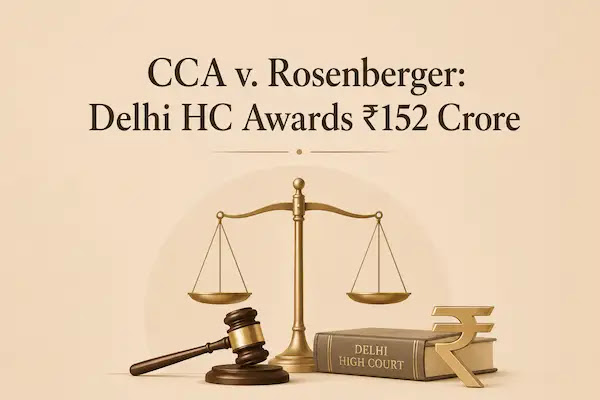
CCA v. Rosenberger: Delhi HC Awards 152 Crore Patent Damages
In a landmark ruling, the Delhi High Court established the 'Dartboard Model' to penalize speculative prior art challenges in...
Browse every analysis published on Its IP Time.
In a landmark ruling, the Delhi High Court established the 'Dartboard Model' to penalize speculative prior art challenges in...
The Delhi High Court has affirmed that descriptive terms like GLASS SKIN cannot be monopolised as trademarks under Section 9(1)(b) of the Trade Marks Act 1999. In a significant win for fair competition, the court cancelled a registration that hindered legitimate trade usage. This ruling emphasizes that popular lifestyle or industry vocabulary remains in the public domain and cannot be fenced off by a single player without proof of distinct secondary significance. Businesses should rely on established trademarks, not generic product descriptors, to avoid costly litigation and potential registration cancellation.
Dynamic injunctions have become the gold standard for protecting live broadcast rights under Section 37 of the Copyright Act, 1957. In Zee Entertainment v. Soccerbox, the Delhi High Court confirmed that these orders extend to mirror sites, redirect URLs, and mobile applications, allowing rights-holders to block infringing content in real-time. This judicial approach addresses the temporal nature of piracy, ensuring that exclusive broadcast reproduction rights are not rendered otiose during major events. The ruling reinforces that prior piracy patterns justify proactive, site-wide enforcement across ISPs and mobile ecosystems.
The Madras High Court has definitively ruled that affixing a trademark in India on goods destined for export constitutes trademark use under the Trade Marks Act 1999. This judgment in V.V.V. & Sons Edible Oils Ltd. v. Meenakshi Overseas LLC clarifies that Indian trademark owners can initiate infringement proceedings against domestic manufacturers even if the products are not sold in the local market. The act of application is sufficient to establish a cause of action, overriding arguments that domestic consumer exposure is necessary for trademark infringement claims in India.
The Delhi High Court has reinforced that the Trade Marks Registry cannot rely on its own procedural failures to extinguish a proprietor's rights. Under Section 25(3) of the Trade Marks Act 1999, the Registrar has a mandatory obligation to issue valid renewal notices. When the Registry fails to serve the O-3 notice at the correct address, the resulting lapse is legally void. This decision protects long-standing brand owners from losing their registration due to administrative oversight, confirming that statutory duties of government authorities are not discretionary.
The Delhi High Court's ruling in K.K. Bansal v. Philips establishes a rigorous evidentiary standard for enforcing Standard Essential Patents (SEP) in India. Patent holders must prove essentiality through detailed claim charts mapping claims to technical specifications, comply with Section 45 of the Indian Evidence Act regarding expert testimony, and provide comparable licence agreements to establish FRAND rates. Furthermore, the court reinforced that international patent exhaustion under Section 107A(b) of the Patents Act prevents patentees from collecting royalties from downstream buyers once a licensed component enters the supply chain.
Weekly Indian IP law digest (June 7–13, 2026): Delhi HC dynamic sports injunctions, Bombay HC pharma marks, Tezpur Litchi GI, and Google AI copyright.
In Indian pharmaceutical trademark law, the 'bare possibility' test is the primary threshold for determining deceptive similarity. Because patient safety outweighs commercial interest, courts do not require proof of actual confusion or probability; they intervene if there is even a remote risk of error during prescription or dispensing. Applying the anti-dissection rule, courts assess marks as a whole rather than by syllable, ensuring that confusingly similar drug names are restrained even when they belong to different therapeutic classes or contain different active ingredients.
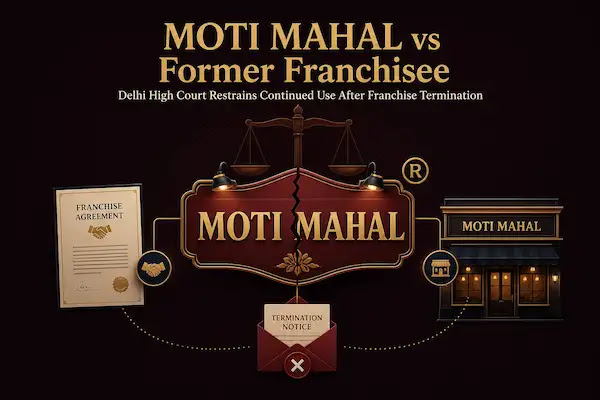
The Delhi High Court's ruling in the Moti Mahal trademark dispute underscores that post-termination use of a mark by a franchisee constitutes clear-cut infringement. By highlighting the strength of express contractual acknowledgment clauses in franchise agreements, the Court provided a robust mechanism for brand owners to secure immediate relief. The order serves as a definitive guide for protecting intellectual property within franchise networks, affirming that aggregators and digital platforms must also comply with takedown orders to prevent irreparable brand harm and consumer confusion in the hospitality sector.
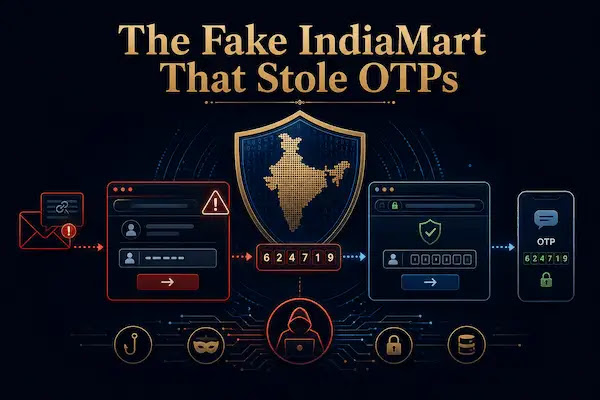
The Delhi High Court's recent IndiaMart injunction marks a major evolution in Indian IP enforcement by targeting the entire infrastructure of cyber fraud, including cloud hosts and telecom providers. By classifying website GUI as original artistic work under Section 2(c) of the Copyright Act and treating cloud platform infrastructure as an instrument of infringement, the Court has provided a robust framework for combatting OTP relay attacks. This order serves as a pivotal precedent for platform-wide protection and the accountability of digital intermediaries in preventing systemic trademark abuse.
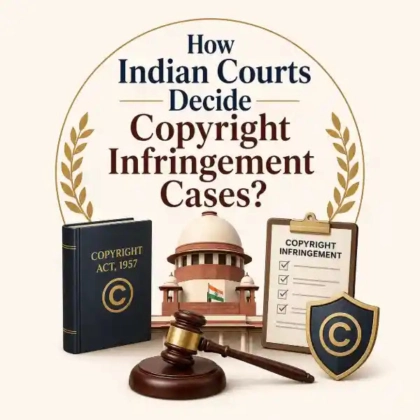
Copyright infringement in India hinges on proving both the originality of the work—meeting the modicum of creativity threshold—and substantial similarity of protected expression rather than underlying ideas. Under the Copyright Act 1957, fair dealing is limited to specific categories like news reporting and research, excluding generic transformative use defenses found in other jurisdictions. Recent Delhi High Court jurisprudence, including dynamic injunctions against piracy and Section 60 relief against groundless threats, provides robust mechanisms for rights holders to protect digital assets and GUI designs from systematic imitation.
Publicly playing music in any commercial establishment constitutes a 'communication to the public' under the Copyright Act, 1957, requiring valid public performance licences from rights holders. The Bombay High Court confirmed that exclusive licensees, such as PPL, have the statutory standing to enforce these rights and seek injunctive relief without needing to be registered as a copyright society under Section 33. Consequently, commercial operators cannot use ambient music or third-party streaming subscriptions as a defense for unlicensed public playback, as these do not grant the necessary commercial performance authorizations.