Skip to content
Subscribe

Browse the archive

Category: trademark

trademark

New Balance vs. NUBEAT: Delhi HC on Passing Off and N-Marks

The Delhi High Court's ruling in New Balance vs. NUBEAT reinforces that passing off remains a potent common law remedy even when parties hold conflicting trademark registrations. By applying the initial interest confusion doctrine, the court underscored that well-known marks are protected against deceptive variants that mimic a brand's visual identity, regardless of the defendant’s attempt to claim commonality in the trade. This decision clarifies that registration is not a shield against passing off claims when prior use and extensive goodwill establish a clear source identifier that third-party labels unfairly exploit.
8 min read
trademark

Imagine Marketing v. Exotic Mile: Delhi HC Denies Repeat Injunction

A second interim injunction application cannot be filed to revisit relief previously declined by the court absent proof of material changed circumstances or undue hardship. The Delhi High Court in Imagine Marketing Pvt Ltd v Exotic Mile affirmed that plaintiffs cannot relitigate settled interlocutory issues simply by citing stray remarks from later appellate orders. This ruling reinforces the doctrine against perpetual interim litigation in Indian trademark law, ensuring judicial finality and protecting defendants from abuse of process under the Civil Procedure Code and the Trade Marks Act 1999.

8 min read
trademark

Loreal v. Vekariya: Amending Passing Off to Infringement

A plaintiff may amend a passing off suit to include a trademark infringement claim if they obtain registration during the pendency of litigation. Indian courts apply the 'real controversy test' to prevent a multiplicity of proceedings, acknowledging that the underlying facts of both claims remain identical. Registration obtained post-institution does not constitute a completely new cause of action that precludes amendment under Order VI Rule 17 of the CPC. This procedural flexibility serves the ends of justice, ensuring that rights holders can effectively enforce their intellectual property without restarting litigation.

5 min read
trademark

Bombay HC Rules: Permissive Use Ends Trademark Ownership Claims

Corporate restructurings often leave subsidiaries holding legacy brand names that belong to the parent entity. When permissive use expires, the subsidiary must cease all branding activity associated with the trademark. As affirmed by the Bombay High Court, goodwill generated under a licensed mark exclusively accrues to the registered proprietor. Claiming independent prior use under Section 34 of the Trade Marks Act is legally inconsistent if the party has already admitted to using the mark with the owner's permission, leading to an inevitable injunction.

13 min read
trademark

Landmark Crafts v Shalini Garg: HP Trademark Infringement Ruling

Justice Jyoti Singh’s order in Landmark Crafts v. Shalini Garg confirms that appending certification marks like ISI to a registered trademark cannot create distinctiveness or evade infringement claims. By granting an ex parte ad interim injunction, the Delhi High Court reaffirmed that courts assess the overall impression of a mark, focusing on its dominant features. This case provides a clear roadmap for practitioners on leveraging Section 12A of the Commercial Courts Act to skip pre-institution mediation when a defendant's conduct demonstrates clear urgency and bad faith.

8 min read
trademark

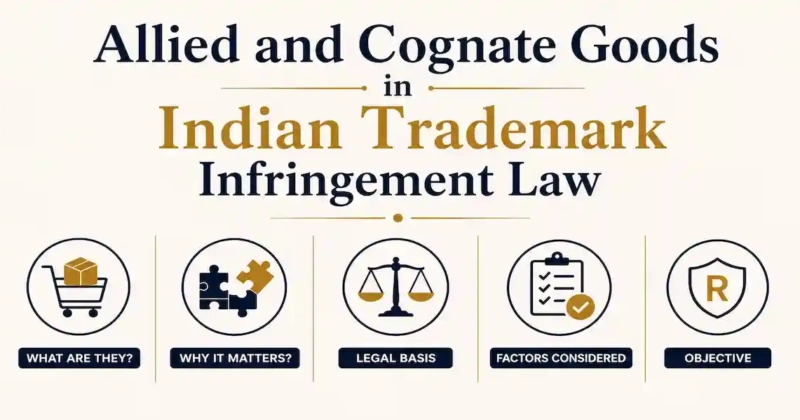
Beer vs. Whisky: Delhi HC on Allied and Cognate Goods

Allied and cognate goods represent a vital doctrine in Indian trademark law, enabling protection for marks across different Nice Classes where a trade connection, common consumer base, or complementary end-use exists. Courts determine infringement under Section 29 of the Trade Marks Act 1999 by assessing commercial reality rather than administrative class boundaries. Decisions such as Devans Modern Breweries establish that even dissimilar products like beer and whisky can be considered cognate if documented business practices and distinct brand reputations demonstrate a likelihood of confusion, rendering the anti-dissection rule a key tool for protecting composite marks.

17 min read
trademark

Trademark Renewal 2026: Mandatory RG-3 Notices and TM-R Deadlines

Trademark registration in India requires renewal every ten years from the date of the original application, not the registration certificate date. Failure to file Form TM-R within the statutory grace period risks permanent removal, though the Registrar must mandatorily issue an RG-3 notice before cancellation. Under the Trade Marks Act 1999, restoration is discretionary after the six-month grace period but before the twelve-month limit. Maintaining an updated address for service with the CGPDTM is critical to ensuring receipt of renewal reminders and preventing accidental loss of rights.

17 min read
trademark

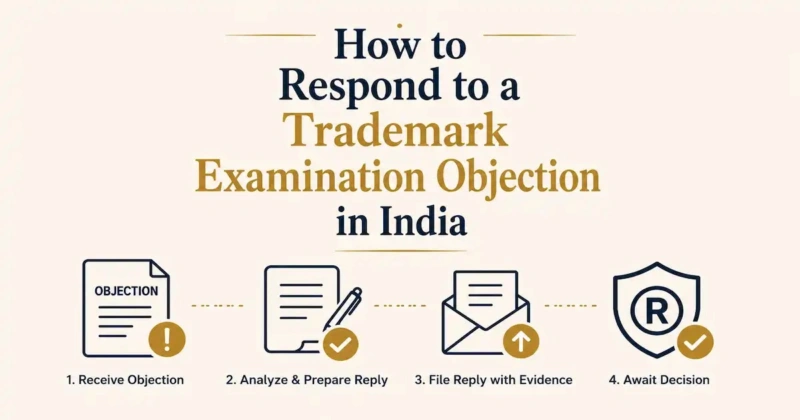
Mastering the Trademark Objection Reply: A Strategic Legal Guide

A trademark examination report under the Trade Marks Act 1999 is not a final refusal, but an invitation to justify registration. To overcome Section 9 absolute grounds or Section 11 relative grounds, applicants must submit a targeted, evidence-based reply within one month of the notice. Success hinges on demonstrating inherent distinctiveness or proving acquired secondary meaning through documented sales, advertising data, and market recognition. Failure to engage with the examiner's specific concerns or missing strict deadlines leads to abandonment, necessitating a precise, legally grounded submission to secure your brand rights.

13 min read
trademark

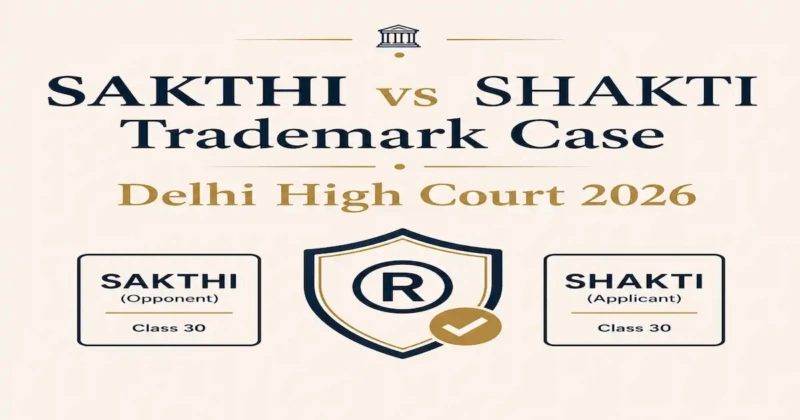
Delhi HC Cancels SHAKTI Mark for Lack of Genuine Use

Trademark registration for a composite mark does not grant automatic exclusivity over a word buried within it unless that component is used independently. A registration without actual commercial use is essentially a 'paper mark' that remains vulnerable to expungement under Section 47 of the Trade Marks Act. Courts require tangible evidence, such as invoices, to prove the standalone use of a mark. Intellectual property owners should not rely on legal fictions; they must demonstrate consistent, independent market presence to defeat rectification petitions from established prior users.

9 min read
trademark

Section 9 Trademarks: Absolute Grounds for Refusal Explained

Section 9 of the Trade Marks Act 1999 mandates that a mark must possess inherent distinctiveness to be registrable. Objections under Section 9(1)(a) for non-distinctiveness, Section 9(1)(b) for descriptiveness, and Section 9(1)(c) for customary trade usage pose significant hurdles that cannot be ignored. However, the proviso to Section 9(1) offers a critical path to registration if applicants can prove acquired distinctiveness through extensive evidence of use prior to the filing date. Distinguishing between absolute and relative grounds is essential for crafting a successful response to examination reports.

18 min read