
A trademark registration in India does not maintain itself. Under Section 25(1) of the Trade Marks Act, 1999, every registered mark carries a ten-year term counted from the date of the original application, not the date the registration certificate was issued. This guide walks through every stage: when you can file, what Form RG-3 actually is and what happens when it is not sent, how Form TM-R works, and what you can still do if your mark has already been removed. The law here is Section 25 of the Trade Marks Act, 1999 read with Rules 57, 58, 59, 60, and 61 of the Trade Marks Rules, 2017.
Introduction
Struggling to understand Trademark Law? Read our complete Trademark Law Guide.
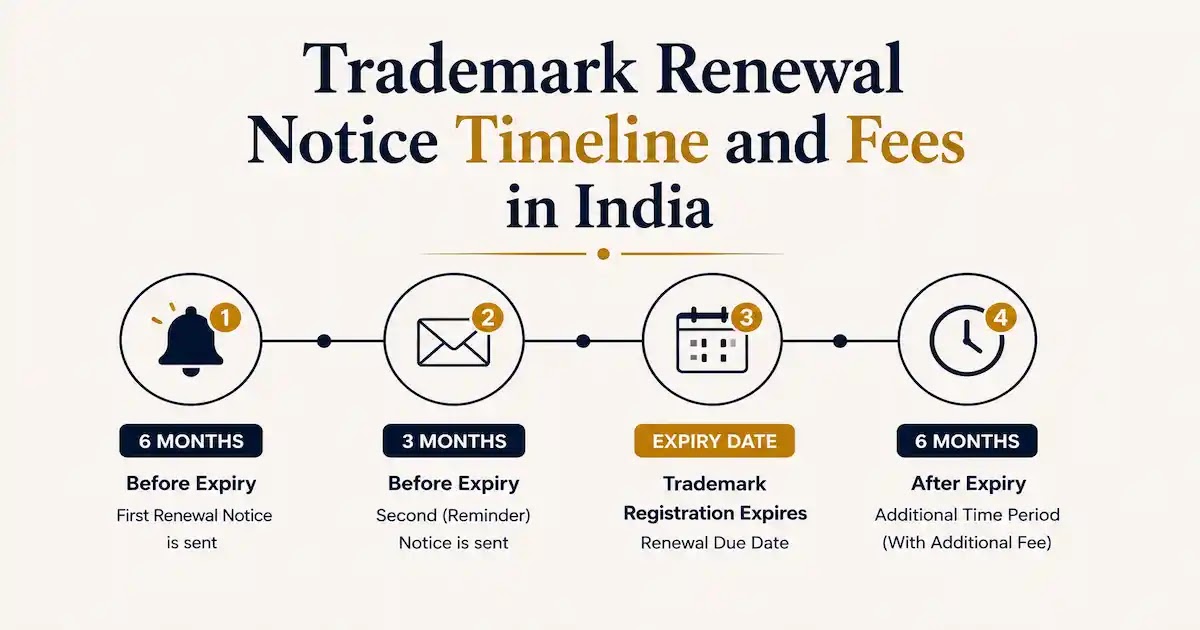
Many brand owners get this wrong. They look at the certificate date, add ten years, and miss the actual deadline by months. Once that ten-year window closes, the consequences escalate. A six-month grace period applies, then a restoration window, then permanent removal of the trademark from the Register. Each stage costs more than the last. A three-class trademark renewed on time costs Rs 27,000 in government fees. The same renewal inside the grace period costs Rs 40,500. By the time you are in restoration territory, you are paying about Rs 54,000, assuming the Registrar even agrees to grant it.
What is Trademark Renewal in India and When Does it Fall Due
Registration of a trademark under Section 25(1) lasts ten years. After that, it can be renewed for further ten-year periods indefinitely, as long as the renewal is filed in time and the prescribed fee is paid. There is no upper limit on the number of renewals. A mark can stay on the Register for a century if its owner keeps renewing it.
The critical point about the expiry date trips up a large number of registrants. The ten-year clock starts from the date of filing the original application, not from the date appearing on the registration certificate. The two dates can be years apart, depending on how long the examination and publication process took. For instance, say you have filed your Trademark application on 15 March 2014 and it was registered in August 2016, your renewal falls due on 15 March 2024, not in August 2026.
Rule 57(1) of the Trade Marks Rules, 2017 allows the renewal application to be filed at any time within one year before the expiry date. This is a very huge window to renew the trademark. Filing early in that twelve-month zone costs exactly the same as filing on the last day, and it removes all the pressure of managing the deadline of 10 years.
Once the expiry date passes without a renewal application on file, the mark enters progressively more expensive and uncertain territory. The structure of what follows, and what each stage costs, is worth understanding before you are in the middle of it.
How to File Trademark Renewal Form TM-R Before and After Expiry
All renewal-related filings, whether on-time renewal, late renewal within the grace period, or restoration after removal, are made on a single form: Form TM-R. The older forms that pre-dated the 2017 Rules, including TM-12 and TM-13, were retired. If you see guides still recommending those, they are working from outdated information. The renewal form, Form TM-R is filed online through the IP India e-filing portal at ipindiaonline.gov.in. Physical filing at one of the five Trade Marks Registry offices in Mumbai, Delhi, Kolkata, Chennai, and Ahmedabad is technically available but costs extra.
Documents required for renewal of Trademark
The Registry already holds your full prosecution history. What you attach to TM-R is essentially three things, i.e., the existing registration certificate confirming the mark and its classes, a fresh power of attorney in Form TM-M if the attorney handling the renewal has changed since the original filing, and proof of fee payment from the portal. No fresh examination, no publication in the Trade Marks Journal, no opposition period. Renewal within the statutory period is a matter of right under Rule 57(2) of the Trademark Rules, 2017. Once you file appropriately with the correct fee, the Registry shall process it.
Fee structure under the First Schedule, Trade Marks Rules, 2017 (E-filing):
| Stage | When | Fee per class |
|---|---|---|
| On-time renewal | Up to 12 months before expiry, or on the expiry date | Rs 9,000 |
| Late renewal (grace period) | Expiry date to 6 months after expiry | Rs 13,500 (base Rs 9,000 + surcharge Rs 4,500) |
| Restoration and renewal | 6 months to 12 months after expiry | Rs 18,000 (base Rs 9,000 + restoration Rs 9,000) |
Physical filing costs Rs 10,000 for on-time renewal and Rs 15,000 during the grace period, per class. The fee multiplies for each class. If your mark is registered in four classes, every figure in this table gets multiplied by four. A portfolio of marks in multiple classes can turn an ignored renewal reminder into a very large cost, very quickly.
One important thing to note: While the Trade Marks Act and Rules allow for individuals, startups, and MSMEs to pay only 50% of the fee at the registration stage (Rs. 4,500 per class), no such concession applies at renewal.
When and How the Registrar Sends Form RG-3 Renewal Notices
Rule 58(1) of the Trade Marks Rules, 2017 creates a specific obligation on the Registry. It reads as follows:
“In case no application for renewal of the registration in the prescribed form together with the specified fee has been received, the Registrar shall send, not more than six months before the expiration of registration of the trademark, a notice in Form RG-3 at the address of service informing the registered proprietor of the approaching date of expiration and the conditions, if any, subject to which the renewal of the registration may be obtained.”
First, the notice is triggered only when no renewal application has already come in. If you have filed TM-R before the RG-3 window opens, no notice goes out because none is needed. Second, the notice goes to the address of service on record with the Registry, which may or may not be current. If you have changed your address or your attorney has changed without updating the Registry, the RG-3 will go to an outdated location and you will not receive it. Third, the notice is Form RG-3, not O-3. The older O-3 was the prescribed form under the Trade Marks Rules, 2002. The 2017 Rules redesignated it as Form RG-3. Courts still refer to both names interchangeably in judgments that span both rule regimes.
Rule 58(1) speaks that the Registrar is required to send Form RG-3 before the expiry date when no renewal application has been received. The notice informs you of the approaching expiry and the conditions for renewal. It is merely a warning, not a deadline extension.
Can the Registry Remove Your Trademark Without Sending the RG-3 Notice
This is one of the most contested questions in trademark renewal law, and the courts have settled it in favour of the registered proprietor. The answer is no. The Registrar cannot lawfully remove a trademark from the Register without first sending the mandatory Form RG-3 notice.
The foundational authority is the Delhi High Court’s Division Bench ruling in Union of India v. Malhotra Book Depot, 2013 (54) PTC 165 (Del) (DB). The registered mark MBD in Class 16 had not been renewed since 1984. The Registry removed it and advertised the removal in the Trade Marks Journal in 1990, without ever having issued the O-3 notice (the predecessor to RG-3). When the proprietors discovered the removal in 2010, they filed for restoration. The Registrar refused. The matter went to a Single Judge, then a Division Bench of the Delhi High Court.
The Division Bench held that removal of a trademark from the Register entails civil consequences for the registered proprietor. It amounts to deprivation of a property right, and that deprivation can only occur in the manner prescribed by law. On a plain reading of Section 25(3), the court held that mere lapse of time and failure to renew, by themselves, do not authorise removal. The Registrar must first send the notice, and only after the proprietor fails to comply with that notice can removal follow. Since the O-3 notice had not been issued, the removal was held to be bad in law. The application for restoration could not be treated as time-barred.
The Division Bench modified the Single Judge’s order slightly. It directed the Registrar to restore and renew the mark, but only after satisfying itself that the respondent was the registered proprietor or successor, and that no identical or similar marks had been registered in the intervening period by third parties.
Rajasthan High Court reaffirmed the same principle more recently in Jitendra Goyal v. Registrar of Trade Marks, 2025 SCC OnLine Raj 3294. The court found that the respondents had removed the mark without complying with Section 25(3) and Rule 58 of the 2017 Rules, and held that to be unlawful. It directed a fresh order to be passed only after compliance with the notice requirement and after providing the petitioner a hearing.
The courts have also held that non-issuance of the RG-3 does not automatically extend the registration indefinitely or suspend all time limits. What it does is prevent the Registrar from treating the mark as validly removed. The application for restoration cannot be rejected as time-barred where the mandatory notice was never sent. But if the notice was in fact generated and dispatched by post, and the proprietor simply did not receive it because their address on record was outdated, the notice is deemed to have been served under the deeming provision applicable to postal service of documents, and the time limits will run normally. This distinction was drawn by the Delhi High Court in Guruji Enterprises Pvt. Ltd. v. Union of India, (2016) 227 DLT 488.
There is also an important practical complication flagged by courts and commentators. For older marks, the Registry often cannot produce records of whether an RG-3 or O-3 was ever issued. Those records may simply not exist or may not have been digitised. Courts have in some cases required RTI applications to ascertain whether a notice was ever sent, which adds delay and cost to the restoration process.
Late Renewal and Restoration: Fees, Timelines, and What Each Window Actually Means
Once the expiry date passes without a renewal application, the Registrar’s power to remove the mark kicks in under Rule 58(2) and Rule 59 of the 2017 Rules. But the law carves out two additional windows before any removal becomes final.
Window 1: The Grace Period (Months 0 to 6 after expiry)
The proviso to Section 25(3) and Rule 58 provide that the Registrar shall not remove the mark from the Register if an application is made in Form TM-R with the prescribed renewal fee and surcharge within six months of the expiry date. The mark stays on the Register during this entire window. Rights remain continuous. There is no gap in protection that a competitor can exploit. You simply pay the surcharge on top of the base renewal fee, and the registration is treated as having been continuously valid.
This is the cheapest and cleanest form of recovery from a missed deadline. Filing is still on Form TM-R, the same portal, and the same process. The only difference is the total fee.
Window 2: Restoration (Months 6 to 12 after expiry)
Once the six-month grace period closes without renewal, the Registrar may remove the mark from the Register and advertise that removal in the Trade Marks Journal under Rule 59. At that point, ordinary renewal is no longer available. What remains is the restoration route under Section 25(4) and Rule 60.
Restoration is not a right. It is discretionary. The Registrar considers whether it is just to restore the mark, having regard to the interests of any other affected persons. The application is made on the same Form TM-R with the higher restoration fee. The Registrar advertises the restoration request in the Trade Marks Journal, giving third parties an opportunity to object. A competitor who has already filed a similar mark in the interregnum is precisely the kind of affected person the Registrar must consider.
There are other differences from grace-period renewal. Processing is slower. There is no certainty of outcome. Restoration requires you to demonstrate that it is appropriate, not just that the fee has been paid.
If the Registrar grants restoration, the mark is renewed for a further ten years from the date of the original expiry, not from the restoration date. Rights are treated as retrospectively restored.
After 12 Months: Permanent Removal
Once one year has passed from the expiry date without renewal or restoration, Section 25(4) and Rule 60 close the last window. The mark is permanently struck from the Register. There is no further administrative remedy. The owner must file a fresh trademark application from scratch, losing the original filing date and priority, and facing the full examination and opposition cycle. If a third party has registered the same mark in the same class during the lapse period, the original owner has no automatic right to reclaim it.
Step-by-Step Guide to Filing Form TM-R on the IP India Portal
- Step 1. Log in at ipindiaonline.gov.in using your registered credentials. If you are filing through an attorney, their portal credentials are used.
- Step 2. Locate your trademark registration by its application number. Confirm the exact expiry date shown in the registry database. Do not rely on what the registration certificate shows if that differs from what the portal shows.
- Step 3. Open Form TM-R. Enter the trademark application number, the class or classes for renewal, and the registered proprietor’s current details exactly as they appear in the Register.
- Step 4. Upload the registration certificate and, if an attorney is filing on behalf of the proprietor, the current Form TM-M power of attorney. If ownership has changed since registration, a Form TM-P recordal of assignment must be completed and recorded before TM-R is processed.
- Step 5. Pay the applicable fee per class through the integrated payment gateway using net banking, UPI, or a debit or credit card. The portal calculates the fee automatically based on the date of filing relative to the expiry date.
- Step 6. Sign the application using Aadhaar OTP or a Class 3 Digital Signature Certificate.
- Step 7. Download and retain the acknowledgement receipt. Track the application status periodically through the portal.
Processing time for an on-time or grace-period renewal runs three to six months from filing. Once accepted, renewal is published in the Trade Marks Journal and a renewal intimation letter is sent to the proprietor or attorney on record.
One point worth noting: if your trademark is registered in more than one class, you file TM-R once but pay the renewal fee for each class separately. Missing one class means that class lapses independently of the others. A brand owner who thinks they have renewed their mark but has accidentally omitted a class from the TM-R can end up with partial protection without realising it.
What Happens if You Miss the Restoration Deadline
The consequences of permanent removal are more severe in practice than they look on paper.
The mark is gone from the Register. Your exclusive rights to use it in the registered class or classes cease. Anyone can now use the same mark or a similar one in that class, and you have no trademark infringement claim to stop them. Passing off may still be available if you have common law goodwill, but that is a harder case to run than a registered mark infringement claim, and it depends on continued reputation in the market. The ® symbol can no longer be used.
For brands that have built real commercial value, the loss of the registration number and the original priority date is particularly damaging. A later re-filing starts from zero on the priority queue. If a third party or squatter has filed the same mark in the window between your lapse and your re-filing, you will be facing them in an opposition rather than holding a priority you spent years building.
Licensing and assignment transactions built on a lapsed mark also become difficult. Most due diligence processes in investment or acquisition contexts treat a lapsed trademark as a red flag. Founders have discovered a lapsed trademark during a funding round and had to scramble to restore or re-file, often under time pressure from investors. This is, incidentally, one of the most common contexts in which trademark lawyers get urgent calls about renewal.
The only theoretical legal recourse after permanent removal is a fresh application and, if relevant, an action for passing off. Neither option gives you back the original registration date. That is why practitioners treat the twelve-month window as a hard outer limit, not a soft target.
Frequently Asked Questions on Trademark Renewal in India
When exactly does a trademark expire in India?
Ten years from the date of filing the original trademark application, not from the date on the registration certificate. Check the application number on the IP India portal for the actual filing date.
Can I file for renewal before the expiry date?
Yes. Rule 57(1) allows filing at any time within one year before the expiry date, at the standard fee with no surcharge.
What is the grace period for late renewal?
Six months from the expiry date, under the proviso to Section 25(3) and Rule 58. The surcharge is Rs 4,500 per class (e-filing), making the total Rs 13,500 per class.
What form is used for restoration?
Form TM-R, the same form used for regular renewal. The fee differs depending on whether you are in the grace period or the restoration window.
Is renewal examination required?
No. Rule 57(2) states that a renewal application filed within the prescribed time must be allowed, as long as the mark has not been cancelled, removed, or made otherwise non-renewable by order of a court or the Registrar. No substantive examination, no publication for opposition.
What is Form RG-3 and is it mandatory?
Form RG-3 is the notice the Registry must send to the registered proprietor’s address for service when no renewal application has been received, not more than six months before the expiry date. Rule 58(1) makes it mandatory. Courts, including the Delhi High Court in Malhotra Book Depot and the Rajasthan High Court in Jitendra Goyal v. Registrar of Trade Marks, 2025 SCC OnLine Raj 3294, have consistently held that the Registry cannot remove a mark without having first sent this notice.
What if the RG-3 notice was not received?
The critical question is whether it was sent, not whether it was received. If the Registry can show the notice was generated and dispatched by post to the correct address for service, it is deemed served even if you did not actually receive it. If the notice was never generated or sent, removal without it is unlawful and the time limits for restoration may not run against you.
Does individual or MSME status reduce renewal fees?
No. The fee concessions available at the registration stage under the First Schedule do not extend to renewal.
Can a mark in multiple classes be partially renewed?
Yes, and this can happen accidentally. Each class in a TM-R filing carries its own fee. A class omitted from the renewal lapses on its own. Always verify that every class has been included and paid for before submitting.
How long does renewal processing take?
Three to six months from filing to the renewal intimation letter and publication in the Trade Marks Journal, under current Registry processing timelines.
Also Read: Calcutta HC Returns ITC Plaint for Skipping Section 12A Mediation
Conclusion
Trademark renewal is one of those things that looks straightforward until it goes wrong and when it goes wrong, the options available to you narrow at each stage while the cost and uncertainty rise. The statutory scheme under Section 25 of the Trade Marks Act, 1999 is actually generous. A full year to file in advance, a six-month grace period, then a further six months for restoration. That is cumulatively two years from the ideal filing date to the last possible remedy. Very few legitimate brand owners should end up losing a registration if they are paying any attention at all to their trademark portfolio.
What actually causes marks to lapse is not the law being strict. It is administration being sloppy, i.e., outdated addresses on the Registry record so the RG-3 never reaches anyone useful, expiry dates being calculated from the wrong date, and multi-class marks where one or two classes get missed in the renewal filing. These are all avoidable problems.
The body of case law on the RG-3 notice is a useful corrective. Courts from Delhi to Rajasthan have consistently refused to allow the Registry to remove marks where the mandatory notice was not properly served. That protection is real. But it is a remedy after the fact, not a substitute for tracking your renewal dates yourself.
Form RG-3 is a procedural safety net. If you are managing a trademark portfolio of any size, the six-month advance notice the Registry is supposed to send under Rule 58 should never be the first time you hear about an upcoming expiry. You should know those dates before the Registry does. File early, file correctly, verify every class, and keep the address for service current. The penalties for getting this wrong are not abstract. A brand you have spent years building can become freely available to anyone who wants to file it after your registration lapses.
If you are dealing with a mark already in the grace period or past it, the restoration route under Section 25(4) and Rule 60 remains open until twelve months after expiry, but it carries no guarantee of success. Get advice and act fast.
For related reading on trademark procedures before the Registry, see our analysis of trademark infringement and brand protection under Indian law, the Alkem Laboratories v. Numen Pharma dispute on pharmaceutical trademark conflicts, and Renee Cosmetics v. Rupali Sharma on Section 9 descriptiveness and trademark cancellation.