Introduction
Looking to master Trade Secrets & Emerging IP Law jurisprudence? Read our full Trade Secrets Law Guide.
The sheer scale of the reliance group attracts opportunistic domain registration makes it a target for cybersquatters hoping to obtain a domain name and sell it back to the company in order to divert its customer or trade on their goodwill. The ever so expanding era of a digital communication and algorithm and internet being the most preferred mode for conducting business. The race to trademark domain names have been on an all time rise, the race has led to domain name disputes and the complicated issue of cybersquatting.
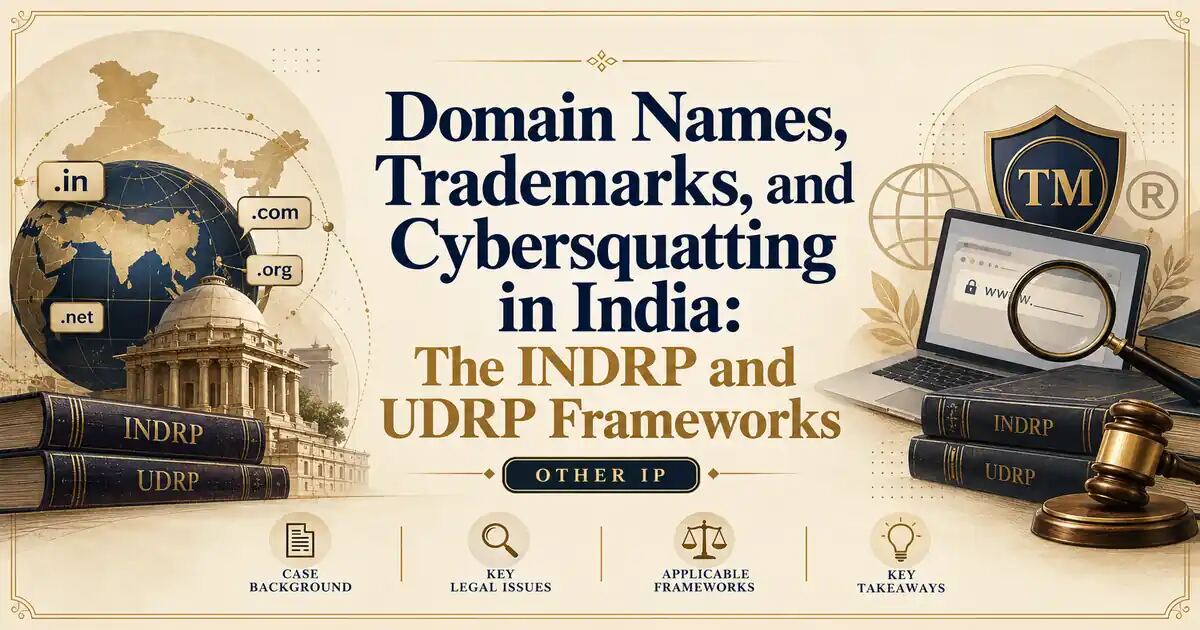
Domain Names, Trademarks and Cybersquatting
A Domain name is a website address, in the form of a url that is unique to a particular website. It is a business identifier, not a merely an address, it is a contract with a registration authority allowing communication between the owner’s computer, chanelled though the registration authority’s server and is akin it a uniqe identifier company name, however, it is disputed whether it confers any intellectual property rights.
Under Indian law, a trademark is any distinctive sign, symbol, label, headings letters and numbers or combinations thereof or shapes of goods and packaging or colour combinations that are cable of being represented and differentiated on paper or in a visual register.
The process of registering a domain name is in a first come first serve basis, which is largely exploited by Cybersquatters take advantage of the seamless registration process and flips them at a very high price through auction/sale. The paradox of easy registration and high value of domain names have resulted in the increase of Cybersquatting which then goes in to litigation and disputes resolution.
The INDRP Framework
INDRP (.IN Domain Name Dispute Resolution Policy) is formulated and administered by the National Interent Exchange of India (NIXI), is the Indian variant of UNDRP (Uniform Domain Name Dispute Resolution Policy. Since domain names are a global medium, it is very difficult to initiate dispute resolution in every disputed country. Structurally, the INDRP mirrors the UDRP, a written complaint is filed with NIXI, which appoints a sole arbitrator from its empanelled list; the registrant (respondent) is given an opportunity to file a statement of defence; and, absent exceptional circumstances, the matter proceeds on documents alone, without oral hearing or discovery. INDRP arbitration proceedings are governed by Arbitration and Conciliation Act, 1996, where the resulting award is a binding arbitral award enforceable, and challengeable only through the grounds available under Section 34 of the act. The INDRP rules of procedure impose strict formal limits under Rule 4(a) setting a checklist for pleadings, complaints and annexures. The arbitral awards are effectively decided upon with the neutral arbitrator’s discretion giving remedies such as cancellation of the registrant’s domain name, or transfer of the domain to the complainant, together with costs.
Reliance Industries Ltd. v. Domains by Proxy / Vicky Sood
This dispute proceeded not under the UDRP before the WIPO Arbitration and Mediation Center (Case No. D2014-0759) rather than INDRP itself because the domains in issue used .com and .org extensions, it remains relevant as the INDRP panels routinely draw on UDRP jurisprudence given the near-identical three-limb test. The case nonetheless has persuasive value in the context of INDRP because INDRP panels, as is well settled, are instructed to and do apply UDRP jurisprudence, with the almost identical nature of the three-part test from INDRP paragraph 4 and UDRP paragraph 4(a).
Case Analysis: Factual Background
The Complainant, Reliance Industries Limited (“RIL”), claimed to have rights in the RELIANCE mark based on its 1978 trademark registration, an extensive schedule of subsequent trademark registrations in a wide variety of classes, and the registered Class 9 mark, JIO (registered on December 9, 2011) as well as a pending Class 38 application. RIL also claimed common law rights in another unregistered trade mark, “Reliance Jio Infocomm Limited”, as the group’s telecom business, which was being set up to offer 4G services in India, on February 15, 2007.
The Respondent, initially shielded by the privacy service Domains By Proxy, LLC and later identified as Vicky Sood of Maharashtra, had registered three domains in quick succession: <reliancejioinfocomm.com> (February 1, 2013), <reliancebroadband.org> (February 17, 2013), and <reliancecustomercare.com> (May 5, 2013). The Respondent did not file any response which led the Center to record the default on June 23, 2014.
Key Legal Issues Considered
Following paragraph 4(a) of the Policy, the Panel had to determine:
(i) whether the disputed domains were the same or similar to a mark in which the Complainant had rights;
(ii) whether the Respondent did not have rights or legitimate interests in the domains; and
(iii) whether the domain names were registered and/or utilized in bad faith
Findings and Judicial Holding
TIn the first instance the Panel accepted that the rights of RIL in RELIANCE were based upon their vast registered and common law evidence, media coverage and industry awards, which demonstrated their rights in that name. In the case of <reliancejioinfocomm.com>, the Panel determined that “Reliance Jio Infocomm Limited” was a legitimate and active corporate name in close association with the registered mark, “Reliance Jio”, and that the combination of “Jio Infocomm” with RELIANCE meant that it created confusion. The Panel held that attaching the generic terms “broadband” and “customer care” to the trademark did not lessen confusing similarity, expressly following Lego Juris A/S v. Frank Park / Privacy Protection Services INC d/b/a Privacy Protection.org, WIPO Case No. D2014-0725, for the settled proposition that generic prefixes or suffixes attached to a well-known mark do not cure and compound confusing similarity.
On rights or legitimate interests, the Panel was satisfied from RIL’s unchallenged argument that the Respondent did not have any authorisation to use the RELIANCE, JIO or the combination of “Infocomm”. The Respondent, by filing a default, satisfied the second limb by failing to provide anything in record to show that it was commonly known under the domains, that it has made any bona fide use of the domains, or that it had any legitimate noncommercial purpose, which satisfies the second limb.
On bad faith, the Panel concluded that the timing was decisive, as three domains were registered within a period of mere few months and almost at the same time as RIL’s public preparations for its 4G telecom launch and its registration of nearly 4000 JIO-formative domains. Such a pattern was seen as strong evidence of prior knowledge of a familiar mark and a possibility of causing ‘confusion’ amongst the public as to its source or affiliation, which fell clearly within paragraph 4(b)(iv) of the Policy.
Dispute Outcome and Remedial Order
All the three challenged domain names were directed to be transferred to Reliance Industries Limited. Judges should be able to rely on a precedent that is technically binding, but which, doctrinally, is relevant to future cases. For the first proposition, it is almost always been said that adding generic or descriptive terms to a famous mark generally will create a greater likelihood of confusing similarity, and for the second, the registration of a famous mark by an unconnected party at a time when the complainant is just beginning his or her business expansion, even if there is no active website, will support an inference of opportunistic bad faith.
How INDRP determines Cybersquatting
Anyperson who considers that a regsitered domain name conflicts with their legitimate rights or interest is under Paragraph 4 of the INDRP Policy required to establish three cumulative elements, the same architecture as 4 (a) of the UDRP. The premises are discussed as follows.
Confusing similarity
The complainant must show it holds rights in a mark, and that the disputed domain is identical or confusingly similar to that name mark or service mark.
Legitimate interest
The evidentiary burden here shifts once the complainant makes a prima facie case that the respondent has no authorisation, licence, or independent right to the name. Burden of proof to show legitimate rights in the domain lies upon the registrant and is discharged only when onus upon him to prove is satisfied.
Bad faith
Bad faith/ illegal use and unlawful purpose may be established through registration for resale to the mark owner, disruption of the complainant’s business, or an intention to attract users by creating confusion for commercial gain. For marks of significant renown, mere registration of a well-known mark by an unrelated party is itself strong evidence to infer that the respondent was acting in bad faith.
Limitations and Lessons for Reform
- INDRP’s is relatively new and it’s principal virtue is speedy award delivery, the sixty-day statutory clock compares favourably with years-long trademark suits before civil courts. Its document-only, non-adversarial nature also reduces costs for complainants, especially repeat, high-volume litigators such as Reliance, which will have the aDespite the efficiency that INDRP offers in protecting trademark owners from cybersquatting, that efficiency comes with significant limitations.
- Procedural rigidity may sometimes undermine the very efficiency that INDRP seeks to achieve. The requirements such as a 100-page annexure limit and strict service and pleadings requirements can result in an otherwise well-founded complaint failing on procedural grounds.
- The INDRP awards does not completely eliminate subsequent litigation, as it remains susceptible to challenge under Section 34 of the Arbitration and Conciliation Act, 1996. This creates residual litigation risk and delay, thereby weakening one of the principal advantages of an expedited domain-name dispute mechanism.
- The remedies available under INDRP usually are cancellation or transfer of the domain name, with no mechanism for awarding damages. The absence of a monetary remedy therefore limits the deterrent effect of the regime, particularly where cybersquatting forms part of a recurring or commercial strategy.
Conclusion
Reliance’s constant resort to INDRP, from the initial Vicky Sood controversy to the barrage of complaints by Reliance Telecom over the various domains it has been involved in, and is the latest jioeat.in award, provides an example of the joys and troubles of the Indian domain dispute regime. The three-part test for similarity, legitimate interest and bad faith are becoming “complainant friendly” and a predictable test for well-known marks. However in the case of jioeat.in, we can see that procedural discipline is imperative for INDRP even if the country’s biggest and strongest trademark owner thinks they have the upper hand. The ‘.in domain’ is an important part of India’s digital identity. As brand owner or a practitioner, we must understand that having a strong mark is not enough, we also need a strong procedure for protection.
Key Precedents & Statutory Guidance
- Search recent High Court judgments in our Latest Indian IP Law Cases Directory.
- Examine core statutory doctrines in our Trade Secrets & Emerging IP Law Guide.
- Review nationwide litigation trends in our Monthly IP Law Roundup.
References
- Domain Name Definition, LexisNexis https://www.lexisnexis.co.uk/legal/glossary/domain-name
- Trademarks Act,1999 https://ipindia.gov.in/tm-act-1999
- Frequently asked question, WIPO https://www.wipo.int/en/web/amc/center/faq/domains
- .IN Domain Name Dispute Resolution Policy, .In Auction Portal https://www.registry.in/domaindisputeresolution
- National Interent Exchange of India (NIXI), Ministeries of IT& Electronic, Government of India https://nixi.in/
- One World One Internet, ICANN https://www.icann.org/en/contracted-parties/consensus-policies/uniform-domain-name-dispute-resolution-policy/uniform-domain-name-dispute-resolution-policy-01-01-2020-en
- The Arbitration and Concilliation Act, 1996 https://judiciary.karnataka.gov.in/kjablr/assets/articles/Arbitration%20and%20Conciliation%20Act,%201996.pdf
- INDRP Rules of Proceedure https://www.registry.in/system/files/INDRP_Rules_of_Procedure.pdf
- Reliance Industries Ltd. v. Domains by Proxy / Vicky Sood https://www.wipo.int/amc/en/domains/decisions/text/2014/d2014-0759.html
- Lego Juris A/S v. Frank Park / Privacy Protection Services INC d/b/a Privacy Protection.org, WIPO Case No. D2014-0725, https://www.wipo.int/amc/en/domains/decisions/text/2014/d2014-0725.html