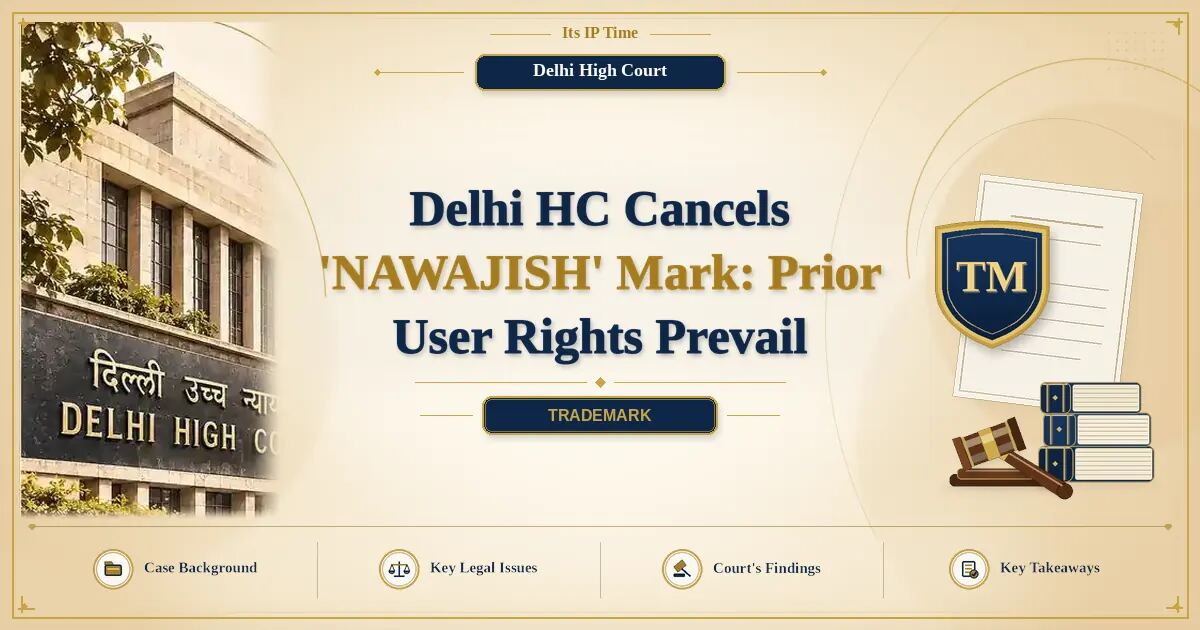
In DUNAR FOODS LIMITED Vs ANKIT VATS TRADING AS AVJK FOODS LLP & ANR. [C.O. (COMM.IPD-TM)-158/2024 2026:DHC:10204], the Delhi High Court expunged the respondent’s trademark registration, reaffirming the judicial primacy of common law prior user rights over subsequent statutory registrations under the Trade Marks Act, 1999.
| Dispute Nature | Cross-petitions for rectification (Section 57) of trademarks for identical rice products. |
|---|---|
| Petitioner Position | Registered owner and prior user of “NAWAJISH” since 2007; claims deceptive adoption by respondent. |
| Respondent Position | Claimed honest concurrent use based on a later 2017 registration; challenged petitioner’s locus standi via ED proceedings. |
| Key Statutory Conflict | Section 28 (Rights conferred by registration) vs. Section 34 (Saving for vested rights of prior users). |
| Court Outcome | Petitioner’s mark upheld; Respondent’s mark cancelled due to dishonest adoption and superior prior rights. |
The Doctrinal Hierarchy: Section 28 and the Subordination of Registration to Prior Use
For foundational statutory analysis, consult our in-depth Trademark Law Guide.
The ruling in Dunar Foods underscores a foundational principle of Indian intellectual property law: the Register of Trade Marks is a record of rights, but it is not the source of title. While Section 28 of the Act confers exclusive rights upon a registered proprietor, these rights are fundamentally qualified by the protective cloak of Section 34. The Delhi High Court has, in this instance, corrected the misconception that a registration certificate provides an unassailable shield against prior market entrants. By rejecting the respondent’s reliance on their 2017 registration, the Court affirmed that statutory rights cannot be weaponized to cannibalize the established goodwill of a senior user. The decision resonates with the jurisprudence in S. Syed Mohideen vs. P. Sulochana Bai, where the Supreme Court articulated that the scheme of the Act intentionally subordinates the rights of a later registrant to the common law rights of a prior user. The registration of a mark is essentially a recognition of a pre-existing or concurrent trade presence; when that presence is proven to be junior and lacking in independent honest adoption, the registration becomes an artificial entry that clogs the registry.
Evidentiary Forensics in Section 57 Rectification Proceedings
The Court’s analysis of the petitioner’s evidence demonstrates the rigorous standard expected in rectification petitions. The petitioner did not merely provide self-serving affidavits but mapped its commercial evolution from its origins in 1956 through its formal incorporation and subsequent continuous usage from 2007. The Court underscored that in cases involving coined or arbitrary terms, such as “NAWAJISH”, the burden on a subsequent user to justify its adoption is substantial. When a defendant fails to provide a plausible explanation for the selection of an identical or near-identical mark in the same niche, the law permits a presumption of bad faith.
The Court provided a critical observation regarding the respondent’s lack of a credible explanation for their adoption of the mark:
When a trader in the same field adopts an identical coined word for identical goods without any plausible explanation or bona fide justification, the only reasonable inference is that the adoption was not honest and was designed to ride upon the prior user’s established reputation.
Hon’ble Mr. Justice Purushaindra Kumar Kaurav, Delhi High Court
This evidentiary standard is a warning to practitioners. The forensic analysis of GST invoices, historical packaging designs, and corporate lineage records serves as the backbone of such litigation. In an age where e-commerce databases allow for the retroactive verification of market entry, parties attempting to claim “first-to-file” superiority without a corresponding history of use face a high probability of having their registration expunged under the Court’s powers to maintain the purity of the Register.
Statutory Safeguards Against Registration Abuse
This provision mandates that the Register must remain a truthful reflection of market reality. The High Court, acting as the ultimate guardian of the Register, is empowered to rectify entries made ‘without sufficient cause’ or those that remain ‘wrongly on the register’ due to violations of Sections 9 and 11, including when registration infringes upon the rights of a senior, prior user.
The Court’s approach to Section 57 is consistent with its duty to prevent the registry from becoming a tool for market distortion. By setting aside the respondent’s registration, the Court emphasized that a mark registered in violation of the relative grounds under Section 11(3), which prohibits registration if the mark would be prevented from being used by the law of passing off, is inherently flawed from its inception. The court effectively utilized the ‘triple test’ for passing off indirectly; it analyzed the petitioner’s prior reputation, the deceptive similarity of the marks, and the likelihood of confusion, ultimately concluding that the respondent’s registration was legally unsustainable.
Regulatory Distractions and the Limits of Corporate Due Diligence
A compelling facet of this case was the respondent’s attempt to challenge the petitioner’s locus standi by citing ongoing Enforcement Directorate (ED) attachments under the Prevention of Money Laundering Act. The Court’s rejection of this defense is a vital contribution to corporate jurisprudence. It clarifies that regulatory or criminal proceedings directed at a company’s financial assets do not, by default, result in the civil death of its intellectual property rights. A temporary restraint on alienating assets does not equate to the forfeiture of the underlying trademark rights or the capacity to defend those rights against infringement.
This finding ensures that corporate entities under financial restructuring or regulatory scrutiny maintain the ability to police their brands. For in-house counsel, the lesson is twofold: first, that administrative or investigative setbacks are not fatal to brand enforcement; and second, that one must ensure the corporate identity and the trademark holding entity are synchronized, even during turbulent periods. The Court correctly identified the ED attachment as a narrow restraint on third-party transfer, not a global prohibition on the company’s ability to defend its market reputation.
Judicial Rationale and the Superiority of Prior User Rights
The Court’s ratio regarding the interaction of conflicting statutory provisions provides a clear directive for future litigation. It reaffirmed the legal reality that the Trade Marks Act is not designed to reward the swiftness of a filing clerk over the reality of a market participant.
The Court articulated the core principle of this interaction as follows:
The law is well-settled that the rights of a prior user are superior to those of a later registrant. In S. Syed Mohideen vs. P. Sulochana Bai, the Supreme Court held as follows, after reading Sections 27, 28 and 34 of the Act together: Thus, the scheme of the Act is such where rights of prior user are recognised superior than that of the registration and even the registered proprietor cannot disturb or interfere with the rights of prior user.
Hon’ble Mr. Justice Purushaindra Kumar Kaurav, Delhi High Court
This judicial pronouncement settles the score for cases where the registrant attempts to rely on a certificate of registration to silence a senior user. The ratio makes it clear that the registration is, at most, a procedural advantage that evaporates the moment a superior prior user demonstrates continuous market usage.
Also Read: Madras HC Rectifies ‘HATSUN’ Mark: Trims Non-Used Product Categories
Key Precedents & Statutory Guidance
- Search recent High Court judgments in our Latest Indian IP Law Cases Directory.
- Examine core statutory doctrines in our Indian Trademark Law Guide.
- In-Depth Guide: Customs IP Recordal in India & ICER Portal Procedures.
- In-Depth Guide: Section 57 Trademark Rectification: Grounds, Jurisdiction & Procedure.
- Catch up in 2 minutes with our latest Weekly Indian IP Law Digest: November 15 to 21, 2026 | Its IP Time (or browse the Weekly IP Digest Archive).
- Review nationwide litigation trends in our Latest Monthly IP Law Roundup.
Strategic Takeaways for Modern IP Practitioners
The Dunar Foods judgment is a masterclass in why superficial reliance on the trademark database is a dangerous practice for modern brand owners. The respondent’s failure to conduct a deep-dive investigation into the market for rice in Class 30 led to a costly and avoidable legal defeat. To prevent such outcomes, in-house teams and their external counsel must implement a multi-layered due diligence framework:
1. Beyond the Registry: A standard trade mark search is merely a baseline. Real due diligence must incorporate market-level verification, including manual searches of state-specific trade license databases, local business directories, and physical market surveys.
2. E-commerce Forensic Trails: With the rise of digital marketplaces, historical listings on platforms act as verifiable proof of date-stamped market usage. Counsel should treat these records with the same evidentiary weight as traditional invoices or warehouse receipts.
3. Proactive Litigation Strategies: The Court’s dismissal of the respondent’s counter-petition suggests that the Delhi High Court is increasingly intolerant of “defensive” litigation tactics designed to harass prior users. If a client is a junior user, the focus should shift toward potential co-existence agreements rather than hostile rectification strategies that lack a firm legal foundation.
In conclusion, the Dunar Foods decision reaffirms the Delhi High Court’s position as a stalwart of traditional, fair-competition principles in intellectual property. By prioritizing the factual history of trade over the procedural outcome of a registration filing, the court has safeguarded the integrity of the market. For the practitioner, the case provides a roadmap for constructing a resilient IP portfolio that relies on the strength of long-term brand building rather than the transient safety of a registry entry. The message is clear: if you are a junior user attempting to usurp a senior player’s name, no amount of paperwork will protect you from the long arm of the law under Section 57.
Case Details: DUNAR FOODS LIMITED Vs ANKIT VATS TRADING AS AVJK FOODS LLP & ANR. | Neutral Citation: 2026:DHC:10204 | Case Number: C.O. (COMM.IPD-TM)-158/2024 | Court: Delhi High Court | Date: 17-11-2026
Presiding Bench: HON’BLE MR. JUSTICE PURUSHAINDRA KUMAR KAURAV