Legal Context
For foundational statutory analysis, consult our in-depth Trade Secrets Law Guide.
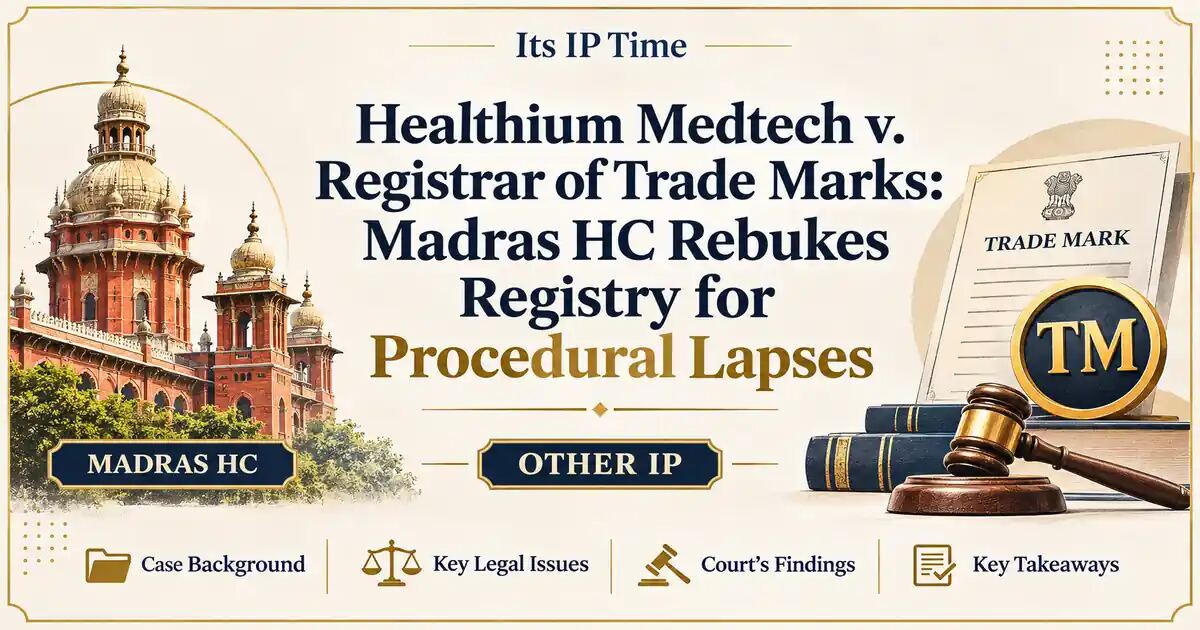
The procedural integrity of the Trade Marks Registry rests upon the foundational requirements of administrative fairness and the statutory mandates of the Trade Marks Act, 1999. In Healthium Medtech Limited v. The Registrar of Trade Marks (WP(IPD).40/2026), the Madras High Court examined the limits of the Registrar’s discretion when dealing with procedural lapses in the prosecution of trademark applications. The case emerges against the backdrop of Section 21 of the Act, which governs the opposition process, and the broader procedural oversight provided under Article 226 of the Constitution of India.
Central to this dispute is the interplay between the applicant’s right to seek registration and the Registrar’s duty to adhere to the strict timelines prescribed in the Trade Marks Rules, 2017. While the statute provides mechanisms for the orderly progression of an application, it simultaneously vests the Registrar with quasi-judicial functions that necessitate the application of the principles of natural justice. The High Court, in its capacity as a supervisory body, was tasked with evaluating whether the Registry correctly exercised its mandate when declining to entertain the petitioner’s submissions.
Issues Before the Court
The primary issue concerned the sustainability of the administrative action taken by the Registrar of Trade Marks at the Chennai office. Specifically, the Court inquired whether the Registrar’s refusal to accept or process the petitioner’s filings constituted a failure to discharge a legal duty, or if such refusal was justified by the procedural constraints of the Trade Marks Act. The Petitioner, Healthium Medtech Limited, challenged the Registry’s conduct, asserting that the denial of access or the rejection of its submissions contravened the spirit of intellectual property protection.
Furthermore, the Court analyzed whether the Registry’s internal management of its case status and electronic filings created an insurmountable hurdle for a bona fide applicant. The legal inquiry probed whether the Petitioner had demonstrated a legitimate grievance that warranted the intervention of the High Court’s writ jurisdiction. Justice Narula, presiding over the matter, focused the analysis on the alignment of the Registrar’s conduct with the legislative intent of maintaining a reliable and accessible register of trademarks.
Treatment of Precedent and Statutory Interpretation
In analyzing the Registrar’s position, the Court relied upon established doctrines regarding the limitations of administrative discretion within the intellectual property framework. The underlying rule, as the Court articulated it, requires the Registry to act as a facilitator of commerce, not a gatekeeper of purely technical obstacles. Justice Narula distinguished this dispute from instances where administrative finality is required, emphasizing that the Registry must ensure that the statutory processes, specifically those concerning notice and opportunity for representation, are observed with precision.
The Court’s interpretation of the Trade Marks Act highlighted that procedural provisions should be interpreted to advance, rather than frustrate, the substantive rights of the registrant. Where a conflict arises between rigid administrative adherence and the principles of natural justice, the latter must hold priority to maintain the credibility of the registration process. Statutory interpretation here served to protect the applicant’s interest in avoiding arbitrary exclusion, ensuring that the Registrar’s powers remain confined to the clear parameters set by the legislature.
Applying the test of procedural fairness, the Court scrutinized the documentation produced by the registry. The bench concluded that the Registry’s failure to account for the Petitioner’s specific circumstances amounted to an oversight that could not be remedied without judicial intervention. By invoking the doctrine of “justice according to law,” the Court reaffirmed that the power of the Registrar is not absolute and must be tempered by the obligation to provide a fair hearing to any entity claiming an interest in a mark.
Key Precedents & Statutory Guidance
- Search recent High Court judgments in our Latest Indian IP Law Cases Directory.
- Examine core statutory doctrines in our Trade Secrets & Emerging IP Law Guide.
- In-Depth Guide: Customs IP Recordal in India & ICER Portal Procedures.
- Catch up in 2 minutes with our latest Weekly Indian IP Law Digest: November 15 to 21, 2026 | Its IP Time (or browse the Weekly IP Digest Archive).
- Review nationwide litigation trends in our Latest Monthly IP Law Roundup.
Significance of the Decision
The ruling in WP(IPD).40/2026 acts as a significant clarification for practitioners who frequently contend with the administrative backlog and technical inconsistencies within the Chennai Registry. It reaffirms the supervisory jurisdiction of the High Court over the Registrar of Trade Marks, particularly when administrative decisions impede the effective prosecution of intellectual property rights. Legal counsel will find this case instructive for its focus on the necessity of maintaining transparency in the administrative file-handling process.
Furthermore, the judgment serves as a reminder to the Registry that its internal protocols, while designed to streamline operations, cannot override the statutory obligations imposed by the Trade Marks Act. The decision mandates that the Registrar provide a reasoned justification for any procedural denial, thereby reducing the scope for opaque administrative action. Litigators seeking to challenge the rejection of documents or the refusal to grant leave will find strong doctrinal support for the argument that the Registrar’s functions must remain accessible and predictable.
This judicial intervention underscores the necessity for the Intellectual Property Office to harmonize its digital infrastructure with the substantive demands of legal compliance. It stands as an important precedent for future writs filed against trademark authorities when administrative convenience is improperly prioritized over the statutory rights of the applicant. Ultimately, the decision preserves the balance between orderly public administration and the protection of private commercial interests within India’s evolving IP landscape.
Case Details: Healthium Medtech Limited, Vs The Registrar of Trade Marks, | Case Number: WP(IPD).40/2026 | Court: Madras High Court | Date: 26-11-04
Presiding Bench: The Hon’ble Mr. Justice P.B. Balaji