Factual Matrix
Looking to master Trade Secrets & Emerging IP Law jurisprudence? Read our full Trade Secrets Law Guide.
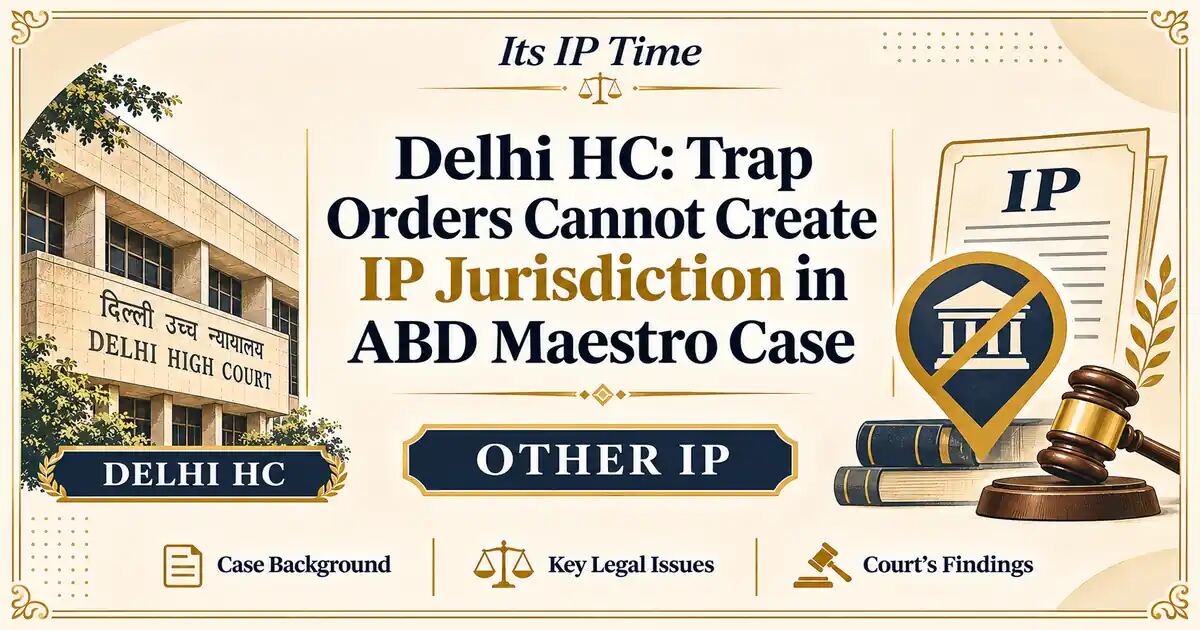
Establishing forum jurisdiction under special intellectual property enactments demands far more than casual digital accessibility or artificial commercial transactions created solely to manufacture a cause of action. In ABD Maestro Private Limited v. Great Galleon Ventures Ltd, the Delhi High Court evaluated whether a plaintiff can validly invoke Section 134(2) of the Trade Marks Act, 1999 and Section 62(2) of the Copyright Act, 1957 without establishing actual, continuous commercial activity within the court’s territorial borders. The plaintiff, ABD Maestro Private Limited, instituted commercial suit CS(COMM)-987/2026 seeking permanent injunction, damages, and delivery up against Great Galleon Ventures Ltd and ancillary defendants, including unidentified John Doe entities. ABD Maestro Private Limited asserted exclusive statutory ownership over its registered trademarks and copyright in distinct label artistic works, claiming widespread brand equity and prior user rights across alcoholic beverage markets.
Trouble arose when Great Galleon Ventures Ltd introduced competing products utilizing deceptively similar trade dress, bottle packaging, and label artwork. The plaintiff alleged that the defendant’s packaging directly infringed its copyright in the artistic work of its product carton and constituted passing off in the market. However, a formidable procedural threshold emerged immediately upon filing. Great Galleon Ventures Ltd operated outside the territorial jurisdiction of Delhi, maintaining its principal places of business and manufacturing units in neighboring states. Similarly, ABD Maestro Private Limited had its primary corporate registration outside the capital territory, placing its reliance upon local retail availability to establish venue.
To establish territorial jurisdiction within the Delhi High Court, ABD Maestro Private Limited pointed to digital visibility across online platforms, interactive website accessibility via social media handles, and localized product purchases. Specifically, the plaintiff relied upon solitary “trap orders” executed through legal representatives within Delhi to prove that infringing goods were entering the local market. The plaintiff contended that such localized purchases, combined with digital reach, satisfied the jurisdictional requirement of carrying on business within the capital. Great Galleon Ventures Ltd resisted the suit at the threshold, filing procedural objections asserting that engineered trap transactions cannot create a legitimate cause of action where no regular commercial distribution exists.
Applicable Law & Statutory Provisions
Jurisdiction in Indian intellectual property litigation operates under a dual framework, balancing general civil rules against specialized statutory exceptions. Under Section 134(2) of the Trade Marks Act, 1999, which governs territorial jurisdiction for registered trademark enforcement, a registered proprietor enjoys the statutory privilege of instituting an infringement suit within the forum where it actually and voluntarily resides, carries on business, or personally works for gain. Section 62(2) of the Copyright Act, 1957, establishing parallel forum convenience provisions for copyright owners, mirrors this statutory concession by permitting copyright infringement actions at the plaintiff’s commercial location.
These specialized provisions purposefully deviate from Section 20 of the Code of Civil Procedure, 1908, which ordinarily mandates instituting suits where the defendant resides, carries on business, or where the cause of action arises in whole or in part. By enacting Section 134(2) and Section 62(2), Parliament intended to protect intellectual property owners from being dragged to distant jurisdictions by alleged infringers. Nevertheless, invoking these beneficial provisions requires satisfying stringent evidentiary standards regarding what legally constitutes “carrying on business” within the forum state. Courts have repeatedly held that carrying on business requires a continuous, substantial commercial presence rather than isolated or casual commercial interactions.
Where passing off claims accompany registered trademark or copyright infringement suits, jurisdictional analysis becomes further complicated. Passing off remains a common law tort governed by Section 20(c) of the Code of Civil Procedure, 1908, requiring a showing that a material part of the cause of action accrued within the court’s territorial limits. Plaintiff entities cannot automatically extend the forum convenience of Section 134(2) or Section 62(2) to passing off claims unless independent territorial jurisdiction exists for the common law remedy. This jurisdictional dichotomy requires litigators to carefully differentiate between statutory infringement remedies and common law tort actions.
Precedential jurisprudence heavily shapes judicial assessment of online domain accessibility and digital commercial presence. In Banyan Tree Holding Ltd v. A. Murali Krishna Reddy, the Delhi High Court established the definitive test for determining jurisdiction over interactive websites, requiring the plaintiff to demonstrate that the defendant purposefully availed itself of the forum state’s jurisdiction by targeting local consumers. Similarly, in Burger King Corporation v. Techboffee, the court clarified territoriality boundaries for offline trademark disputes, holding that casual or passive presence fails to fulfill statutory mandates. The judicial framework requires examining whether trap transactions satisfy these evidentiary standards.
Judicial Analysis
Justice Narula scrutinised the jurisdictional foundation laid by ABD Maestro Private Limited, dissecting the evidentiary weight of trap transactions and digital presence. The bench reiterated that judicial scrutiny of territorial jurisdiction at the preliminary stage must look past clever pleading to examine underlying commercial reality. Central to the court’s inquiry was whether engineered trap orders can independently generate a localized cause of action or establish that a plaintiff carries on business within the forum territory under Section 134(2) of the Trade Marks Act, 1999 and Section 62(2) of the Copyright Act, 1957.
Addressing the evidentiary legitimacy of manufactured purchases, the High Court analyzed whether trap transactions suffice to confer jurisdiction. The judge observed that while trap orders may occasionally assist in proving product availability or sample acquisition for infringement analysis, they cannot serve as a synthetic substitute for genuine commercial presence. A plaintiff cannot unilaterally manufacture jurisdiction in a preferred forum by dispatching investigators or agents to execute isolated purchases when the defendant does not routinely target or supply that market.
Trap transactions engineered solely by the plaintiff’s agents fail to demonstrate purposeful availment by the defendant. The bench observed that allowing single, artificial transactions to dictate territorial venue would invite widespread forum shopping, defeating the statutory purpose of jurisdictional rules. The court emphasized that a defendant must actively target consumers within the forum state, demonstrating an intent to engage in commercial transactions within that specific territory. Isolated, buyer-induced transactions do not reflect voluntary commercial penetration by the seller.
Analyzing digital visibility, the court held that mere website accessibility or online domain presence within a state does not equate to carrying on business. Under the Banyan Tree doctrine, an interactive website confers jurisdiction only if it results in actual, commercial transactions purposefully aimed at consumers within the forum state. The court found that passive listings, promotional social media pages, or general web visibility cannot satisfy the statutory requirements of Section 134(2) of the Trade Marks Act, 1999 or Section 62(2) of the Copyright Act, 1957. Commercial activity must possess character, continuity, and real market presence.
Evaluating the passing off claim, the bench emphasized that misrepresentation and commercial injury must manifest within the territorial limits of the forum court. Passing off requires proving existing commercial goodwill and active consumer deception within the local market. Where a plaintiff fails to establish regular trade channels, active retail distribution, or established reputation within Delhi, a common law passing off action cannot survive territorial scrutiny under Section 20(c) of the Code of Civil Procedure, 1908. Consequently, the bench declined to entertain the passing off action alongside the statutory infringement claims without proper jurisdictional backing.
Also Read: India’s Semiconductor IP Paradox: Layout-Design Registrations, the SICLD Act, and Domestic Ownership
Key Precedents & Statutory Guidance
- Search recent High Court judgments in our Latest Indian IP Law Cases Directory.
- Examine core statutory doctrines in our Trade Secrets & Emerging IP Law Guide.
- In-Depth Guide: Customs IP Recordal in India & ICER Portal Procedures.
- In-Depth Guide: Allied and Cognate Goods in Indian Trademark Infringement Law.
- Catch up in 2 minutes with our latest Weekly Indian IP Law Digest: November 15 to 21, 2026 | Its IP Time (or browse the Weekly IP Digest Archive).
- Review nationwide litigation trends in our Latest Monthly IP Law Roundup.
Practical and Commercial Implications
Strategic forum selection in intellectual property litigation requires corporate counsel to conduct rigorous pre-litigation jurisdictional audits before filing suit. Relying exclusively on manufactured trap purchases or nationwide e-commerce visibility exposes plaintiffs to immediate procedural challenges, costly jurisdictional trials, and potential plaint rejection under Order VII Rule 10 or Rule 11 of the Code of Civil Procedure, 1908. Litigators must advise corporate clients that courts increasingly scrutinize forum shopping tactics designed to haul defendants into inconvenient jurisdictions.
Corporate entities seeking to establish venue under Section 134(2) of the Trade Marks Act, 1999 or Section 62(2) of the Copyright Act, 1957 must maintain meticulous documentation of local commercial activities within the intended forum. Substantive evidence must accompany the plaint to survive preliminary jurisdictional challenges. Key commercial records required to prove genuine business presence include:
- Tax invoices demonstrating regular, continuous sales through authorized local distributors or retail outlets within the jurisdiction.
- GST registration certificates and physical office lease agreements proving an established operational presence within the forum state.
- Targeted local marketing expenditure, regional advertising contracts, and promotional campaign invoices specific to the territorial market.
- Logistical distribution agreements and supply chain registers showing systematic product movement into the regional territory.
Defendants facing intellectual property infringement suits in non-domiciliary forums must challenge territorial jurisdiction at the earliest procedural stage. Filing a prompt application under Order VII Rule 11 of the Code of Civil Procedure, 1908 prevents tacit submission to jurisdiction and forces the plaintiff to substantiate its venue selection. Defense litigators should systematically dissect the plaintiff’s reliance on trap orders and passive website access, citing Banyan Tree and Burger King precedents to demonstrate the lack of purposeful availment.
Litigation tactics must adapt to modern commercial reality. While trap orders remain valuable evidentiary tools to prove physical product features, trade dress copying, or counterfeit manufacturing, they cannot serve as the sole foundation for territorial jurisdiction. Corporate legal counsel must separate the evidentiary role of trap transactions from fundamental statutory jurisdiction rules. Establishing robust, documented commercial operations in key commercial hubs remains the only dependable strategy for securing favorable legal venues in complex Indian IP disputes.
Case Details: ABD MAESTRO PRIVATE LIMITED Vs GREAT GALLEON VENTURES LTD | Neutral Citation: 2026:DHC:9844 | Case Number: CS(COMM)-987/2026 2026:DHC:9844 | Court: Delhi High Court | Date: 03-11-2026
Presiding Bench: Hon’ble Mr. Justice Purushaindra Kumar Kaurav