Procedural Standing in Transnational Geographical Indication Disputes
For foundational statutory analysis, consult our in-depth GI Law Guide.
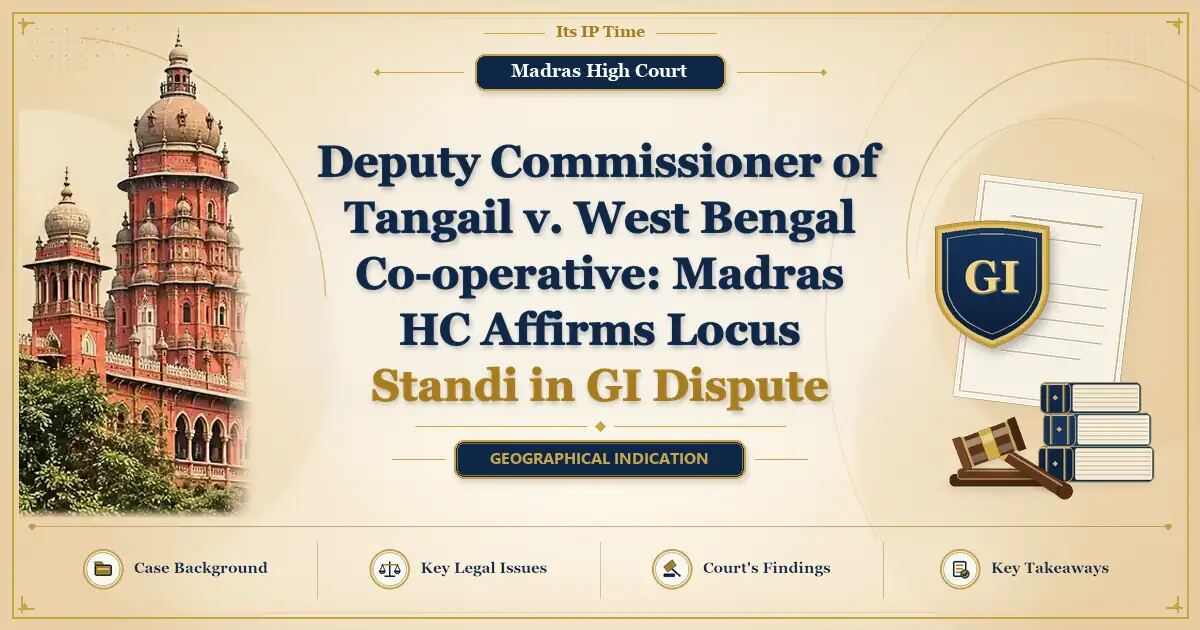
The threshold question of whether a foreign state entity possesses the locus standi to challenge a domestic Geographical Indication (GI) registration has been affirmatively settled by the Madras High Court. In Deputy Commissioner of Tangail, Bangladesh v. West Bengal State Handloom Weavers Co-operative Society Ltd. & Ors., Justice P.B. Balaji dismissed an application for summary rejection, effectively clearing the path for a substantive examination of the competing claims over the ‘Tangail Saree’ designation. This development signals a rigorous judicial approach to the interpretation of Section 27 of the Geographical Indications of Goods (Registration and Protection) Act, 1999, which governs the rectification of the register. By refusing to dispose of the petition at the preliminary stage, the bench avoided a premature closure on the complex intersection of traditional knowledge, cross-border migration of craft, and the statutory requirements of the Act.
Background and Material Facts
The dispute centers on the provenance and nomenclature of the Tangail Saree, a traditional handloom textile inextricably linked to both Bangladesh and the Indian state of West Bengal. In September 2020, the West Bengal State Handloom Weavers Co-operative Society Ltd. initiated an application for the registration of the ‘Tangail Saree of Bengal’ as a Geographical Indication. The Indian Geographical Indications Registry subsequently granted this registration on January 2, 2024. This administrative act recognized the specific weaving communities that migrated from the Tangail district of Bangladesh to West Bengal, where they continued to preserve the traditional craft. Resistance from the Bangladeshi authorities emerged shortly thereafter, predicated on the cultural and historical roots of the textile within the Tangail region of Bangladesh. The Deputy Commissioner of Tangail, acting through the Bangladesh High Commissioner in New Delhi, initiated a rectification petition in 2025. This challenge seeks the cancellation or variation of the Indian GI registration, asserting that the entry was wrongly made or remains wrongly on the register. Furthermore, the petitioner bolstered its position by securing a domestic GI registration for the ‘Tangail Sari’ in 2024 and obtaining recognition from UNESCO for the traditional saree weaving art of Tangail in December 2025.
Legal Issues and Statutory Framework
The primary legal controversy before the Court rested upon the interpretation of Section 27 of the Geographical Indications of Goods (Registration and Protection) Act, 1999. This section serves as the statutory mechanism for the rectification of the register, allowing for the cancellation or variation of entries that are found to be improperly registered. Crucially, the right to move the High Court or the Registrar for such relief is reserved for a “person aggrieved.” The West Bengal State Handloom Weavers Co-operative Society Ltd. predicated its defense on the argument that the Deputy Commissioner of Tangail lacked the requisite legal standing to qualify as an aggrieved party. They posited that a foreign governmental entity, absent a direct commercial interest in the Indian market as defined by the narrow construction of the Act, failed to meet the threshold for such a challenge. Opposing this, the petitioner argued that the existence of a conflicting GI registration and the international recognition of their sovereign claim to the heritage provided a clear legal interest in seeking the rectification. The Court was therefore tasked with determining whether this threshold challenge warranted the dismissal of the petition in limine.
Court’s Reasoning and Findings
Justice P.B. Balaji adopted a cautious, procedural approach that prioritized a full-fledged factual inquiry over summary disposal. The bench rightly concluded that the question of whether the petitioner is an “aggrieved person” under Section 27 cannot be determined in isolation from the merits of the underlying geographical and historical claims. By rejecting the application for summary dismissal filed by the West Bengal cooperative, the Court ensured that the substantive dispute regarding the legitimacy of the ‘Tangail Saree of Bengal’ registration remains open for adjudication. The judicial logic employed here emphasizes the necessity of a complete evidentiary record when addressing disputes of this magnitude. Since the pleadings in the main petition reached completion, the Court mandated that the parties transition to the discovery phase, specifically directing the filing of affidavits of admission and denial of documents. This procedural directive indicates that the Court perceives the dispute as requiring a granular assessment of evidence rather than a rigid, initial reliance on the technical definitions of standing.
“The Court said the parties should be relegated to a full-fledged inquiry before deciding the plea for rectification or cancellation of the GI registration.”
Hon’ble Justice P.B. Balaji
The decision reflects an understanding that in the realm of intellectual property, particularly where geographical indicators intersect with cross-border heritage, the status of an aggrieved person is intrinsically linked to the commercial and cultural impact of the registration. The refusal to truncate these proceedings serves as a procedural safeguard against the inadvertent deprivation of a party’s right to challenge an entry that may directly affect its cultural assets.
Also Read: Kolhapuri Chappal GI: Why Design Copying Remains Unprotected
Key Precedents & Statutory Guidance
- Search recent High Court judgments in our Latest Indian IP Law Cases Directory.
- Examine core statutory doctrines in our Geographical Indications Law Guide.
- In-Depth Guide: Customs IP Recordal in India & ICER Portal Procedures.
- In-Depth Guide: Section 57 Trademark Rectification: Grounds, Jurisdiction & Procedure.
- Catch up in 2 minutes with our latest Weekly Indian IP Law Digest: November 15 to 21, 2026 | Its IP Time (or browse the Weekly IP Digest Archive).
- Review nationwide litigation trends in our Latest Monthly IP Law Roundup.
Decision and Significance
The Madras High Court’s ruling on November 20, 2026, functions as a vital procedural checkpoint for future GI litigation involving sovereign or foreign entities. By upholding the maintainability of the petition, the Court has affirmed that challenges to GI registrations, particularly those involving multi-jurisdictional claims to traditional knowledge, must be scrutinized through a full evidentiary process. This aligns with the legislative intent behind the 1999 Act, which allows for the correction of the register to ensure accurate attribution of regional goods. Practically, this decision compels both domestic and foreign stakeholders to prepare for intensive litigation regarding the historical veracity and geographical boundaries associated with GI-protected products. The focus now shifts toward the December 7 hearing, where the parties will present their respective evidentiary support. For practitioners, the case underscores the difficulty of employing summary dismissal strategies in complex IP disputes where the core issue involves the definition of protected territory and cultural ownership. The reliance on the “person aggrieved” standard is likely to evolve as the Court reviews the substantive documents. If the Indian registration is found to rely on migrated skills that originated elsewhere, the evidentiary weight will become the decisive factor in determining whether the registration remains legally sound. Counsel should observe that the Court has consciously avoided a definitive ruling on the merits at this preliminary stage, preferring to let the procedural record dictate the outcome. The case further highlights the growing tension between domestic GI protections and international recognitions, such as those issued by UNESCO. While the Court is bound by the domestic statute, the global context of the product’s origin provides the backdrop against which the “wrongly made or wrongly remaining” test of Section 27 will be applied. The litigation will likely set a standard for how Indian courts reconcile local statutory requirements with international claims of cultural property. Ultimately, the order ensures that the dispute over the Tangail Saree will not be resolved through procedural technicalities but rather through a forensic examination of the geographical and historical assertions made by both the West Bengal cooperative and the Bangladeshi authorities. The legal community will watch the subsequent phases of this inquiry with interest, as it promises to clarify the limits of GI protection when traditional crafts traverse national borders. The requirement for affidavits of admission and denial represents a critical step toward narrowing the factual issues for trial. In summary, the bench has preserved the integrity of the adversarial process. By directing the parties to substantiate their claims through the prescribed trial mechanism, the Court ensures that the determination of the rectification petition rests on a robust evidentiary foundation. Litigators should take note of this trend, as the Court demonstrates an increasing preference for addressing the underlying substance of complex cross-border IP claims rather than curtailing them through preliminary challenges. The battle for the Tangail Saree designation is now, firmly and officially, a matter for substantive trial.
Case Details: Deputy Commissioner of Tangail, Bangladesh v. West Bengal State Handloom Weavers Co-operative Society Ltd. & Ors. | Case Number: (GI) A. 1/2026 in OP(GI) No. 1 of 2025 | Court: Madras High Court | Date: 26-11-20
Presiding Bench: Hon'ble Justice Pb Balaji Dismissed An Applica and Hon'ble Justice Pb Balajithe Rectification Pet and Hon'ble Justice Pb Balajitangail Saree Follow