In RATAN JAIN Vs MAHAVEERCHAND DHOKA [CS.161/2022], the Madras High Court dismissed the suit in its entirety, effectively utilizing the summary judgment mechanism to terminate a contentious trademark infringement action at the pre-trial stage. The Commercial Division, presided over by the Hon’ble Dr. Justice A.D. Maria Clete, addressed the strategic intersection of the Trademarks Act, 1999, and the procedural mandate of the Commercial Courts Act, 2015. By invoking Order XIII-A of the Code of Civil Procedure, 1908, the Court scrutinized the merit of the Plaintiff’s proprietary claims against the Defendant’s commercial adoption of a mark within the beverage sector. The ruling underscores the shift in Indian judicial philosophy toward preventing meritless or “nuisance” trademark litigation from consuming judicial time and hindering legitimate market competition through expensive, prolonged trials.
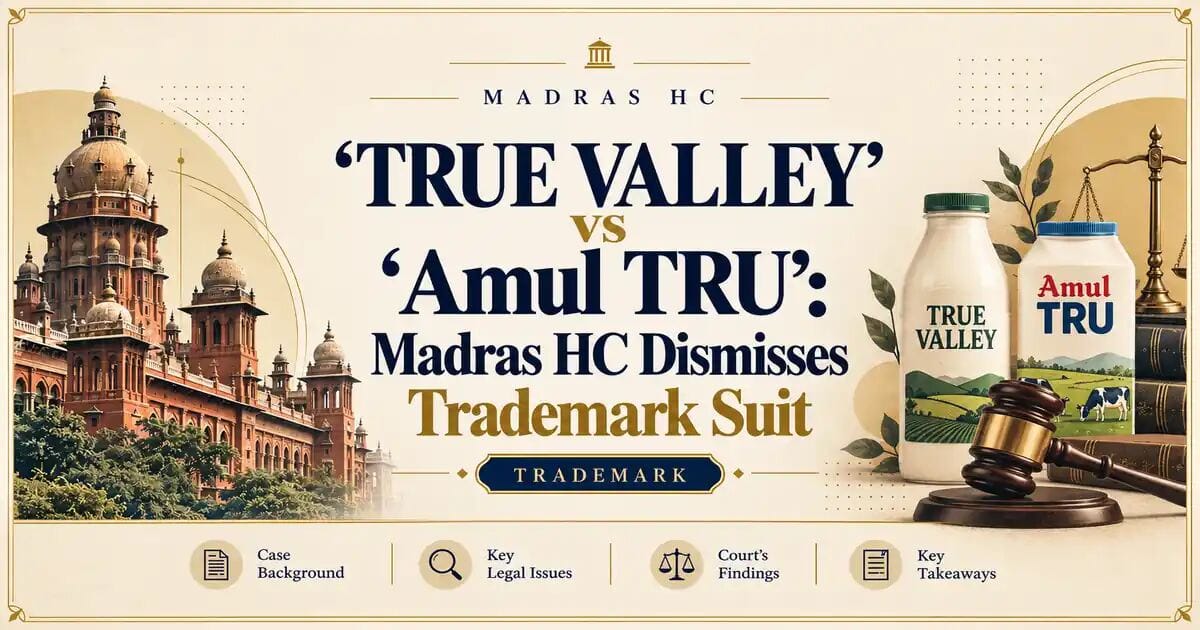
| Disputed Subject Matter | Registered Trademark “TRUE VALLEY” (No. 2276842 in Class 32) versus the Defendant’s product mark “Amul TRU” used for non-alcoholic fruit juices and dairy-based beverages. |
|---|---|
| Plaintiff’s Case | Asian Beverage Private Limited asserted exclusive statutory rights under Section 28 of the Trademarks Act, 1999, alleging that the Defendant’s mark “Amul TRU” was deceptively similar to its registered mark “TRUE VALLEY,” claiming potential confusion in the Class 32 beverage market. |
| Defendant’s Defense | Kaira District Co-operative Milk Producers Union Limited argued that its mark was a composite of the world-renowned “Amul” brand and the descriptive suffix “TRU,” and that the Plaintiff failed to establish a real prospect of success, necessitating a summary disposal under Order XIII-A. |
| Governing Law & Authorities | Sections 27, 28, 29, 134, and 135 of the Trademarks Act, 1999; Order XIII-A of the Code of Civil Procedure, 1908 (as amended); Principles of the triple test under Order XXXIX. |
| Decisive Holding | The Court allowed the Defendant’s application under Order XIII-A, determining the suit was untenable and dismissing it entirely without the necessity of a full-scale oral trial. |
The Intersection of Statutory Rights and Procedural Efficiency
New to Indian Trademark Law? Start with our comprehensive Trademark Law Guide.
The core of this dispute rested on the Plaintiff’s reliance on Section 28 of the Trademarks Act, 1999, which grants the registered proprietor the exclusive right to use the trademark. However, the legal landscape in India, as interpreted through the lens of the Commercial Courts Act, 2015, necessitates that a claimant’s statutory monopoly must be balanced against the evidentiary requirements of demonstrating deceptive similarity. The Madras High Court’s decision emphasizes that registration is not a sword to be used indiscriminately against established commercial entities, particularly when the mark in question consists of descriptive components or is used in conjunction with a dominant, well-known house mark like “Amul.”
The Court’s reliance on Order XIII-A reflects a rigorous assessment of whether the trial would serve any meaningful purpose. In instances where the visual and phonetic distinctions are manifest, such as the comparison between “TRUE VALLEY” and “Amul TRU,” the court has the mandate to evaluate the evidence provided at the threshold. This shift minimizes the “litigation tax” imposed by parties who rely on the slow pace of the Indian judiciary to maintain a facade of exclusivity that the market reality does not support.
This provision, as amended by the Commercial Courts Act, 2015, allows the Court to give a summary judgment against a plaintiff or defendant on a claim if it appears that the party has no real prospect of succeeding on the claim and there is no other compelling reason why the claim should be disposed of before a full trial.
Evidentiary Forensics: Weighing Documentary Proof over Mere Registration
A critical component of this judgment is the Court’s reliance on objective, contemporaneous evidence over the abstract claim of infringement. In modern trademark litigation, the reliance on mere registration certificates is often insufficient when faced with a defendant who can demonstrate a well-established supply chain, GST documentation, and national marketing footprints. The Defendant in this matter successfully utilized forensic evidence to demonstrate that its mark existed in a different commercial ecosystem, thereby negating the likelihood of consumer confusion.
The evidentiary standards in commercial cases now require more than just assertions of phonetic similarity. Courts are increasingly looking for actual market evidence, such as invoice trends, point-of-sale data, and the branding context of the products. When the Defendant produces such a record, it shifts the burden onto the plaintiff to justify why the trial is required, which in this case, the Plaintiff failed to do.
Regarding the procedural findings, the Court articulated the specific basis for its departure from standard trial procedures. The following observation details the Court’s determination on the sufficiency of the record:
Today, when the matter is taken up for hearing, the Application No.770 of 2023 filed under order XIII-A of CPC 1908 to dispose of claim/suit without oral examination of witnesses is Allowed.
Hon’ble Dr. Justice A.D. Maria Clete, Madras High Court
Doctrinal Foundations: Section 28 and the Limits of Monopoly
The doctrinal conflict between the absolute protection under Section 28 and the common law rights under Section 34 remains a central pillar of Indian IP jurisprudence. In cases involving marks like “TRUE” or “TRU,” which are inherently descriptive, the court must engage in an analysis of whether the plaintiff has acquired sufficient secondary meaning to preclude others from using common English words. As highlighted in S. Syed Mohideen v. P. Sulochana Bai, the statutory right of a registered proprietor is subject to the prior rights of others, and in this instance, the Defendant’s integration of the “Amul” brand effectively diluted any potential for confusion.
Furthermore, the Court’s approach aligns with the principles in Neon Laboratories v. Medical Technologies, where the court looked at the global commercial impression of the marks. By allowing the summary judgment, the court confirmed that a registered mark cannot be used to prevent third parties from using a composite mark where the dominant feature is a well-known brand name that acts as the primary source identifier. This prevents “trademark bullying” and ensures that the Trademark Registry remains a record of genuine commercial interests rather than a collection of defensive obstacles.
The Jurisprudential Significance of the Final Order
The dismissal of the suit without the requirement of a full-scale trial marks a significant development in how the Madras High Court manages its commercial docket. It reinforces the authority of the judge to intervene early in the interest of justice. The finality of the judgment is captured in the Court’s directive, which effectively closes all ancillary applications and provides immediate relief to the Defendant, protecting their operational continuity.
Hence the present suit is dismissed. No cost. Consequently, connected applications are closed.
Hon’ble Dr. Justice A.D. Maria Clete, Madras High Court
Strategic Due Diligence for In-House Counsel
This case serves as a cautionary tale for in-house legal departments regarding the reliance on the trademark register during the product development phase. The “registration illusion”, the assumption that a certificate of registration is an absolute shield against infringement claims, often crumbles when faced with a defendant capable of demonstrating legitimate, long-term market presence through consistent evidence. When a brand identifies a conflict, the strategy must involve more than just a threat of litigation.
General Counsel should mandate that all product launches undergo a “deep-clearance” audit. This audit must transcend the Trademark Registry and include a scan of: (a) regulatory databases (e.g., FSSAI, GST records), (b) regional digital marketplaces, and (c) historical brand usage across social media. If a potential conflict is identified, the strategy should favor a risk-based assessment, considering coexistence agreements or territorial limitations, rather than proceeding on the assumption that a registration will survive a rigorous summary judgment challenge. The cost of a failed infringement suit, involving potential counter-claims and the risk of the court directing a cancellation under Section 57, far exceeds the cost of a comprehensive, proactive clearance protocol.
Also Read: Delhi HC Restrains ‘VEEPRO’ Mark for Infringing ‘WIPRO’ Trademark
Key Precedents & Statutory Guidance
- Search recent High Court judgments in our Latest Indian IP Law Cases Directory.
- Examine core statutory doctrines in our Indian Trademark Law Guide.
- Procedural Breakdown: Customs IP Recordal in India & ICER Portal Procedures.
- Review nationwide litigation trends in our Monthly IP Law Roundup.
Summary of Corporate Best Practices
To navigate the post-2015 litigation climate, corporations must ensure that their intellectual property strategies are built on a foundation of verifiable market reality. When initiating litigation, counsel must ensure that the “triple test” under Order XXXIX is supported by robust data rather than mere legal posturing. Conversely, when defending, the focus should remain on aggressive, early-stage procedural wins such as Order XIII-A, coupled with a simultaneous Section 57 rectification strategy if the plaintiff’s mark is found to be descriptive or over-broad. This “shield and sword” approach ensures that resources are allocated to preserving market share rather than exhausting budgets on trials that lack merit. In the final analysis, the law exists to protect the honest trader, and as the Madras High Court has demonstrated, it will not permit its mechanisms to be used to stifle competition through the assertion of unsustainable proprietary claims.
Case Details: RATAN JAIN Vs MAHAVEERCHAND DHOKA | Case Number: CS.161/2022 | Court: Madras High Court | Date: 2026-10-09
Presiding Bench: Hon’ble THE HONOURABLE DR. JUSTICE A.D. MARIA CLETE