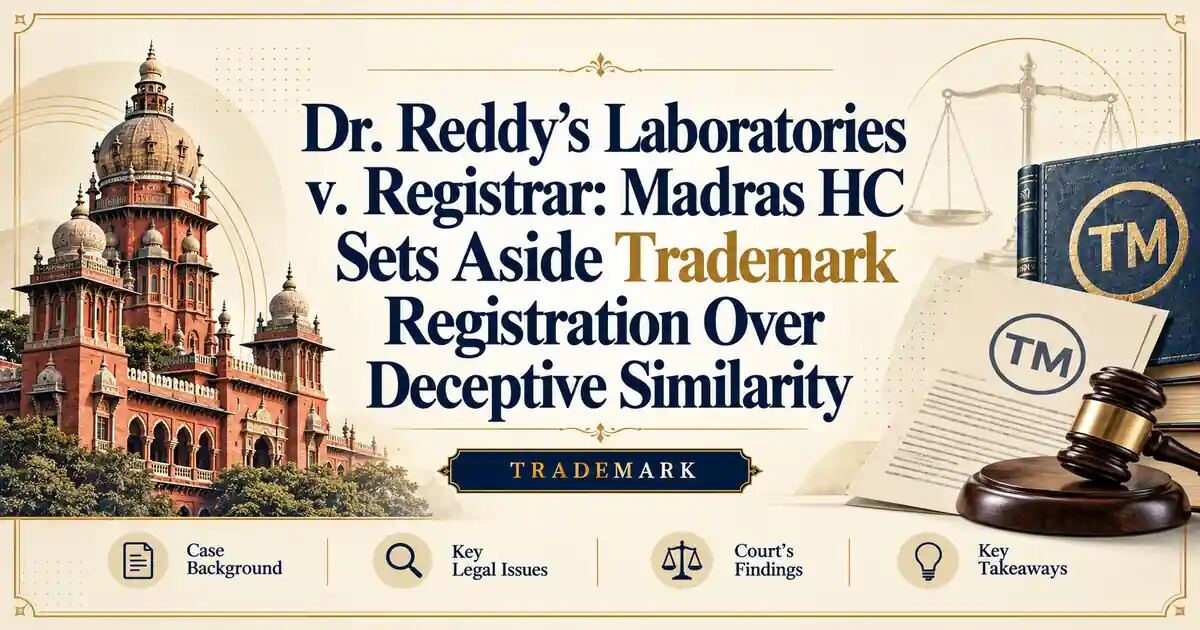
The judicial oversight of trademark registration and opposition proceedings under Section 91 of the Trade Marks Act, 1999, which grants a right of appeal to the High Court against decisions of the Registrar, remains a fundamental mechanism for maintaining the integrity of the Trade Marks Register. In DR.REDDYS LABORATORIES LIMITED Vs THE REGISTRAR OF TRADEMARKS (CMA(TM).31/2025), the Madras High Court examined the boundaries of the Registrar’s discretion when determining the deceptive similarity between competing pharmaceutical marks. This analysis focuses on the doctrinal application of the test of imperfect recollection as applied to marks in Class 5.
What Sparked the Dispute Between Dr. Reddy’s Laboratories and the Respondent?
For foundational statutory analysis, consult our in-depth Trademark Law Guide.
The genesis of this controversy lies in the opposition proceedings initiated by Dr. Reddy’s Laboratories Limited against Trade Mark Application No. 1730955 filed by the second respondent, Nice Neotech Medical Systems. Dr. Reddy’s, a registered proprietor of the mark “NISE” in Class 5 for pharmaceutical preparations, contended that the respondent’s mark “NICE” was phonetically and visually indistinguishable from its own, posing an unacceptable risk of confusion. It asserted that it had adopted the mark “NISE” as early as 1995, basing its nomenclature on the active pharmaceutical ingredient found within its products. The appellant maintained that the respondent’s subsequent adoption of a deceptively similar mark, despite operating in distinct market segments, constituted an infringement upon its established reputation. Conversely, the second respondent denied all allegations of dishonest adoption or potential for consumer misrepresentation. It argued that the goods in question belonged to different classifications, thereby negating any likelihood of commercial association. This position sought to isolate the mark from the stringent standard applied to medicinal products, where even a slight similarity in naming conventions is often treated with extreme caution. The Registrar, through the Assistant Registrar of Trade Marks and G.I., ultimately issued an order on August 22, 2025, which prompted the appellant to seek relief from the Madras High Court under the provisions of the 1999 Act and the Intellectual Property Rights Division Rules of 2022.
What Legal Questions Did the Court Consider?
Central to the Court’s inquiry was whether the Assistant Registrar had properly applied the standard of an average purchaser with imperfect recollection when evaluating the marks “NISE” and “NICE.” The court was tasked with determining if the respondent’s mark failed the test of deceptive similarity mandated by the statutory framework for trademark protection. Furthermore, it examined whether the lower authority had erroneously prioritized the respondent’s claims while discounting the appellant’s historical usage and established proprietary interests in the mark. A significant portion of the judicial discourse addressed the methodology of comparison. The court evaluated whether the assessment of similarity requires a holistic approach or whether it allows for the compartmentalization of phonetics and visual representations. Legal submissions underscored that the test must be objective, based not upon the sophisticated scrutiny of experts, but rather upon the potential for confusion in the mind of the ordinary consumer. The court weighed whether the respondent’s argument concerning different classes of goods could successfully overcome the inherent risk of confusion posed by the phonetic proximity of the two marks.
What Did the Court Hold on Deceptive Similarity?
The Court’s assessment reaffirmed the established doctrine that the determination of deceptive similarity is not a mechanical exercise of comparing isolated letters or sounds. Justice Narula’s judgment emphasized that the core requirement is to evaluate the mark’s overall impression upon the target demographic. In instances involving pharmaceutical products, the threshold for similarity is significantly higher because the risk of harm resulting from the misidentification of medication is substantial. The ruling clarified that the Registrar’s decision to allow the registration must withstand the scrutiny of whether an ordinary buyer, exercising ordinary caution, would be misled. The court scrutinized the findings of the Assistant Registrar, noting that a perfunctory rejection of the opposition fails to satisfy the legal standards required to protect registered proprietors from dilution and confusion. Ultimately, the court held that the Assistant Registrar’s analysis was deficient, as it failed to sufficiently weigh the impact of the phonetic similarity between “NISE” and “NICE.” The court emphasized that when the marks are used on goods of a similar nature, or where the mark is already well-known within the industry, the Registrar must exercise heightened vigilance. The failure to do so, as observed in the present order, necessitates a re-evaluation of the evidence presented during the opposition proceedings to ensure the integrity of the registry.
Also Read: Delhi HC Restrains ‘VEEPRO’ Mark for Infringing ‘WIPRO’ Trademark
Key Precedents & Statutory Guidance
- Search recent High Court judgments in our Latest Indian IP Law Cases Directory.
- Examine core statutory doctrines in our Indian Trademark Law Guide.
- Procedural Breakdown: Customs IP Recordal in India & ICER Portal Procedures.
- Review nationwide litigation trends in our Monthly IP Law Roundup.
Why Does This Decision Matter for IP Holders?
proprietary rights in a trademark cannot be undermined by the simplistic assertion that goods belong to different commercial categories if the phonetics and visual composition of the marks are likely to cause confusion. For IP practitioners, the case clarifies that reliance on the ‘imperfect recollection’ standard is a primary safeguard for established brands, particularly in highly regulated sectors like pharmaceuticals. It serves as a stern reminder to the Trade Marks Registry that orders disposing of opposition proceedings must demonstrate a rigorous application of the law, rather than merely repeating the parties’ claims. The procedural emphasis on the Intellectual Property Rights Division Rules of 2022 suggests that the judiciary is actively narrowing the scope for arbitrary decision-making within the Registry. Litigators should note that the court’s preference for a holistic view of the marks limits the effectiveness of arguments predicated on the dissection of individual components of a trademark. The decision provides a valuable precedent for appellants seeking to set aside Registrar orders that lack a deep, reasoned analysis of the potential for consumer deception. By reinforcing the high standard required for coexistence between similar marks, the court has safeguarded the value of long-standing brand assets. Legal counsel must ensure that evidence of prior use and market reputation is presented with precision during opposition hearings, as this foundational documentation is critical should an appeal be necessary under Section 91.
Case Details: DR.REDDYS LABORATORIES LIMITED Vs THE REGISTRAR OF TRADEMARKS | Case Number: CMA(TM).31/2025 | Court: Madras High Court | Date: 26-10-26 This judicial analysis reviews the statutory principles and evolving judicial precedent concerning Any Write Ups under contemporary Indian intellectual property jurisprudence.
Presiding Bench: Hon'ble Information not available