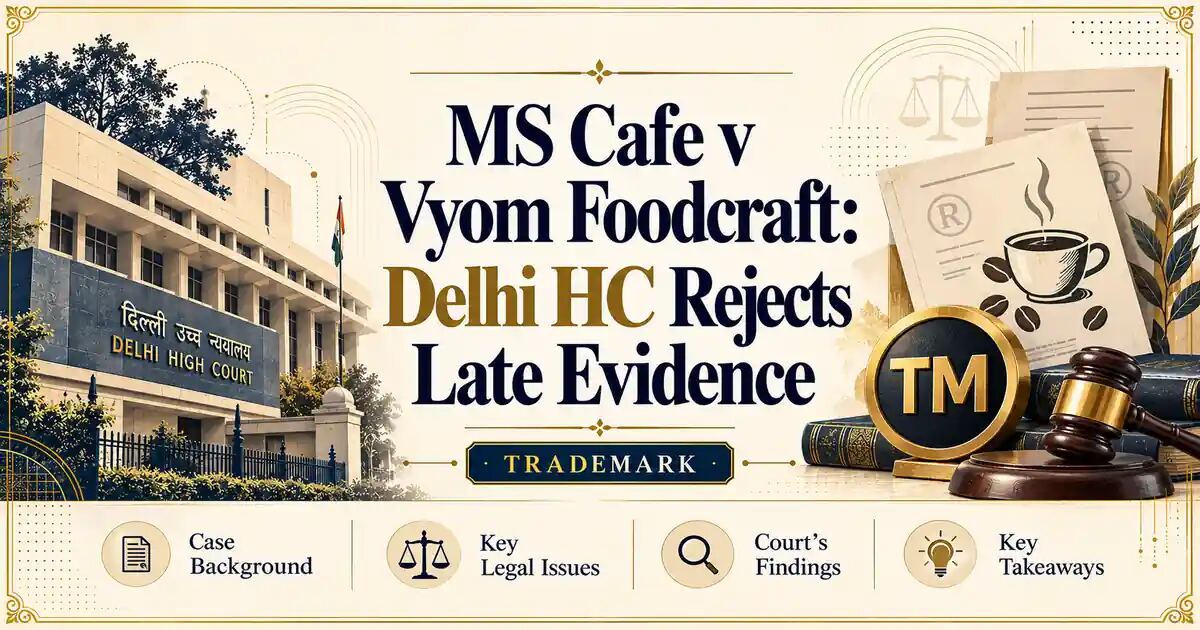
In MS CAFE BROWN SUGAR PVT LTD Vs VYOM FOODCRAFT PVT LTD & ANR. [CS(COMM)-1008/2024 2026:DHC:9604], the Delhi High Court refused the plaintiff’s application under Order XI Rule 1(5) of the Code of Civil Procedure, 1908, as amended by the Commercial Courts Act, 2015, seeking leave to place on record additional historical commercial records. Justice Purushaindra Kumar Kaurav affirmed that administrative mismanagement, internal store room cleaning exercises, or ignorance following a change in corporate management do not constitute “reasonable cause” for non-disclosure at the time of instituting a commercial suit. Reaffirming the statutory embargo against piecemeal evidentiary filings, the Court underscored that litigants asserting prior user rights over trademarks must front-load their complete documentary evidence upon filing the plaint, rather than seeking to bolster their case in subsequent tranches after evaluating the defendant’s written statement.
| Disputed Subject Matter | “BROWN SUGAR” family of marks (Classes 29 and 30) for restaurant services and food products. |
|---|---|
| Plaintiff / Petitioner’s Case | Plea of prior adoption and continuous commercial use since 2000; application under Order XI Rule 1(5) CPC seeking to introduce sales/purchase invoices, cash books, promotional material, and TDS Form 16-A certificates (2003-2011) discovered during Diwali store room cleaning. |
| Defendant / Respondent’s Defense | Objection based on mandatory procedural disclosure under the Commercial Courts Act, 2015; assertion that plaintiff filed documents in five tranches to bolster its case post-written statement; demonstration that select pages of disputed records were already in original plaint filings. |
| Governing Law & Authorities | Order XI Rule 1(1)-(5) CPC (as amended by Commercial Courts Act, 2015); Section 16 of the Commercial Courts Act, 2015; Nitin Gupta v. Texmaco Infrastructure; Zee Entertainment v. Saregama India; Sudhir Kumar @ S. Baliyan v. Vinay Kumar G.B.; Bela Creation v. Anuj Textiles. |
| Decisive Holding & Relief | Application dismissed; the High Court held that internal record misplacement does not satisfy the “reasonable cause” standard under Order XI Rule 1(5) CPC, as the documents were throughout within the power, possession, and control of the corporate entity. |
Doctrinal Conflict: Section 28 Registration Rights Versus Section 34 Prior User Defense
Struggling with Indian Trademark Law principles? Explore our complete Trademark Law Guide.
In Indian trademark jurisprudence, the statutory interplay between Section 28 and Section 34 of the Trade Marks Act, 1999, forms the core of priority disputes. Section 28(1) confers upon the registered proprietor the exclusive right to use the mark in relation to goods or services for which it is registered. However, this statutory right is not absolute. Section 34 operates as an overriding provision, safeguarding common law rights of a prior continuous user. The Supreme Court of India in S. Syed Mohideen v. P. Sulochana Bai (2016) 2 SCC 683 definitively established that rights conferred by registration under Section 28 are subject to the rights of a prior user protected under Section 34. This principle was reaffirmed in Neon Laboratories Ltd. v. Medical Technologies Ltd. (2016) 2 SCC 672, establishing that the first-to-use rule takes priority over the first-to-register rule.
In the present dispute, the plaintiff sought to overcome the defendants’ trademark applications claiming user from 26.10.2010 by alleging prior adoption and continuous commercial use of the “BROWN SUGAR” family of marks since the year 2000. However, invoking Section 34 requires an unbroken, verified chain of documentary evidence establishing actual commercial use prior to the adversary’s adoption date. Token, sporadic, or unverified assertions do not meet the statutory threshold of continuous user under Section 34.
When a party fails to submit its historical user evidence alongside the initial plaint, a conflict arises between substantive rights under trademark law and procedural requirements under civil procedure. While Section 34 protects prior adoption, the procedural framework of the Commercial Courts Act, 2015, restricts a party’s ability to introduce unfiled documents at later stages. If a plaintiff fails to overcome the procedural barrier of Order XI Rule 1(5) CPC, its statutory priority under Section 34 becomes legally unenforceable in the pending suit due to the absence of admissible proof on record.
Procedural Rigour Under Commercial Courts Act: Deconstructing “Reasonable Cause”
The Commercial Courts Act, 2015, transformed civil litigation in India by introducing distinct procedural rules for commercial disputes. Under the ordinary civil regime governing non-commercial suits, Order VII Rule 14(3) of the CPC permits the introduction of late documents subject to the court’s general leave, without establishing strict statutory preconditions. Conversely, Order XI Rule 1 of the CPC, as amended by the Commercial Courts Act, imposes a mandatory procedural regime designed to eliminate systemic delays, piecemeal evidence filings, and tactical litigation conduct.
Under Order XI Rule 1(1) and (2) CPC, a plaintiff is required to file a complete list of all documents in its power, possession, control, or custody relevant to the matter, whether relying on them or not, accompanied by a verified Statement of Truth on oath. The statutory mechanism provides a narrow 30-day window under Order XI Rule 1(4) CPC for urgent filings. Beyond this period, Order XI Rule 1(5) CPC creates a strict statutory embargo against introducing documents that were within the plaintiff’s power, possession, control, or custody at the time of filing, unless the plaintiff establishes “reasonable cause” for non-disclosure.
The High Court analyzed the evolution of this procedural standard across key precedents, including Nitin Gupta v. Texmaco Infrastructure & Holding Ltd. (2019 SCC OnLine Del 8367), Hassad Food Company Q.S.C. v. Bank of India (2019 SCC OnLine Del 10647), and the Supreme Court’s decision in Sudhir Kumar @ S. Baliyan v. Vinay Kumar G.B. ((2021) 13 SCC 71). Explaining the fundamental distinction between ordinary civil suits and commercial proceedings under Order XI Rule 1(5) CPC, the Court reiterated the statutory embargo:
A plaintiff in an ordinary suit, if desirous of producing a document required to be produced along with the plaint at a subsequent stage, is only required to obtain the leave of the Court. The Legislature has not laid down the grounds on which such leave is to be granted… As distinct therefrom, under Order XI Rule 1(5) as applicable to commercial suits, there is an embargo on the Court, not to allow the plaintiff to rely on any document which was in plaintiff’s power, possession, control or custody and not disclosed along with the plaint. The disclosure under Rules 1(1) & (2) has to be accompanied with listing and filing of the documents. The said embargo placed on the Court can be lifted only upon the plaintiff establishing reasonable cause for non-disclosure along with the plaint.
Hon’ble Mr. Justice Purushaindra Kumar Kaurav, Delhi High Court
The plaintiff shall not be allowed to rely on documents, which were in the plaintiff’s power, possession, control or custody and not disclosed along with the plaint or within the extended period, save and except by leave of the Court, which leave shall be granted only upon the plaintiff establishing reasonable cause for non-disclosure along with the plaint.
Evidentiary Forensics of Commercial Proof: GST, TDS Form 16-A, and Continuous Sales Ledgers
To substantiate its assertion of continuous user from 2003 to 2011, the plaintiff sought leave to introduce four sets of additional documents: sales registers, cash books, purchase books, marketing materials, and 49 Form 16-A TDS certificates for Assessment Year 2011-2012. The core justification submitted by the plaintiff was that these documents were stored in old cartons within its godown and were only discovered during a recent annual Diwali cleaning exercise. Additionally, an affidavit filed by the plaintiff’s Director stated that after her husband’s demise in 2017, she took over the corporate operations in 2018 without prior knowledge of old physical archives.
The High Court subjected these assertions to judicial scrutiny. Senior Counsel for the defendants, Mr. Neeraj Grover, demonstrated that the plaintiff had already filed documents in no less than five separate tranches over the course of the litigation. Crucially, the defense established that specific pages in the belated list of documents were identical to pages already filed alongside the original plaint in November 2024. For instance, page 40 of the late application was identical to page 480 of the original plaint (a sales invoice dated 08.04.2008), and page 08 was identical to page 499 of the original plaint (a sales account for 2004-05).
This factual inconsistency destroyed the credibility of the “Diwali cleaning” explanation. The Court reasoned that it was logically untenable for a litigant to possess page one of a financial register at suit institution, yet claim that subsequent pages of the same continuous ledger were misplaced in a godown. The judgment drew a clear distinction between “subsequently discovered documents” (records originating from external sources or third parties after suit filing) and “subsequently searched documents” (internal corporate records perpetually remaining within the party’s physical store rooms). Addressing the legal standard of negligence within the commercial framework, the Court cited Bela Creation Pvt. Ltd. v. Anuj Textiles (2022 SCC OnLine Del 1366):
In the absence of any averment to the effect that the aforesaid declaration, contained in the Statement of Truth accompanying the written statement and counter-plaint filed by the petitioner, was incorrect, the learned Commercial Court was justified in holding that additional documents, which were in the custody of the petitioner at the time of filing the written statement, could not be permitted to be introduced at a later stage. “Reasonable cause”, within the meaning of Order XI Rule 1(10) of the CPC, as amended by the Commercial Courts Act, cannot extend to negligence in filing of documents before the Court. “Reasonable cause”, necessarily, must refer to a cause which was outside the control of the petitioner, and which prevented the petitioner from filing the concerned documents along with the written statement.
Hon’ble Mr. Justice Purushaindra Kumar Kaurav, Delhi High Court
Impact on Order XXXIX Injunctions and Section 57 Rectification Vulnerabilities
The procedural exclusion of historical evidence under Order XI Rule 1(5) CPC carries direct consequences for interlocutory and substantive relief in trademark litigation. When seeking interim injunctions under Order XXXIX Rules 1 and 2 of the CPC, a plaintiff must satisfy the threefold test: establishing a prima facie case, showing the balance of convenience lies in its favor, and proving irreparable injury. Where a suit relies on prior user under Section 34 to restrain a competitor’s registered or long-used mark, the inability to place baseline continuous user documents on record weakens the prima facie case.
Furthermore, this evidentiary exclusion impacts broader cancellation and enforcement strategies. Under Section 57 of the Trade Marks Act, 1999, cancellation or rectification proceedings before the High Court require evidentiary support showing continuous prior adoption, non-use, or bad faith registration. If a party’s commercial ledgers, purchase bills, and tax filings are barred in the civil suit due to procedural defaults under the Commercial Courts Act, that party faces systemic difficulty in establishing the evidentiary threshold necessary to rectify the register or resist counterclaims under Section 47 for non-use.
Also Read: Delhi HC Restrains ‘VEEPRO’ Mark for Infringing ‘WIPRO’ Trademark
Key Precedents & Statutory Guidance
- Search recent High Court judgments in our Latest Indian IP Law Cases Directory.
- Examine core statutory doctrines in our Indian Trademark Law Guide.
- Procedural Breakdown: Customs IP Recordal in India & ICER Portal Procedures.
- Review nationwide litigation trends in our Monthly IP Law Roundup.
Corporate IP Due Diligence and Governance Mandates for In-House Counsel
This ruling highlights critical operational principles for corporate legal departments, general counsel, and IP litigators managing brand portfolios in India. To prevent procedural default under the Commercial Courts Act, corporate entities must align internal governance with civil procedure requirements.
1. Pre-Suit Forensic Evidence Mapping: Prior to serving legal notices or executing the Statement of Truth under Order XI Rule 1(3) CPC, legal teams must conduct a thorough audit of all continuous user evidence. Primary commercial proof including GST invoices, historical sales books, Form 16-A TDS certificates, e-way bills, and promotional material must be fully collated, cataloged, and annexed at initial filing.
2. Institutionalizing Corporate Archival Continuity: Corporate entities exist independent of individual directors or managerial personnel. Reliance on personal ignorance following changes in management or the passing of key executives is legally unviable. Entities must establish digitized, central IP repositories for invoices, tax filings, and brand usage records.
3. Elimination of “Tranche Filings”: Attempting to introduce evidence through piecemeal applications, replications, or supplementary lists exposes the litigant to strict judicial scrutiny. Courts view multi-stage filings as improper attempts to overcome defense objections raised in written statements.
4. Strict Audit of Third-Party Tax and Regulatory Records: Documents accessible via statutory authorities or corporate advisors, such as Form 16-A TDS records or historic Income Tax filings, are deemed within the constructive control and knowledge of the corporate entity, removing them from the ambit of newly discovered evidence.
Case Details: MS CAFE BROWN SUGAR PVT LTD Vs VYOM FOODCRAFT PVT LTD & ANR. | Neutral Citation: 2026:DHC:9604 | Case Number: CS(COMM)-1008/2024 2026:DHC:9604 | Court: Delhi High Court | Date: 29-10-2026 (pdf) 29-10-2026 (txt)
Presiding Bench: HON’BLE MR. JUSTICE PURUSHAINDRA KUMAR KAURAV