Also Read: Delhi HC Restrains ‘VEEPRO’ Mark for Infringing ‘WIPRO’ Trademark
Key Precedents & Statutory Guidance
- Search recent High Court judgments in our Latest Indian IP Law Cases Directory.
- Examine core statutory doctrines in our Indian Trademark Law Guide.
- Procedural Breakdown: Customs IP Recordal in India & ICER Portal Procedures.
- Review nationwide litigation trends in our Monthly IP Law Roundup.
Background & Material Facts
Struggling with Indian Trademark Law principles? Explore our complete Trademark Law Guide.
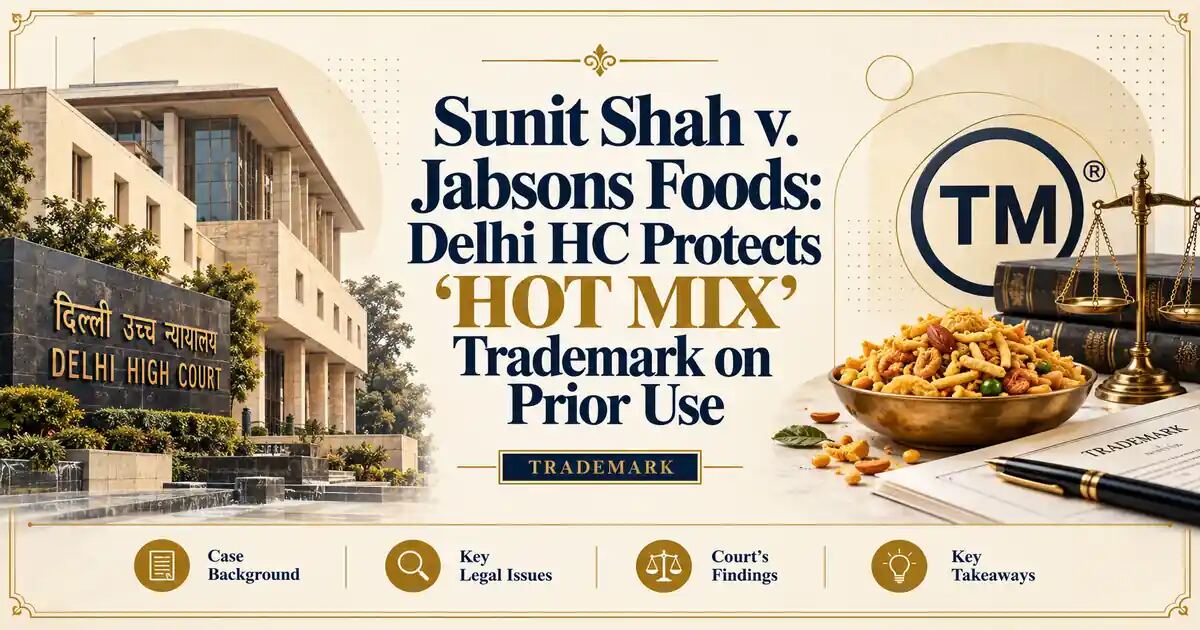
In Mr. Sunit Shah Proprietor of M/s. Shah Namkeen Vs M/s. Jabsons Foods Pvt. Ltd., the Delhi High Court addressed a critical conflict involving the registration and prior use of the trademark “HOT MIX.” The plaintiff, Sunit Shah (trading as Shah Namkeen), asserted rights over the “SHAH HOT MIX” label, citing a registration for artistic work dating back to 2003 (Registration No. A-63634/2003). Central to the plaintiff’s grievance was the defendant’s launch of competing namkeen products under the mark “HOT MIX.”
The plaintiff alleged that the defendant’s usage constitutes both trademark infringement and passing off, arguing that “HOT MIX” forms an essential and distinctive feature of its registered label mark. Jabsons Foods sought to defend its commercial position, prompting the plaintiff to file for an interim injunction via I.A. 1561/2025. This application under the Code of Civil Procedure (CPC) sought to restrain the defendant from utilizing the impugned mark, which the plaintiff claimed is deceptively similar to its own established brand identity.
Legal Issues
The core dispute required the Court to navigate the intersection of statutory registration and the common law principles governing prior usage. Specifically, the Bench examined:
- Whether the defendant’s use of “HOT MIX” infringes the plaintiff’s rights under Section 29(2) and 29(6) of the Trade Marks Act, 1999, which define infringement where a mark is identical or deceptively similar to a registered trademark.
- Whether the doctrine of prior user, encapsulated in Section 34 of the Act, creates an overriding protection for the plaintiff regardless of the defendant’s subsequent actions.
- Whether the threshold for a prima facie case of passing off had been met to justify the granting of an interim injunction pending trial.
Court’s Reasoning & Findings
Justice Narula scrutinized the interplay between registered rights and commercial reality. The Court emphasized that statutory registration does not provide an absolute shield if the claimant can demonstrate superior prior usage in the marketplace. Referring to the precedent set in Registrar of Trade Marks v. Ashok Chandra Rakhit Ltd., the Court reaffirmed that rights acquired through long-standing and continuous user are formidable legal protections that cannot be easily displaced by later registrants or commercial actors.
The Bench further examined the test of “imperfect recollection” and the likelihood of confusion among consumers in the namkeen industry. By analyzing the “essential feature” of the plaintiff’s label, the Court concluded that the defendant’s adoption of “HOT MIX” posed a direct threat to the plaintiff’s brand equity. Consequently, the Court determined that the balance of convenience heavily favored the plaintiff, as the defendant’s continued usage would cause irreparable injury to the distinctiveness of the established SHAH HOT MIX brand.
Decision & Significance
The Delhi High Court’s ruling serves as a stark reminder to corporate counsel: registration is only half the battle. While the Trade Marks Act provides the framework, the evidentiary weight of prior commercial use often decides the outcome in infringement litigation. This decision confirms that the court will act swiftly to prevent market confusion when a plaintiff can substantiate its history of use against an encroaching competitor.
For IP litigators, this case reaffirms that Section 34 remains a powerful tool in the arsenal of a prior user. When advising clients on branding strategies, practitioners must ensure that market entry is preceded by rigorous searches not just of the Registry database, but of the actual competitive landscape for evidence of prior usage. Defendants facing similar injunction applications must now contend with a Judiciary that is increasingly protective of established brand identity, regardless of the relative size or market reach of the parties involved.
Ultimately, this judgment solidifies the doctrinal position that statutory registration of a label cannot be used to cannibalize or dilute a mark that has already acquired market presence through prior use. Rights holders who diligently document their commercial journey and first-use dates will find themselves on firmer ground when seeking injunctive relief. Failing to do so, as seen here, leaves an entity vulnerable to superior common law claims that can dismantle an entire product line’s branding in one stroke.
Case Details: MR. SUNIT SHAH PROPRIETOR OF M/S. SHAH NAMKEEN Vs M/S. JABSONS FOODS PVT. LTD. | Neutral Citation: 2026:DHC:9547 | Case Number: CS(COMM)-641/2024 2026:DHC:9547 | Court: Delhi High Court | Date: 28-10-2026