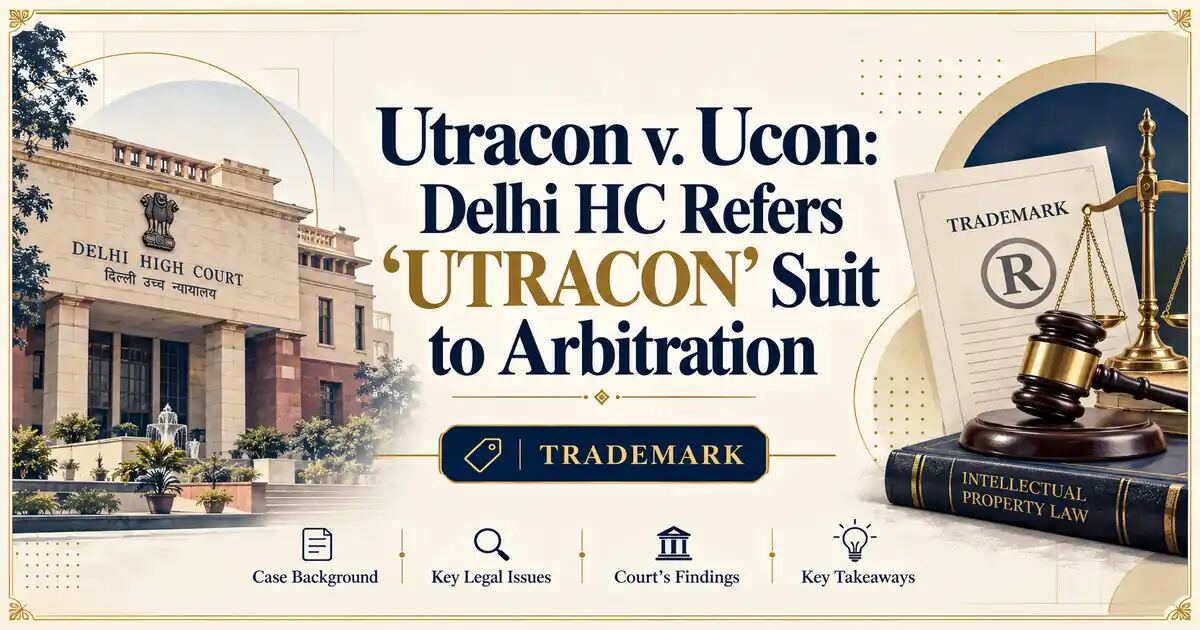
In UTRACON CORPORATION PTE LTD Vs UCON PT STRUCTURAL SYSTEM PRIVATE LIMITED FORMERLY UTRACON STRUCTURAL SYSTEMS PRIVATE LIMITED & ORS. [CS(COMM)-661/2024 2026:DHC:9594], the Delhi High Court, presided over by Hon’ble Mr. Justice Purushaindra Kumar Kaurav, adjudicated upon the procedural and substantive interplay between statutory trademark enforcement and mandatory arbitral references under Section 8 of the Arbitration and Conciliation Act, 1996. The single judge bench examined whether a commercial suit alleging post-licence trademark infringement, passing off, and copyright violation against a former subsidiary licensee and its affiliated entities must be referred to arbitration when the underlying right to adopt and utilize the proprietary mark originates from an integrated corporate restructuring transaction comprising a Sale of Shares Agreement and a concurrent Trademark Licence Agreement.
| Disputed Subject Matter | Trademark “UTRACON”, stylized logo variants, trade name, and domain name “www.utraconindia.com” in Class 37 for post-tensioning and heavy structural engineering services. |
|---|---|
| Plaintiff / Petitioner’s Case | Plaintiff claimed statutory ownership under Class 37 (registered 14.08.2012, adopted 1998); asserted that post expiration of the 10-year Licence Agreement on 31.03.2021, Defendant No. 1 and affiliated non-signatory entities (Defendants 5 to 7) committed actionable trademark infringement and passing off; contended that statutory IP claims constitute actions in rem non-arbitrable under Civil Court jurisdiction. |
| Defendant / Respondent’s Defense | Defendant No. 1 filed I.A. 41705/2024 under Section 8 of the Arbitration and Conciliation Act, 1996, seeking reference to arbitration; contended that rights to the UTRACON mark arose out of a composite transaction involving the 2012 Sale of Shares Agreement (SOS Agreement) and Licence Agreement; argued that claims constitute contractual rights in personam and that non-signatory affiliates operate as a single economic unit. |
| Governing Law & Authorities | Sections 8, 11, and 45 of the Arbitration and Conciliation Act, 1996; Sections 28, 34, 57, and 134 of the Trade Marks Act, 1999; Order XXXIX Rules 1 & 2 CPC; Vidya Drolia v. Durga Trading Corp.; S. Syed Mohideen v. P. Sulaiman; Neon Laboratories Ltd. v. Medical Technologies Ltd.; Cox and Kings Ltd. v. SAP India (P) Ltd. |
| Decisive Holding & Relief | The High Court held that where trademark enforcement stems from contractual non-compliance following determinable commercial transactions, the claims represent rights in personam; parties and interconnected corporate affiliates were referred to arbitral adjudication, requiring alignment of contractual dispute mechanisms. |
Jurisdictional Friction: Contractual Arbitrable Covenants versus Statutory Trademark Enforcement
For foundational statutory analysis, consult our in-depth Trademark Law Guide.
The operational core of the litigation traces back to a corporate restructuring undertaken in March 2012. Plaintiff, Utracon Corporation Pte Ltd, a Singaporean entity specializing in post-tensioning and heavy structural construction engineering, adopted the “UTRACON” brand in 1998 and secured statutory Indian trademark registrations under Class 37 in August 2012. Defendant No. 1 was originally incorporated in Chennai in 2004 as a wholly owned subsidiary of the Plaintiff. To re-align its Indian operations, the parties executed a Sale of Shares Agreement (SOS Agreement) on 22.03.2012, whereby Defendant No. 2 acquired 90 percent of Defendant No. 1’s equity. Simultaneously, Plaintiff and Defendant No. 1 executed a ten-year Trademark Licence Agreement permitting Defendant No. 1 to utilize the UTRACON Marks and associated technical drawings against royalty payments through 31.03.2021.
Disagreements materialized upon the expiration of the ten-year tenure. Plaintiff alleged that Defendant No. 1 failed to comply with Clause 8.4 obligations, which mandated an immediate corporate name change, notification to commercial clients, and complete cessation of mark usage. Instead, Defendant No. 1 continued operations under the UTRACON trading style, claiming an oral extension through March 2022, while accusing Plaintiff of breaching reciprocal non-compete covenants by establishing an independent Indian subsidiary, Utracon Engineering Services Private Limited, in 2019. Furthermore, Directors of Defendant No. 1 incorporated sister concerns, Defendants 5, 6, and 7, incorporating UTRACON and UCON within their corporate names. Plaintiff filed CS(COMM) 661/2024 seeking injunctive relief for infringement, passing off, and domain name hijacking, obtaining an ex-parte ad-interim order on 07.08.2024. Defendant No. 1 filed an application under Section 8 of the Arbitration and Conciliation Act, 1996, seeking mandatory referral based on arbitral covenants embedded within the SOS Agreement and Licence Agreement.
Mandates that a judicial authority, before which an action is brought in a matter which is the subject of an arbitration agreement, shall refer the parties to arbitration unless it finds that prima facie no valid arbitration agreement exists.
The factual framework required the Court to examine express covenants executed between the corporate entities. The judgment underscored specific negative undertakings regarding proprietary brand protection and mandatory post-termination exit compliance incorporated in Clause 8.4 of the Licence Agreement:
Within 30 (Thirty) calendar days from the date of termination or expiry of this Agreement, USSI undertakes and agrees to the following: i. USSI will change its registered company name and the new name be it current or in future, cannot includes, resemble or similar to the name “UTRACON” or the logo of UTRACON as defined in Annexure A; ii. shall notes in writing on the change of company name to all its clients; and iii. shall place a notice in a publicly National available newspapers on the change of its corporate name.
Hon’ble Mr. Justice Purushaindra Kumar Kaurav, Delhi High Court
The Doctrinal Clash of Section 28 and Section 34: Registration Rights, Prior Use, and Arbitrability
A core legal issue in trademark jurisprudence concerns the tension between statutory title under Section 28(1) of the Trade Marks Act, 1999, which grants exclusive rights to the registered proprietor, and the protection of common law prior adoption preserved under Section 34. The Supreme Court in S. Syed Mohideen v. P. Sulaiman (2016) established that statutory rights conferred by registration under Section 28 remain subordinate to common law rights rooted in prior continuous adoption and passing off. This principle was further expanded in Neon Laboratories Ltd. v. Medical Technologies Ltd. (2016), where the Supreme Court confirmed that a prior user’s common law entitlement overrides the rights of a registered owner who has failed to commence commercial utilization.
In the context of arbitrability, Plaintiffs routinely argue that because Section 28 establishes statutory exclusivity, any enforcement action is inherently an action in rem exercisable against the global public, thereby excluding arbitral jurisdiction. However, Justice Kaurav clarified that when the dispute originates from a permissive contractual licence, the right under scrutiny is not an abstract public right in rem, but a subordinate, determinable right in personam governed by contract. When a licensor sues a former licensee for post-termination use, the judicial inquiry does not determine the global validity of the trademark registration; it adjudicates whether the licensee’s contractual authority to use the brand has expired.
The Court reinforced that restrictive covenants barring a licensee from contesting the licensor’s ownership are personal undertakings that do not alter the register of trademarks. The judgment cited negative covenants embedded within Clause 3.5 of the subject Licence Agreement to highlight how personal contractual obligations govern inter se brand usage:
USSI understands that UCPL is in the process of registering its Trademarks “UTRACON” and its logo (Trademarks as defined in Annexure A), in India and outside India. USSI, its Affiliates and associates hereby agrees and undertakes that it will not register and/or try to register Trademarks and represent in any way that it has title to or ownership of Trademarks, nor shall do or cause to be done any act or thing contesting or in any way impairing UCPL’s right, title of ownership and interest in and to Trademarks.
Hon’ble Mr. Justice Purushaindra Kumar Kaurav, Delhi High Court
Forensic Standards of Evidence: Auditing GST Invoices, E-Commerce Logs, and Continuous Usage Claims
To establish priority under Section 34 or defend against infringement claims, parties must satisfy rigorous evidentiary standards of continuous commercial usage. In contemporary commercial litigation, vague assertions of goodwill or internal correspondence are insufficient to prove prior adoption. Courts enforce strict forensic requirements regarding commercial documents:
- GST and Tax Invoices: Litigators must submit itemized GST invoices bearing explicit trademark nomenclature, line-item descriptions, and verified tax returns (GSTR-1 and GSTR-3B filings) demonstrating uninterrupted commercial billing under the brand name.
- E-Commerce Audit Trails and Digital Fingerprints: Where digital distribution or web domains are implicated, parties must produce continuous domain registration logs, server access records, meta-data timestamps, and verified digital payment gateway statements establishing continuous online commercial interaction.
- Project Completion and Infrastructure Certification: In specialized structural sectors like post-tensioning engineering, evidentiary submissions must contain third-party completion certificates, structural audit reports, public tender documents, and client acceptance letters specifically identifying brand usage on physical site works.
Where an ex-licensee continues using a mark post-termination, these evidentiary records do not generate independent continuous user rights under Section 34. Instead, all commercial usage during the subsistence of a licence inures solely to the benefit of the licensor under the doctrine of permissive use. Consequently, post-termination GST filings and commercial invoices generated by an ex-licensee constitute evidence of actionable breach rather than proprietary user rights.
Order XXXIX Interim Relief, Arbitral Referrals, and Rectification Strategy Under Section 57
The intersection of commercial civil suits and arbitral references poses strategic dilemmas when evaluating interim injunctions under Order XXXIX Rules 1 & 2 of the Code of Civil Procedure, 1908. To secure interlocutory restraint, a plaintiff must satisfy the traditional triple test: establishing a prima facie case, proving that the balance of convenience heavily favors injunctive relief, and demonstrating that irreparable injury would result absent court intervention. However, when a Defendant moves an application under Section 8 of the A&C Act, the Civil Court’s authority to grant or maintain interim orders is circumscribed by the mandatory command to refer parties to arbitration.
Furthermore, litigants must distinguish between contractual infringement claims and statutory cancellation proceedings under Section 57 of the Trade Marks Act, 1999. A petition under Section 57 seeking rectification or cancellation of a trademark entry on the register of trademarks represents an action in rem aimed at public register purity. Such cancellation proceedings lie exclusively within the jurisdiction of the Registrar of Trade Marks or the High Court and cannot be referred to private arbitration. Conversely, where the relief sought is an inter se injunction restraining a former licensee from using a mark based on a terminated agreement, the proceeding remains an action in personam fully amenable to arbitral reference.
Also Read: Delhi HC Restrains ‘VEEPRO’ Mark for Infringing ‘WIPRO’ Trademark
Key Precedents & Statutory Guidance
- Search recent High Court judgments in our Latest Indian IP Law Cases Directory.
- Examine core statutory doctrines in our Indian Trademark Law Guide.
- Procedural Breakdown: Customs IP Recordal in India & ICER Portal Procedures.
- Review nationwide litigation trends in our Monthly IP Law Roundup.
In-House Corporate Governance Strategy: Restructuring, Licensing Mechanics, and Arbitral Alignment
The ruling in Utracon Corporation offers tactical insights for Senior Partners, General Counsel, and corporate decision-makers managing international brand licensing, joint ventures, and equity divestments. Misalignment between dispute resolution clauses across transaction agreements creates procedural vulnerability, enabling parallel proceedings in multiple forums.
Corporate legal departments must enforce comprehensive brand governance protocols during cross-border restructurings:
- Harmonization of Dispute Resolution Clauses: Transactional attorneys must ensure complete alignment between Share Purchase Agreements, Joint Venture Contracts, and Intellectual Property Licence Agreements. Aligning arbitral seats, governing law, and tribunal appointments eliminates jurisdictional fragmentation when disputes involve interconnected transactions.
- Single Economic Unit and Non-Signatory Drafting: When executing restructuring agreements, licensors must explicitly extend arbitral clauses to encompass subsidiary entities, directors, key executive officers, and newly incorporated affiliates. Pre-emptively binding non-signatory affiliates prevents plaintiffs or defendants from attempting to defeat arbitration by adding non-signatory parties.
- Proactive Section 57 Statutory Actions: If a brand owner intends to challenge the validity of corporate names or registered marks held by an ex-partner, statutory rectification applications under Section 57 should be pursued before the Trade Marks Registry or competent High Court independently of contractual arbitral references.
- Structured Exit Audit Protocols: IP management teams must establish formal off-boarding procedures post-termination. Licensors must issue formal notices verifying the total removal of trade names, alteration of domain records, updating of client registries, and public newspaper disclaimers as mandated by contractual covenants.
Case Details: UTRACON CORPORATION PTE LTD Vs UCON PT STRUCTURAL SYSTEM PRIVATE LIMITED FORMERLY UTRACON STRUCTURAL SYSTEMS PRIVATE LIMITED & ORS. | Neutral Citation: 2026:DHC:9594 | Case Number: CS(COMM)-661/2024 2026:DHC:9594 | Court: High Court of Delhi | Date of Decision: 28.10.2026
Presiding Judge: HON’BLE MR. JUSTICE PURUSHAINDRA KUMAR KAURAV