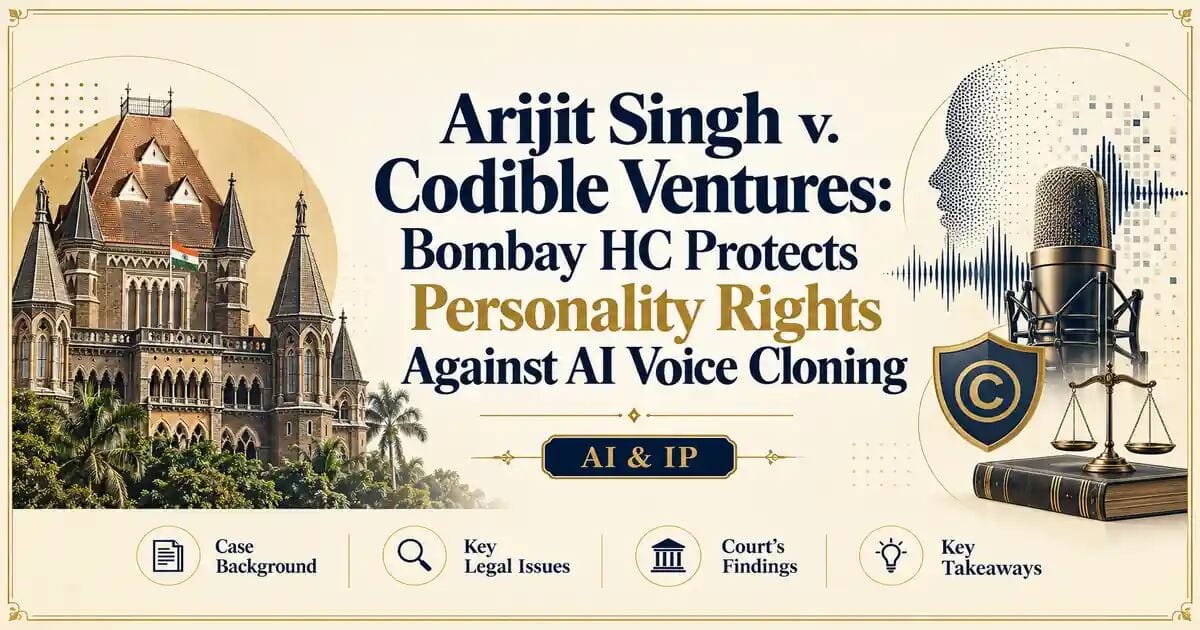
Facts of the Case: Arijit Singh v. Codible Ventures LLP
In this case, the plaintiff, Arijit Singh, filed a suit against 38 defendants, including AI platforms, owners of restaurants and pubs, organizers of virtual reality events, merchandisers, e-commerce portals, and domain name registrars, seeking protection of his personality rights and publicity rights over his own name, voice, signatures, photograph, image, caricature, likeness, persona, and various other attributes of his personality against unauthorized commercial exploitation and misuse.
Defendant Nos. 1-8 were using AI technology to create content that imitated Arijit Singh’s identity and personality. This included elements such as his voice, name, photograph, singing style, likeness, and persona. The Plaintiff further stated that the defendants were doing all this to take advantage of Arijit Singh’s already established goodwill and reputation.
Defendants 9 and 11 to 25 are unauthorisedly commercially exploiting the Plaintiff’s personality traits, namely, his name, image, photograph, caricature, and likeness on various merchandise. Plaintiff submits that these Defendants are misusing and exploiting the Plaintiff’s personality traits for personal and commercial gain at the expense of the Plaintiff’s rights.
Defendants 26 to 32 are the registrars of the unauthorised domain names associated with the Plaintiff’s name and identity.
Defendants 33 to 36 are the owners of those e-commerce platforms, which “operate on Amazon, Flipkart, Meesho” and Redbubble websites. on which the Defendant Nos. 11 to 23 are listing their impugned goods bearing the Plaintiff’s name, image, photograph, likeness, caricature.
Defendant 37 invited its users to sign up for a virtual reality event hosted on maicity.io where, upon signing up, the name and image of the Plaintiff was broadcasted to users.
The defendants whose identity or details could not be found were impleaded as Defendant 38 under the name “Ashok Kumar” or “John Doe”.
Plaintiff’s Submissions: Personality Rights, Dilution, and Performer’s Moral Rights
Plaintiff argued that he has achieved immense success, goodwill and reputation as a singer due to his notable contributions to the music industry in India as well as abroad.
He claimed that, as a well-known singer and celebrity, he holds the right to command and control the use of his personality traits because these traits are part of his exclusive Personality Rights and Publicity Rights.
It is stated that the misappropriation of any attribute of the Plaintiff’s personality traits without his express permission for a commercial purpose is liable to be restrained not only on the basis of the publicity but also on the basis of the tort of dilution, specifically tarnishment.
Additionally, any unauthorized distortion, mutilation, or other modification, or dissemination of the Plaintiff’s performances, voice, or video recordings thereof, causing harm to his reputation, would amount to a violation of the Plaintiff’s moral rights in his performances under Section 38-B of the Copyright Act, 1957.
Procedural Posture: Ex-Parte Ad-Interim Relief
At the time of the order dated 26 July 2024, the Defendants did not make any detailed arguments on their behalf because the Court heard the Plaintiff’s application ex parte.
The Court allowed Arijit Singh to seek ad-interim relief because it felt that if the Defendants were given notice beforehand, the harm that needed to be stopped immediately could continue in the meantime, defeating the very purpose of the application.
Legal Issues Formulated
The issues raised in the present case were:
- Whether the unauthorised use of a person’s voice, image, or photograph, even when such material is publicly available, without their consent amounts to an infringement of their personality and publicity rights?
- How to balance the protection of Plaintiff’s personality rights against the principles of freedom of speech and expression?
- Whether the unauthorised use of the Plaintiff’s image, signature, and voice by the Defendants, without his consent, could adversely affect his livelihood and right to commercially exploit his personality?
Statutory and Constitutional Framework
Copyright Act, 1957: Section 38-B (Performer’s Moral Rights)
Section 38-B gives a performer the right to be identified as the performer of his performance. If a performance is distorted or modified in a way that harms the performer’s reputation, he can take action against it.
However, normal editing or technical changes will not be considered harmful to the performer’s reputation.
Article 21: Protection of Life, Dignity, and Right to Livelihood
Article 21 states that no person can be deprived of life or personal liberty except according to the procedure established by law. It also includes the right to live with dignity and the right to livelihood.
Article 19(2): Reasonable Restrictions on Free Speech
Article 19(2): Reasonable Restrictions on Free Speech states that the right to freedom of speech and expression is not absolute. The State can impose reasonable restrictions on this right in the interests of national security, public order, decency, morality, defamation, contempt of court, or incitement to an offence.
Judicial Precedents Cited
Karan Johar v. Indian Pride Advisory Pvt. Ltd. & Ors.
The Court held that celebrities have legal protection over their personality and publicity rights. If a person uses a celebrity’s name, image, likeness, or any other personality attribute without permission, it may amount to a violation of the celebrity’s personality rights and right to publicity.
Anil Kapoor v. Simply Life India
The Court stated that income earned through endorsements is an important source of livelihood, for a celebrity. Therefore, the unauthorised use and sale of merchandise such as T-shirts, magnets, keychains, cups, stickers and masks bearing a celebrity’s face, name, or other personality attributes cannot be permitted, as it may seriously affect the celebrity’s earnings and livelihood.
R. Rajagopal v. State of T.N., famously called the “Auto Shankar case”
Court held that the right to privacy is a legal right, and its violation may give rise to a claim for damages. If a person’s name, image, likeness or life story is used or published without their consent for advertising or any other purpose, it may amount to a violation of their right to privacy.
Amitabh Bachchan v. Rajat Nagi
The Delhi High Court granted an ad-interim injunction in favour of Amitabh Bachchan and restrained the defendants from using his name, image, voice and other personality attributes without authorisation. The Court also directed the concerned authorities to block the infringing websites and phone numbers.
Applause Entertainment Private Limited v. Meta Platforms Inc. and others
The Bombay High Court granted an ex parte ad-interim injunction in favour of Applause Entertainment and directed Meta to remove the infringing posts from its platform. The Court also directed Meta to disclose the details of the persons behind the infringing accounts and allowed the injunction to extend to similar future infringements through a dynamic injunction.
D.M. Entertainment (P) Ltd. v. Baby Gift House
The Delhi High Court restrained the defendants from selling dolls using Daler Mehndi’s likeness without his authorisation. The Court held that a celebrity has the right to control the commercial use of his identity and unauthorised commercial exploitation of his persona can violate his right of publicity.
Decision and Injunction Order of the Bombay High Court
The Bombay High Court granted an ex parte ad-interim injunction in favour of Arijit Singh and restrained the Defendants from unauthorised use of his name, voice, image, likeness, signature and other personality attributes, particularly for commercial purposes. The Court also granted relief against the unauthorised use and manipulation of his voice through AI-based technology.
The Court further directed the removal or modification of infringing online content, including deletion of references to Arijit Singh’s name, image, voice and likeness in certain videos. It also issued directions concerning the locking or suspension of certain domain names and disclosure of information relating to the infringing activities.
Ratio Decidendi
The ratio decidendi of the judgment is that a celebrity’s name, voice, image, likeness, persona and other distinctive personality attributes are protectable under personality and publicity rights. Unauthorised commercial use of such attributes, including through AI-generated content, may amount to wrongful exploitation where the celebrity is identifiable and the use is made for commercial gain. The Court further held that freedom of speech and expression does not extend to the unauthorised commercial exploitation of a celebrity’s persona.
Editorial Analysis: Personality Rights in the Generative AI Era
This case shows the need for a clear legal framework in India to deal with AI-related misuse of personality and personal identity, while maintaining a proper balance between individual rights, technological development and freedom of expression.
The case also shows that personality rights and publicity rights are becoming increasingly important with the development of AI technology. Using a celebrity’s popularity to create AI-generated content, voice clones, fake images, merchandise or other commercial material without authorisation may amount to wrongful exploitation.
Case Summary and Coram
- Applicant / Plaintiff : Arijit Singh
- Defendants : Codible Ventures LLP and Ors.
- Date of judgement : 26/07/2024
- Bench: Hon’ble Justice R.I. Chagla
- Citation : COM IPR SUIT (L) NO.23443 OF 2024
- APPLICATION(L) NO. 23560 of 2024.
References
https://indiankanoon.org/doc/103091928
http://student.manupatra.com/Academic/Studentmodules/Judgments/2022/June/MANU_DE_2043_2010.pdf