Skip to content
Subscribe

Browse the archive

Category: trademark

trademark

Landmark Crafts v Shalini Garg: HP Trademark Infringement Ruling

Justice Jyoti Singh’s order in Landmark Crafts v. Shalini Garg confirms that appending certification marks like ISI to a registered trademark cannot create distinctiveness or evade infringement claims. By granting an ex parte ad interim injunction, the Delhi High Court reaffirmed that courts assess the overall impression of a mark, focusing on its dominant features. This case provides a clear roadmap for practitioners on leveraging Section 12A of the Commercial Courts Act to skip pre-institution mediation when a defendant's conduct demonstrates clear urgency and bad faith.
8 min read
trademark

Beer vs. Whisky: Delhi HC on Allied and Cognate Goods

Allied and cognate goods represent a vital doctrine in Indian trademark law, enabling protection for marks across different Nice Classes where a trade connection, common consumer base, or complementary end-use exists. Courts determine infringement under Section 29 of the Trade Marks Act 1999 by assessing commercial reality rather than administrative class boundaries. Decisions such as Devans Modern Breweries establish that even dissimilar products like beer and whisky can be considered cognate if documented business practices and distinct brand reputations demonstrate a likelihood of confusion, rendering the anti-dissection rule a key tool for protecting composite marks.

17 min read
trademark

Trademark Renewal 2026: Mandatory RG-3 Notices and TM-R Deadlines

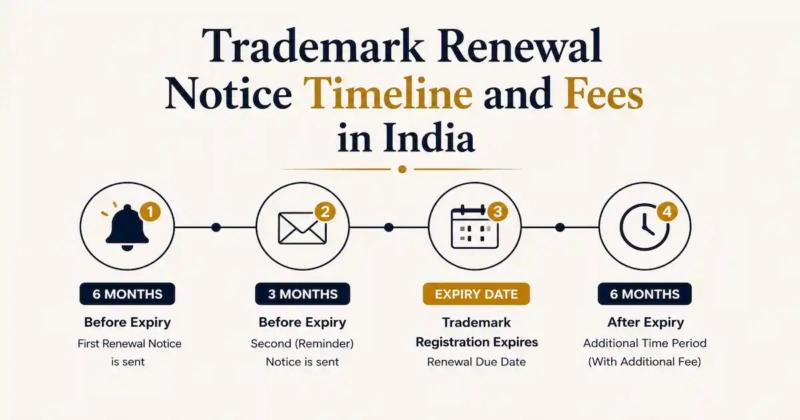
Trademark registration in India requires renewal every ten years from the date of the original application, not the registration certificate date. Failure to file Form TM-R within the statutory grace period risks permanent removal, though the Registrar must mandatorily issue an RG-3 notice before cancellation. Under the Trade Marks Act 1999, restoration is discretionary after the six-month grace period but before the twelve-month limit. Maintaining an updated address for service with the CGPDTM is critical to ensuring receipt of renewal reminders and preventing accidental loss of rights.

17 min read
trademark

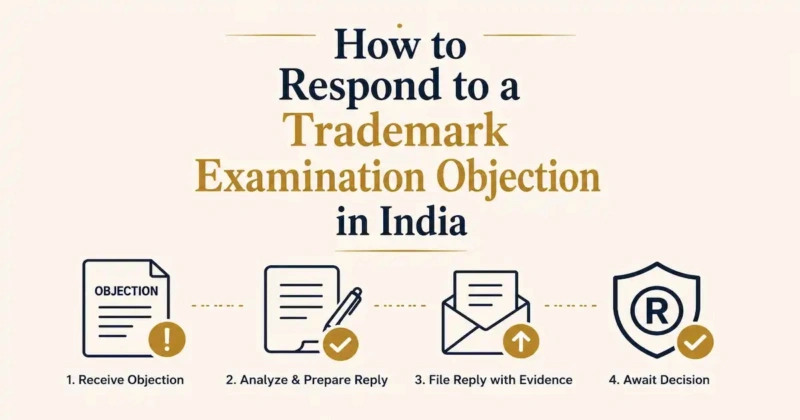
Mastering the Trademark Objection Reply: A Strategic Legal Guide

A trademark examination report under the Trade Marks Act 1999 is not a final refusal, but an invitation to justify registration. To overcome Section 9 absolute grounds or Section 11 relative grounds, applicants must submit a targeted, evidence-based reply within one month of the notice. Success hinges on demonstrating inherent distinctiveness or proving acquired secondary meaning through documented sales, advertising data, and market recognition. Failure to engage with the examiner's specific concerns or missing strict deadlines leads to abandonment, necessitating a precise, legally grounded submission to secure your brand rights.

13 min read
trademark

Section 9 Trademarks: Absolute Grounds for Refusal Explained

Section 9 of the Trade Marks Act 1999 mandates that a mark must possess inherent distinctiveness to be registrable. Objections under Section 9(1)(a) for non-distinctiveness, Section 9(1)(b) for descriptiveness, and Section 9(1)(c) for customary trade usage pose significant hurdles that cannot be ignored. However, the proviso to Section 9(1) offers a critical path to registration if applicants can prove acquired distinctiveness through extensive evidence of use prior to the filing date. Distinguishing between absolute and relative grounds is essential for crafting a successful response to examination reports.

18 min read
trademark

Can Registry Orders Ignore Replies? Delhi HC on Natural Justice

The Delhi High Court has reaffirmed that the Trade Marks Registry must pass reasoned, speaking orders that substantively engage with an applicant's arguments. Failing to address specific submissions in an examination reply violates the principles of natural justice, rendering the refusal order legally untenable. Registrars must conduct a holistic assessment of a mark as a whole, rather than dissecting it, and evaluate distinctiveness specifically in relation to the goods applied for. This precedent mandates that the Registry move beyond boilerplate objections to provide transparent, reviewable justifications for all trademark registration denials.

13 min read
trademark

DRS Logistics v. Google: Delhi HC Clarifies Platform Liability

A trademark owner cannot hold an advertising platform in contempt for failing to proactively monitor third-party ads unless a court order explicitly mandates such surveillance. While platforms must adhere to their stated policies regarding trademark protection, the Delhi High Court clarifies that in India, these obligations are complaint-driven rather than automated. Litigants must ensure that any settlement or judicial undertaking is translated into an express operative direction within the final order, as contempt jurisdiction is strictly limited to the breach of explicit judicial mandates, not merely private policy commitments.

14 min read