
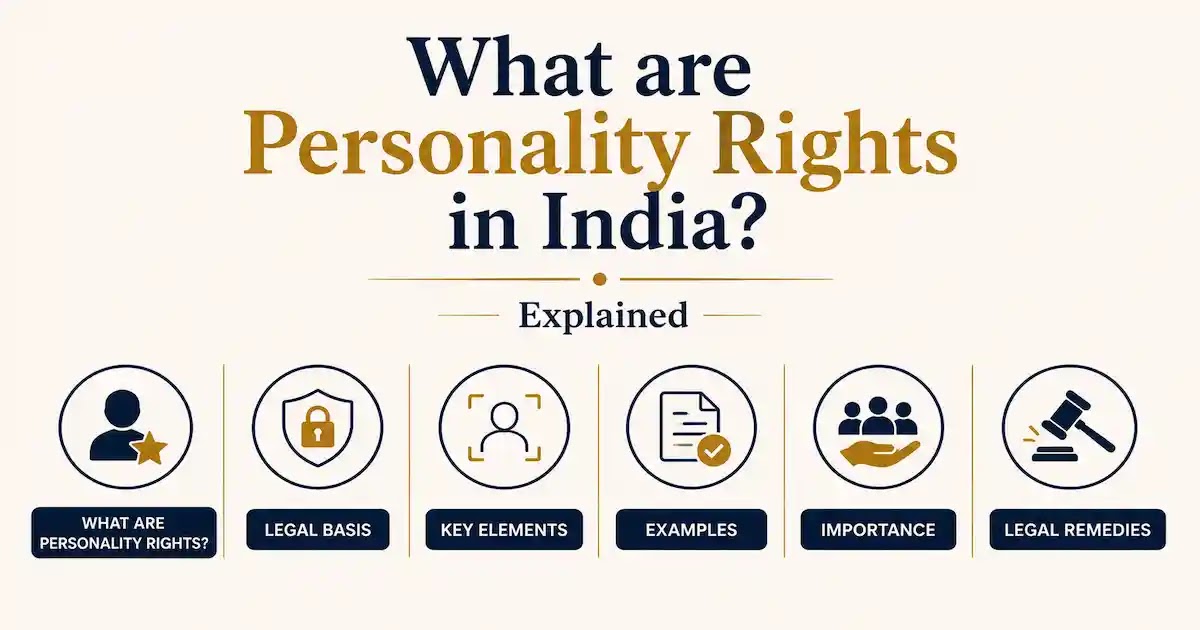
The doctrine of personality rights in India is not the product of a single statute or a single case. It assembled itself across Article 21 of the Constitution, Sections 38 and 38A of the Copyright Act, 1957, the law of passing off under the Trade Marks Act, 1999, and the intermediary liability framework under Section 79 of the Information Technology Act, 2000. None of those provisions mentions personality rights by name. Courts built the doctrine from the raw material of adjacent rights, filling a legislative void that Parliament continues to leave unfilled.
Introduction
There is no Personality Rights Act in India. There never has been. What exists instead is thirty years of judicial construction, one constitutional provision stretched to cover territory Parliament never legislated for, and a wave of 2025 rulings that have turned a celebrity’s digital likeness into a category of property the law is only just beginning to understand. That gap between what courts do and what the statute books say is the subject of this post.
The question worth asking is not whether personality rights exist in Indian law… The question is who they protect, how courts are actually enforcing them, and where the judge-made framework starts to fracture under pressure.
The Constitutional Root: Article 21 and the Right to Privacy
The foundational case is R. Rajagopal v. State of Tamil Nadu, (1994) 6 SCC 632, known in legal circles as the Auto Shankar case. The Supreme Court held that every individual has a right to control the commercial use of their identity as part of the fundamental right to privacy under Article 21 of the Constitution.
The principle the Supreme Court articulated was that an individual should be permitted to prevent others from using their name, image, and other aspects of personal identity for commercial purposes without consent. That framing matters because it anchored personality rights in a fundamental right, not in a statutory tort. Courts that followed did not have to invent a new cause of action. They could locate it in Article 21 and then work outward into copyright, trademarks, and passing off for the remedy.
The Puttaswamy judgment of 2017, Justice K.S. Puttaswamy v. Union of India, (2017) 10 SCC 1, completed that constitutional architecture. The Supreme Court’s unanimous recognition of privacy as a fundamental right strengthened the hand of every personality rights plaintiff who came after it. When the Madras High Court in 2025 ruled in X v. Union of India (WP No. 25017 of 2025) that online identity protection is inseparable from dignity under Article 21, it was drawing a direct line from Rajagopal through Puttaswamy to the deepfake era.
What does “Personality Rights” Actually Cover
The commercial definition came from two Delhi High Court judgments that are now routinely cited together.
In ICC Development (International) Ltd. v. Arvee Enterprises, 2003 (26) PTC 245 (Del), the Delhi High Court held that the right of publicity has evolved from the right of privacy and can inhere only in an individual, not in a corporation or an event. The court was specific: the right attaches to an individual’s name, personality trait, signature, and voice. An individual may acquire the right of publicity through association with an event, a sport, or a film, but the right itself belongs to the person.
That was the doctrinal starting point. The commercial dimension was sharpened in Titan Industries Ltd. v. M/s Ramkumar Jewellers, 2012 (50) PTC 486 (Del). The facts are well known. The jewellery manufacturer Titan had contracted Amitabh Bachchan and Jaya Bachchan to endorse its TANISHQ brand. A competing jeweller in Muzaffarnagar put up hoardings that reproduced Titan’s own advertisements featuring the Bachchans, without any agreement with either the brand or the celebrities. The Delhi High Court granted relief, holding that a celebrity will always have a right to control the extent of commercial use of their identity and that such misuse constitutes both a violation of personality rights and passing off.
Anil Kapoor v. Simply Life India and Others, 2023 SCC OnLine Del 6914, extended the perimeter considerably. The court, presided over by Justice Pratibha M. Singh, held that protection is not limited to name, image, and voice. It extends to mannerisms, dialogue delivery, physical gestures, and catchphrases that have become inseparably identified with the person. Kapoor’s signature phrase “Jhakaas” and his distinctive gait were both included within the protected sphere. The court also explicitly prohibited AI-generated deepfakes, GIFs, ringtones, and face morphing that replicated any of these attributes. That widening of scope from biometric identity to the full commercial gestalt of a person is the inflection point that makes Anil Kapoor the most consequential personality rights ruling before the 2025 cases arrived.
Deepfakes, Voice Cloning, and the Digital Threats
The volume of personality rights litigation in India escalated sharply in 2025. The cases that arrived were qualitatively different from earlier disputes. This was no longer about counterfeit merchandise or a competing jeweller appropriating a Tanishq hoarding. What courts were seeing was AI generating sexually explicit deepfakes of actresses, voice cloning tools trained on a singer’s recordings to produce commercial audio without consent, and financial fraudsters circulating deepfake videos of influencers to lure retail investors into WhatsApp-based scams.
In September 2025, Aishwarya Rai Bachchan filed CS(COMM) 956/2025 before the Delhi High Court. The complaint covered the entire range: fake websites impersonating her, AI-generated deepfakes in explicit contexts, unauthorized merchandise, and chatbots producing content in her name. The court granted a sweeping injunction, directed platforms including Google and YouTube to take down the identified URLs within 72 hours, and required subscriber information of infringers to be disclosed in sealed cover. The court recorded that it would not “turn a blind eye” to the exploitation.
Abhishek Bachchan’s case, CS(COMM) 960/2025, filed the next day, raised identical concerns. Justice Tejas Karia’s order was the first in India to directly engage with the implications of AI and digital impersonation on reputation, dignity, and commercial goodwill as a combined question in a single ruling.
The Bombay High Court had already addressed AI voice cloning in Arijit Singh v. Codible Ventures LLP, 2024 SCC OnLine Bom 2445. The court found that AI platforms were using the singer’s recordings to generate synthesised voice content that mimicked his vocal attributes. It recognized Arijit Singh as a celebrity performer under Section 38 of the Copyright Act, held that the defendants’ use of AI tools violated his personality rights, publicity rights, and moral rights simultaneously, and noted that the issue “shocked the conscience” of the court. The Bombay High Court followed the same reasoning to protect Sunil Shetty the following year, granting an interim injunction against AI deepfakes and false endorsement content, explicitly grounding the relief in both Article 21 and the Copyright Act.
The Akkineni Nagarjuna case, 2025 SCC OnLine Del 6331, produced a restraint that extended to any technology, including AI and deepfakes, across every medium. The Sri Sri Ravi Shankar case, 2025 SCC OnLine Del 6332, went a step further: the Delhi High Court’s order covered the metaverse, future digital formats, and voice-cloned audio, not just content formats that exist today.
There is also the less discussed Dr. Naresh Trehan ruling, Global Health Limited and Anr. v. John Doe and Ors., CS(COMM) 6/2025, decided on 8 January 2025. Trehan is not a film star or a singer. He is a cardiac surgeon. Deepfake videos of him giving medical advice on social media and WhatsApp had been viewed 1.1 million times. The Delhi High Court granted a John Doe order requiring takedown and treated the case under the same personality rights framework that had been built for celebrity entertainers. The significance is not subtle: personality rights had crossed from the entertainment industry into professional medicine.
Dr. Devi Shetty, founder of Narayana Health, had secured similar relief from the Delhi High Court in November 2024. The court applied the personality rights test established in the Arijit Singh judgment, found that Shetty satisfied the criteria for celebrity status, and granted a dynamic injunction covering AI, deepfake technology, and all mediums including the metaverse.
Finally, the Ankur Warikoo case brought the framework squarely to the world of digital content creators. Warikoo is a personal finance educator with no film career and no performing arts credentials. AI-generated deepfakes of him were circulating on social media as part of a stock market fraud scheme. The Delhi High Court extended personality rights protection to him under the same framework, directed Meta to take down infringing URLs within 36 hours, and required subscriber details to be disclosed. The court treated deepfake misuse as a direct threat to financial security, not merely to reputation.
The Four Legal Frameworks Courts Apply
The absence of a statute means that personality rights in India do not have a single legal home. Courts assemble protection from four distinct frameworks, sometimes using all four in the same order.
Article 21 of the Constitution forms the foundation. Because the right to control one’s commercial identity is treated as part of the right to privacy under Article 21, a personality rights plaintiff can assert a constitutional violation, not just a common law or statutory tort. This matters enormously for the scope of relief available and for establishing the urgency that justifies ex parte orders.
Copyright performer rights under Sections 38 and 38A of the Copyright Act, 1957, provide statutory footing for celebrities who are also performers in the technical sense. A performer’s right subsists for fifty years from the beginning of the calendar year following the year in which the performance was made. Section 38A grants the performer exclusive rights over sound recordings and visual recordings. The problem is that the Copyright Act’s definition of “performer” covers actors, singers, and musicians, but does not map cleanly onto every public figure whose identity holds commercial value. A corporate doctor who is not a stage performer, strictly construed, falls outside this definition. Courts have worked around this limitation by combining copyright claims with constitutional and common law grounds, and the statutory gap remains.
Trademark passing off covers the dimension where a celebrity’s persona functions like a brand identifier. When an unauthorised party uses a celebrity’s name, image, or catchphrase in a way that creates a false impression of endorsement or association, it parallels the elements of passing off: misrepresentation, goodwill, and damage. The Titan Industries case and the D.M. Entertainment v. Baby Gift House, 2010 (42) PTC 520 (Del) ruling both relied on this analysis. Section 14 of the Trade Marks Act, 1999, which prohibits registration of a mark comprising a person’s name or representation without their consent, adds a further statutory layer. Shah Rukh Khan’s trademark registration over his name and acronym illustrates the prophylactic approach that celebrities are now taking before disputes arise.
Section 79 of the Information Technology Act, 2000, is where platforms enter the picture. The safe harbour that Section 79 provides to intermediaries is conditional. Once a platform receives actual knowledge of unlawful content through a court order or a government notice, it must remove or disable access expeditiously. Courts in personality rights cases have been issuing time-bound directions: 72 hours for takedown of identified URLs in the Bachchan cases, 36 hours in the Ankur Warikoo matter. Platforms that comply can maintain safe harbour protection. Platforms that delay risk losing it. You can read more about how courts apply platform liability in the keyword advertising context in our post on Hindware v. Google and intermediary liability.
John Doe Orders and How Enforcement Actually Works
The identifying problem in personality rights enforcement is that the infringer is often anonymous. A deepfake is created by an account registered to nothing. The merchandise is sold by a marketplace seller with a fake name. The financial fraud WhatsApp group has no registered operator.
The answer courts have arrived at is the John Doe order, known in Indian jurisprudence as the Ashok Kumar order, following Taj Television v. Rajan Mandal where Indian courts first issued injunctions against unidentified parties. The mechanics of a John Doe order in a personality rights case are now fairly standardised. The court grants a blanket interim injunction against all identified and unidentified defendants, covering every format in which the infringing content exists. Platforms are directed to remove specific URLs and block access to infringing content within 36 to 72 hours of the order. The Union Ministry of Electronics and Information Technology and the Department of Telecommunications are frequently impleaded as parties, specifically to facilitate implementation and URL blocking. Platforms must also disclose available subscriber details of the infringing accounts to assist identification.
The dynamic injunction variant, which courts have also deployed in personality rights cases, takes this further. Rather than issuing a static order against a list of URLs, a dynamic injunction is a continuing order that requires platforms to take down mirror sites and fresh infringing content automatically, without returning to court for each new URL. The Arijit Singh case and the Nagarjuna case both produced dynamic protections of this type. It is the same mechanism that appears in the copyright piracy context, as covered in our piece on the Disney, Warner Bros, and dynamic injunctions against torrent sites.
There are limits to what John Doe orders can achieve. Infringers outside India, including defendants in the Jubin Nautiyal case who were based in Romania and the UAE, present enforcement challenges that domestic court orders cannot fully bridge. Content that spreads faster than enforcement mechanisms can respond, particularly in private messaging applications, may be taken down from public platforms while continuing to circulate privately. The harm is sometimes done before any order can arrest it.
Why such cases all go to Delhi
On 19 February 2026, Justice Tushar Rao Gedela of the Delhi High Court asked a question during the hearing of Jubin Nautiyal v. Jammable Limited and Ors., CS(COMM) 166/2026, that no court had asked quite this directly before.
Jubin Nautiyal is a singer from Uttarakhand. His case involved AI platforms cloning his voice and singing style, deepfake videos, face morphed content, merchandise sold on Flipkart and Amazon, and chatbots built around his persona. He filed in Delhi. Justice Gedela asked why.
“What is the reason for coming here? Court in Uttarakhand can’t call them and pass directions? Are you saying Google is not available in Uttarakhand? Why Uttarakhand doesn’t have jurisdiction when you yourself are located there?”
The singer’s counsel gave the standard answer: MeitY and the Department of Telecommunications are located in Delhi, and many infringing entities operate from the capital. The court was unpersuaded by the ministry location argument alone, observing that the location of a ministry does not automatically confer jurisdiction over every related dispute from across the country.
The court nonetheless granted interim protection. Nautiyal received his ex parte ad interim injunction. But the jurisdictional observation lingered, and it reveals something that practitioners should take seriously.
Delhi has become the default forum for personality rights litigation not because the entertainment industry is located there (it is not; Mumbai is the cultural production capital of India), but for structural reasons. The constitutional framing of personality rights under Article 21 historically made Delhi the instinctive venue given its proximity to central government. Digital governance infrastructure, including MeitY and DoT, is concentrated in Delhi. The intermediary compliance machinery runs through Delhi. Previous personality rights orders from the Delhi High Court created a body of precedent that plaintiffs and counsel are comfortable citing. The practical result is that a singer from Uttarakhand, an actor from Karnataka, and a surgeon from Haryana all file their personality rights cases in Delhi.
Whether that concentration is good for the doctrine is debatable. It produces efficiency in precedent and enforcement. It also produces inconsistency elsewhere: other High Courts take narrower views on some questions, and the Punjab and Haryana High Court has historically read the scope of personality rights more conservatively than Delhi. The Nautiyal jurisdictional observation may not change where cases are filed, but it signals that at least one Delhi bench thinks the question deserves an answer.
Who Can Claim Personality Rights in India
The Dr. Naresh Trehan and Dr. Devi Shetty rulings are important precisely because they moved personality rights protection beyond the entertainment economy. Both are surgeons, not performers. Their institutional identities carry commercial value and public trust in ways that create distinct vulnerabilities to deepfake exploitation, particularly when the fake content involves medical advice.
The extension to non-entertainment figures creates a doctrinal question that Indian courts have not yet answered cleanly. The personality rights test as articulated in Arijit Singh (2024) requires the claimant to establish celebrity status, widespread public recognition, and the commercial value of their persona. A cardiac surgeon who heads a major hospital chain and appears on television may satisfy those criteria. An Ankur Warikoo, with millions of YouTube subscribers and a recognisable face, may satisfy them too. What about an academic? A journalist? A local politician? The outer boundary of “celebrity” for personality rights purposes remains undefined.
The Ankur Warikoo case is particularly telling because his claim succeeded in a deepfake-for-fraud context where the harm was financial rather than reputational in the traditional entertainment endorsement sense. That suggests courts are treating the harm function, not just the fame function, as relevant to whether protection is available.
Posthumous personality rights remain an open wound in the doctrine. In Krishna Kishore Singh v. Sarla A. Saraogi and Ors., the Delhi High Court was asked by Sushant Singh Rajput’s father to restrain a film inspired by the late actor. Courts in various jurisdictions have taken conflicting positions on whether personality rights survive death and whether they vest in legal heirs. There is no settled Indian law on this question, and without legislation, it will continue to produce inconsistent results.
The Statute We Are Still Waiting For
Courts have signalled the need for legislation with increasing clarity. The problem is that judicial signals do not produce Parliament’s attention on any particular schedule.
What the absence of a statute produces in practice is a system where protection depends heavily on the legal resources the claimant can deploy. Celebrities with established counsel, the ability to file in Delhi, and the commercial justification that supports an urgent injunction application get fast and fairly comprehensive relief. The ordinary person whose face appears in a deepfake circulating through private messaging groups has far fewer practical options. The Copyright Act’s performer rights framework does not reach them. Trademark law reaches them only if they have registered something. Passing off requires demonstrable goodwill. Article 21 is available but the constitutional litigation infrastructure around it is designed for the well-resourced litigant.
MeitY published draft amendments to the Information Technology (Intermediary Guidelines and Digital Media Ethics Code) Rules, 2021, relating to synthetically generated content in October 2025. That is progress. It is not a personality rights statute.
India also has no clear framework for what constitutes “consent” in the context of AI training data. A celebrity’s face appearing in publicly available photographs does not give an AI developer consent to train a model on those photographs and generate commercial content from the resulting model. Courts have treated that as obvious. Legislators have not codified it. The gap between judicial assumption and statutory clarity is precisely where the next wave of disputes will develop.
Also Read: Zippy vs. Veer Ji: Protecting Factory Footage from Misuse
Conclusion
For entertainment celebrities with recognisable personas and established commercial value, the framework is now genuinely functional. Courts grant ex parte relief quickly. John Doe orders cover anonymous defendants. Platforms take content down within 72 hours or face consequences. The extension to medical professionals and digital content creators has widened the protected class meaningfully. For the copyright infringement dimension, see our article on copyright infringement principles and cases in India, which covers the performer rights analysis that frequently overlaps with these claims.
The jurisdictional question that Justice Gedela raised in the Nautiyal hearing points to a structural problem that legislation could solve. If personality rights protection requires filing in Delhi because MeitY is there and because Delhi precedent is the reliable body of law, then people whose legal issue is not in Delhi are structurally disadvantaged. A national statutory framework would give every High Court the same statutory tools and the same interpretive mandate. Right now, the Delhi High Court is effectively running a national personality rights jurisdiction that it has not formally been given.
A person’s digital identity is not merely a representation of them, it is a commercial and social instrument that third parties can weaponise with precision and at scale. The judge-made doctrine has stretched to accommodate that reality with more agility than anyone might have expected from a system without dedicated legislation. The question is how long it can continue to stretch before the gaps become too wide for courts to bridge alone. The answer to that question sits in Parliament, not in any courtroom.