Protecting Persona in the Digital Age: Analyzing Rupali Ganguly v. Huts and Looms
Looking to master Indian Trademark Law jurisprudence? Read our full Trademark Law Guide.
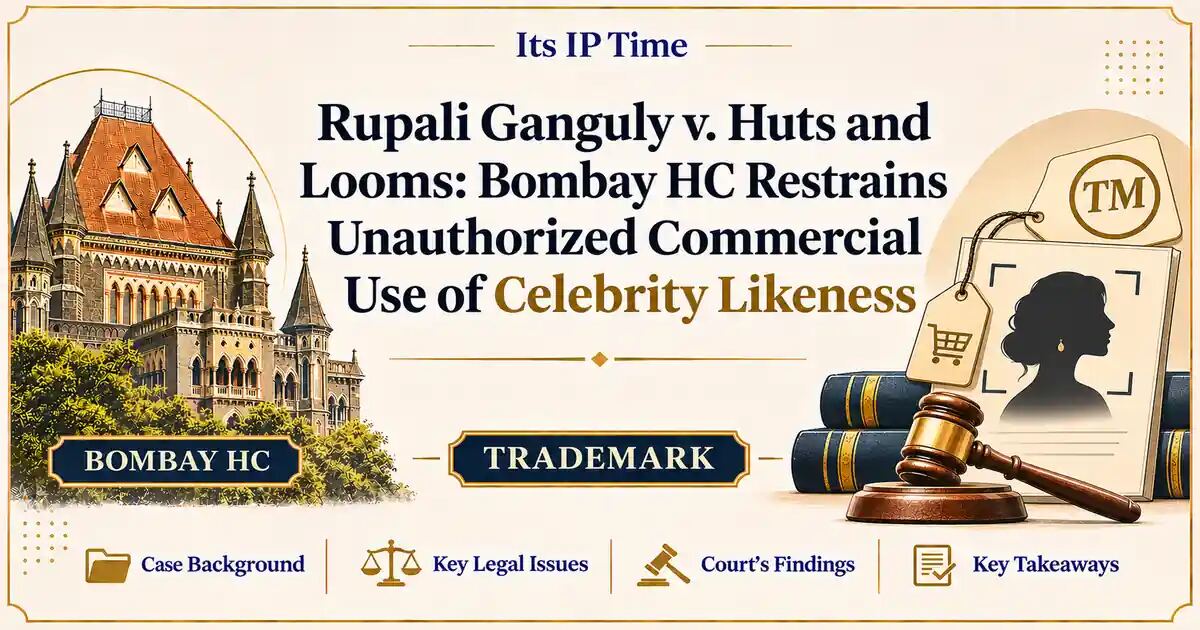
Celebrity rights litigation in India recently hit a significant milestone with the Bombay High Court’s order in Rupali Ganguly nee Rupali Ashwin Verma Vs Huts and Looms Pvt Ltd. This ruling provides a decisive mechanism for public figures to shield their identity from unauthorized commercial exploitation. Practitioners observing this suit, docketed as COMIPL/37517/2026, will find clear judicial support for the protection of personality and publicity rights under common law and statutory frameworks.
The Dispute Before the Court
Rupali Ganguly approached the Bombay High Court seeking urgent intervention against the unauthorized use of her likeness. The core of the grievance involved Defendant No. 1 and various other entities, including a John Doe Defendant (Defendant No. 18), utilizing the plaintiff’s image and persona to promote products without her consent. This unauthorized use effectively misappropriated her identity for commercial gain, stripping the plaintiff of control over her public image.
The plaintiff argued that such actions violate her inherent personality and publicity rights. By linking her image to goods and services, the defendants exploited her fame to create a false association in the minds of the public. This lawsuit asserts that such conduct is actionable under common law principles of passing off and specific provisions within the Copyright Act, 1957.
Relief Sought
The plaintiff prayed for a sweeping ad-interim injunction to halt the unauthorized activities immediately. Specifically, the request sought to restrain the defendants from passing off their goods or services as those emanating from or endorsed by the plaintiff. Furthermore, the petition demanded that the defendants remove and disable access to all infringing content identified in Exhibits E through T of the Plaint.
The inclusion of a John Doe defendant highlights the practical challenges in modern digital enforcement. By targeting unnamed entities involved in the dissemination of infringing material, the plaintiff aimed to close the net on all active participants. The court was requested to compel digital platforms to expedite the takedown of content that exploited the plaintiff’s likeness.
Parties’ Contentions
Counsel for the plaintiff maintained that the right to control one’s image is a fundamental aspect of an individual’s rights. They invoked the Copyright Act, 1957, specifically sections 38, 38-A, and 38-B, to assert moral rights regarding performances and personal representations. These provisions protect the creator’s right to prevent distortions or unauthorized commercial use of their work and persona.
Additionally, the plaintiff relied on common law rights, emphasizing the necessity to protect oneself against passing off. The defendants, meanwhile, faced the court’s scrutiny regarding their unauthorized use of the plaintiff’s image. The evidentiary record showed that the defendants actively employed the plaintiff’s likeness to promote commercial interests, providing the court with a concrete basis to evaluate the claims of infringement.
The Court’s Approach
Justice presiding over the matter evaluated the plea through the traditional three-prong test for interim relief. First, the court examined whether a prima facie case existed. Upon reviewing the material placed on record, the Bench found that the plaintiff successfully demonstrated a strong prima facie case for ad-interim protection.
The court’s reasoning centered on the protection of the plaintiff’s name, image, and likeness as proprietary assets. It recognized that these attributes flow from the right to freedom of speech and the right to publicity. The judgment implies that unauthorized commercial appropriation of a celebrity’s image undermines the value of their endorsement and confuses the consumer base. The judge noted:
The balance of convenience significantly favored the plaintiff, who suffered direct harm from the misappropriation of her identity. Irreparable injury was evident, as continued unauthorized use of her likeness could lead to irreversible damage to her reputation and commercial prospects.
Order
The Court issued a stringent ad-interim injunction against the defendants. It explicitly restrained the defendants from passing off their goods as those connected with the plaintiff. Defendant No. 18, identified as the John Doe, and other associated parties were directed to take immediate action to remove and disable access to all infringing content listed in the Plaint.
This order serves as a powerful deterrent against similar infringements. By granting the relief, the court affirmed the legal standing of personality and publicity rights in the Indian judicial system. The directions require the specified parties to cease all promotional activity that links the plaintiff’s identity to their commercial offerings without explicit, prior authorization.
Also Read: Delhi High Court Quantifies ‘VOLTAS’ Mark Damages at Net Profit
Key Precedents & Statutory Guidance
- Search recent High Court judgments in our Latest Indian IP Law Cases Directory.
- Examine core statutory doctrines in our Indian Trademark Law Guide.
- In-Depth Guide: Customs IP Recordal in India & ICER Portal Procedures.
- In-Depth Guide: Personality Rights & Character Merchandising under Indian IP Law.
- Catch up in 2 minutes with our latest Weekly Indian IP Law Digest: November 15 to 21, 2026 | Its IP Time (or browse the Weekly IP Digest Archive).
- Review nationwide litigation trends in our Latest Monthly IP Law Roundup.
What the Order Means
This ruling is a net positive for high-profile individuals seeking to maintain sovereignty over their persona. It clarifies that the legal system will not remain indifferent to the unauthorized commercial exploitation of a person’s likeness. For IP practitioners, this case serves as a benchmark for how to frame personality rights claims when merging statutory copyright protections with common law passing-off arguments.
Defendants who lean on the images of celebrities without a formal license now face a higher risk of summary injunctions. The court’s willingness to grant relief against John Doe defendants further streamlines the enforcement process in digital environments where the identity of infringers might otherwise remain obscure. Practitioners advising on celebrity endorsements should note that the court prioritizes the individual’s right to manage their public image above the commercial expediency of the infringer.
Practitioner Takeaways
- Broaden the Cause of Action: Always combine statutory copyright claims with common law passing-off arguments to cover both the technical and equitable aspects of persona protection.
- Evidence is Paramount: The strength of the prima facie case rested on the detailed exhibits (E to T) documenting the specific infringing content. Detailed evidence is the prerequisite for obtaining urgent ad-interim relief.
- Utilize John Doe Orders: In digital infringement cases, include a John Doe defendant to allow for the future addition of parties who may be discovered during the takedown process.
- Leverage Personality Rights: The judicial recognition of “Personality Rights” and “Publicity Rights” as flowing from the right to freedom of expression provides a robust foundation for claims that move beyond simple trademark infringement.
This decision reaffirms that the court views the unauthorized commercial use of an individual’s image as a serious breach of privacy and property rights. Rights holders should act quickly upon discovery of infringement to preserve the balance of convenience in their favor. By framing the dispute around both moral rights and commercial harm, counsel can effectively secure the protective orders necessary to safeguard their client’s brand integrity.
Case Details: RUPALI GANGULY NEE RUPALI ASHWIN VERMA Vs HUTS AND LOOMS PVT LTD | Case Number: COMIPL/37517/2026 | Court: Bombay High Court | Date: 05/11/2026
Presiding Bench: Hon'ble Please provide the text snippet of the judgment so I can extract the names for you.